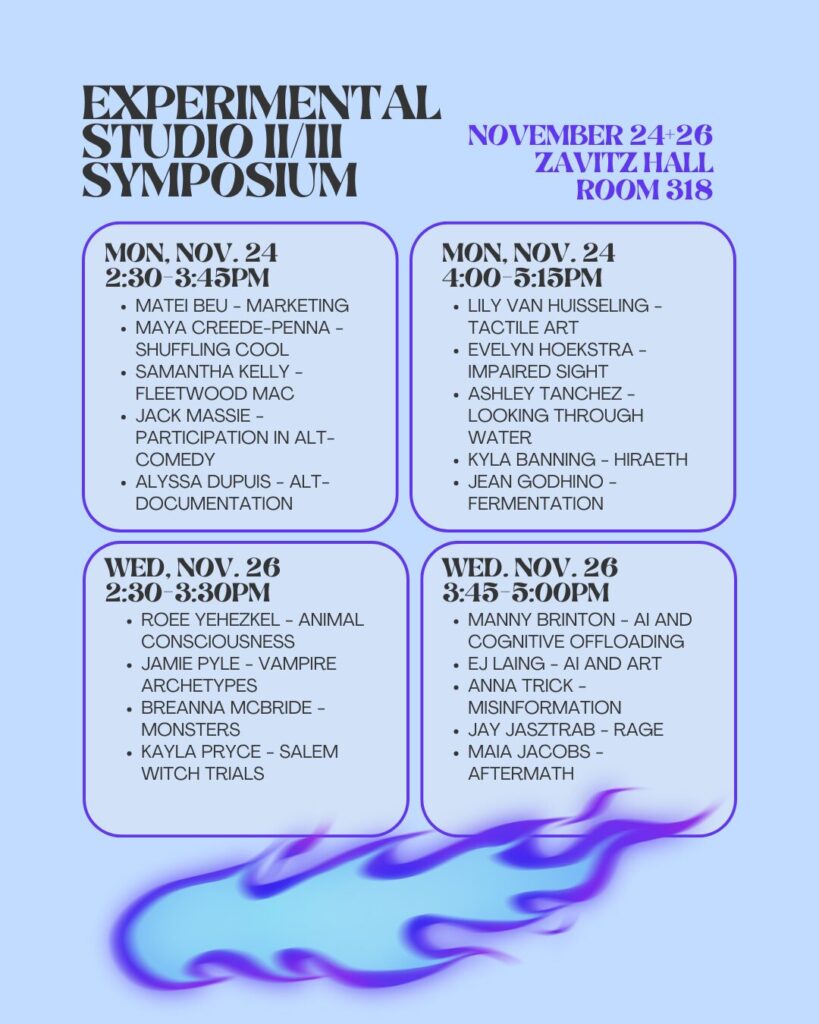
Congratulations! You have been invited to present at this year’s Experimental Studio II/III Symposium!
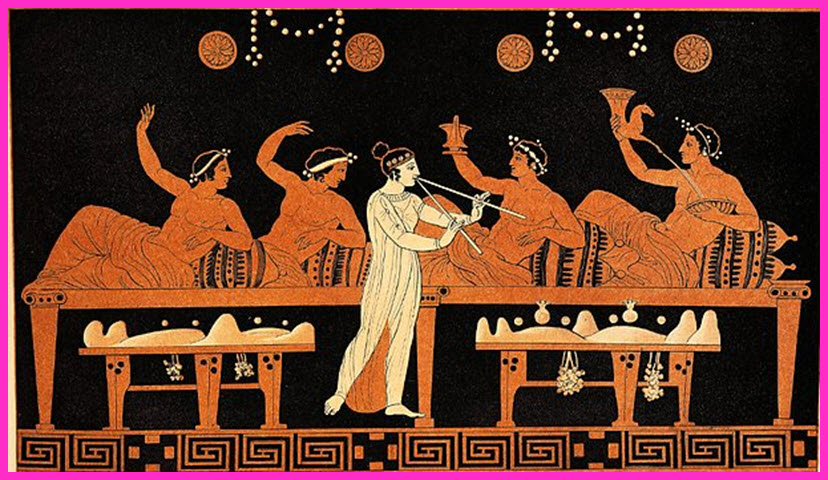
“In Ancient Greece, the symposium (Ancient Greek: συμπόσιον, sympósion, from συμπίνειν, sympínein, ‘to drink together’) was the part of a banquet that took place after the meal, when drinking for pleasure was accompanied by music, dancing, recitals, or conversation.” (https://en.wikipedia.org/wiki/Symposium) Today, it is understood as more of a small academic conference – but that doesn’t mean eating, (the) drinking (of dry beverages), music, dancing, recitals, and/or conversation can’t be part of it.
You will pick a topic that you are excited to learn more about for your presentation. This topic can be almost anything – but you must be able to relate it to the overarching theme of “experimental studio.” You are encouraged to explore ways in which the form of your presentation will complement your chosen topic. Will you read an essay? Present a manifesto? The findings of an experiment? Will you present a slideshow? Artefacts? An “infotainment”? Data charts? Additionally, consider the research methodologies that might best contribute to your presentation. Are you looking for academic essays? A monograph of a particular artist? An exhibition catalogue? A traditional folk song? A recipe? Are you doing primary research – that is, conducting some kind of experiment or practice-based research of your own? WHY?!
Your presentation will be 10 minutes long. (This is quite a long time to just read something, so bear that in mind.) You have the duration of the semester to work on it with regular opportunities to discuss your progress with the instructor.
Visit https://witchinstitute.com/ for an archive from a Symposium held at Queen’s University in 2021.
And https://www.gallerytpw.ca/we-are-what-we-care-for for another at Gallery TPW in 2023.
The project is structured into four components:
- Proposal (DUE MON SEPT 22) – 1-page outline of your proposed presentation including your topic, the potential form(s) your presentation may take, and potential research methods/avenues.
3 Points: clarity of proposal, argument of content’s importance (why you’re interested and why you think we should be interested too), demonstrated thinking in exploration of form+content+research methodologies - Bibliography Draft (DUE WED OCT 29) – MLA or Chicago style bibliography containing 2-5 research materials, at least one of which is a “traditional” “academic” source, and another which is a “non-traditional” source. A full bibliography draft is required even if you are conducting practice-based research.
3 Points: depth of initial research, relevance of materials to proposed topic, formatted in MLA or Chicago style - Presentation (MON NOV 24 + WED NOV 26) – 10-minute presentation on your thoroughly-researched topic. Consider whether you would like documentation of this presentation, and if so, how you will document it without disrupting the flow of the Symposium.
8 Points: implementation of form in relation to content, articulation, depth of understanding, depth of research, audience engagement, length of presentation - Blog Post (DUE MON DEC 1) – A neatly laid out post which includes a text version of your presentation (essay, script, notes, etc), photo or video documentation of the presentation and/or slides (whichever is most relevant), and final bibliography.
6 Points: depth of research, clarity of text, clarity of digital layout, documentation or slides give an excellent sense of the live presentation, bibliography of 3-6 relevant materials in MLA or Chicago style
20 Total Points = 20% of final grade
The Experimental Studio II/III Symposium will equip you with the tools necessary to propose and present at academic and artistic symposia, conferences, and other info-sharing gatherings. This assignment invites you to rethink the structures of academic research + presentation from the point of view of an “experimental studio” artist.
What Makes A “Good” Presentation?
-clear excitement, it’s obvious that the presenter is passionate about the topic
-engage the audience / facilitate a conversation /make them feel included in the presentation
-visuals (graphs, slides, etc)
-start with something to make the audience think / revisit
-step out of comfort zone
-ability to improvise
What Makes A “Bad” Presentation?
-no nuance in the topic
-not coming prepared
-tech issues
-don’t put text on screen if you’re gonna read it verbatim
Presentation vs Lesson
-Presentation might have entertaining elements
-Presentation learning happens differently; different expectations of learning
-Presentation audience might leave affected / new perspective
-Lesson is more regimented
-Presentation can be story-based, narrative
-Lecture is more fact-based