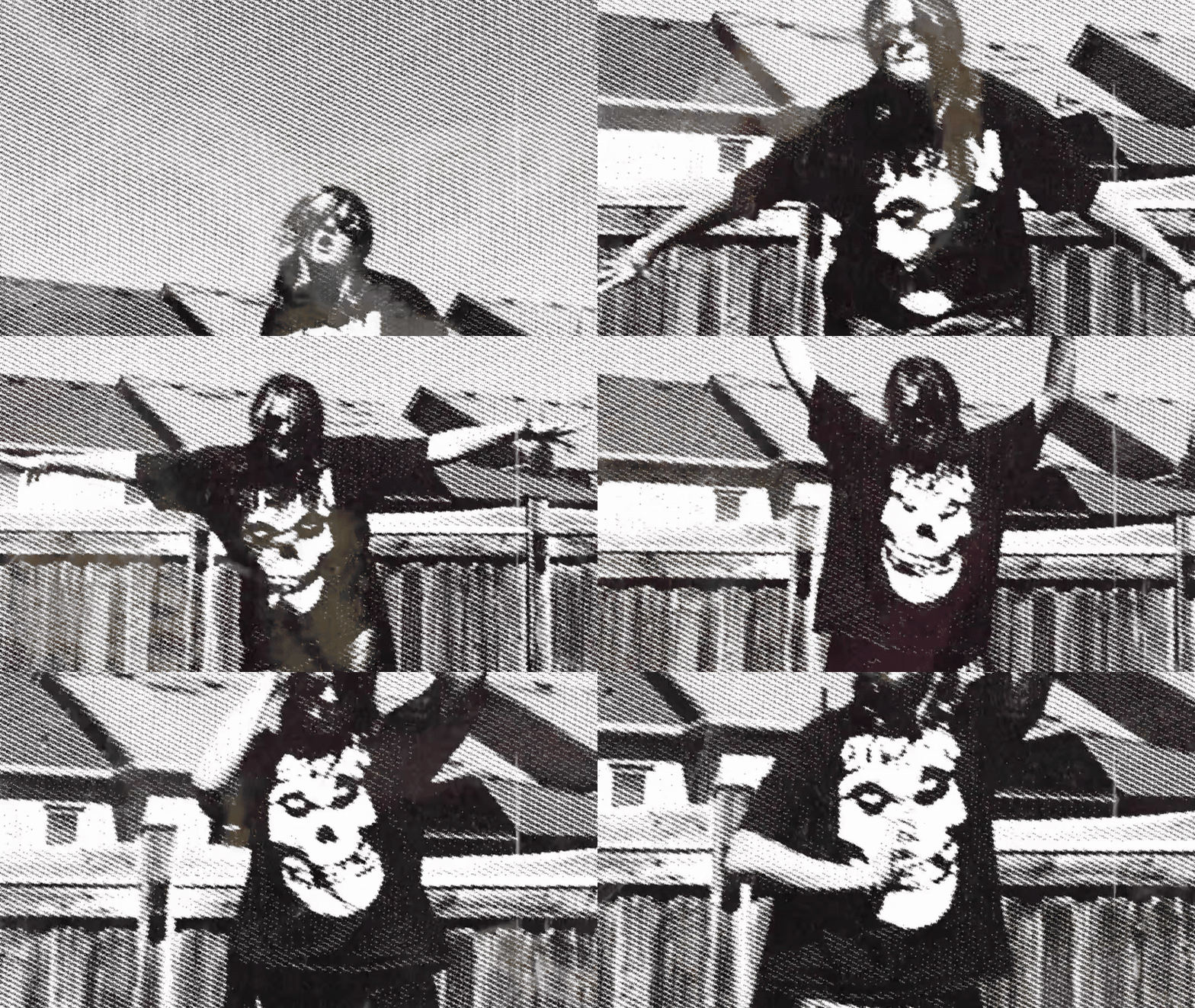
☠ˢʸᴹᴾᴼˢᴵᵁᴹ : ᴹᵒⁿˢᵗᵉʳ ᴹᵃⁿⁱᶠᵉˢᵗᵒ☠
Slideshow:
Notes:
OPENING
The Twilight Zone-Style Introduction
This is a world where the line between creator and creation blurs… Where denial feeds abominations, desire gives birth to them. A world in which the viewer turns into the antagonist Where the mirror glances back at you with teeth. The creatures that emerge from within us are the ones we are most afraid of. Tonight, the monsters are not on your screens… Or under your beds.
Tonight… the monsters are among us.
PART I
What We’ll Cover: Monsters as Cultural Mirrors
Welcome to the Monster Manifesto.
Tonight, we’ll investigate:
Monsters in art
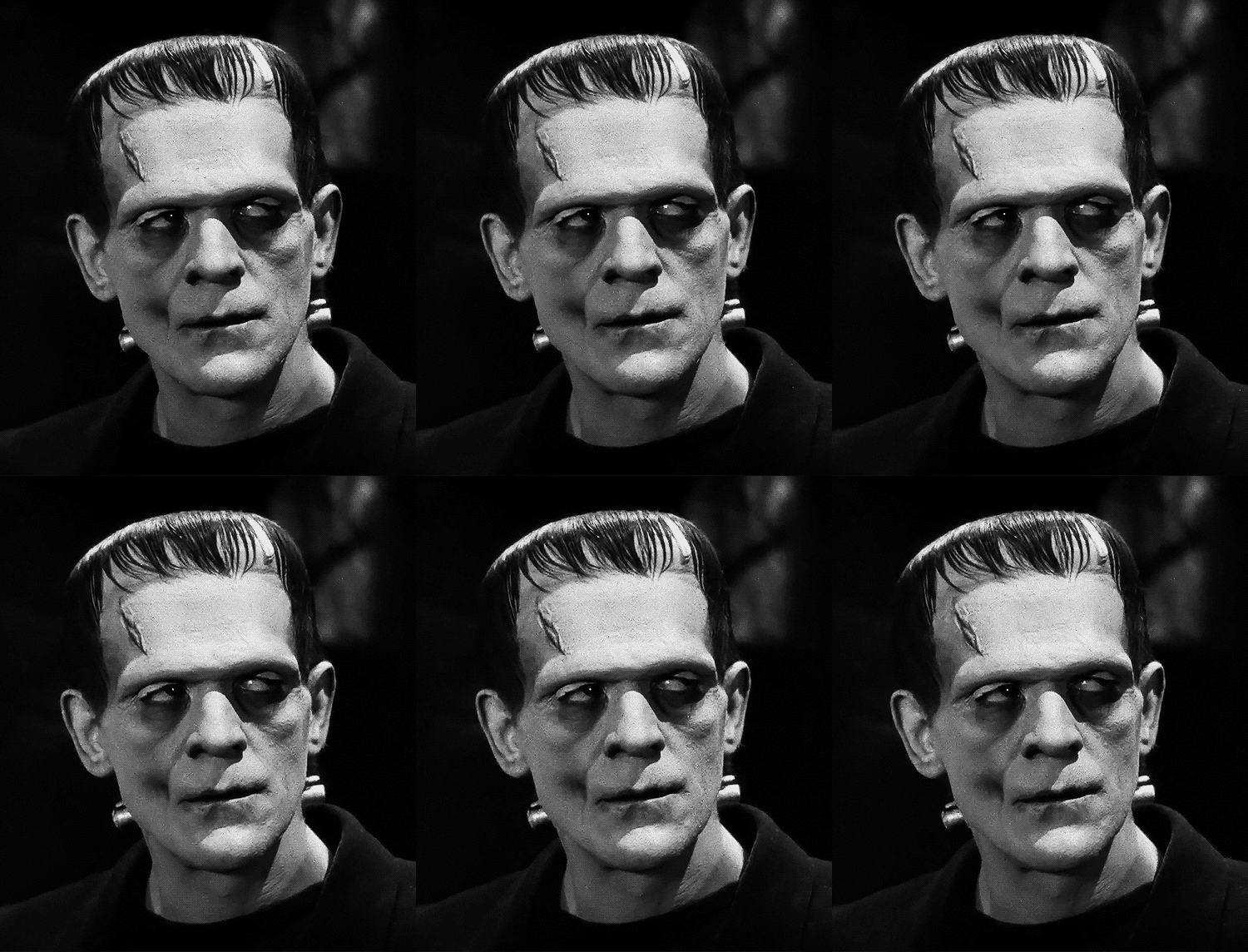
The history of monsters across cultures Frankenstein and the dread of the Other
The Brundlefly and the fear of the body
Count Orlok and the fear of desire, disease, and repression
But before anything… we must comprehend what a monster is.
Theorist Jeffrey Jerome Cohen tells us that monsters embody ‘a time, an emotion, a location’—they are shaped by our fears, worries, and aspirations.
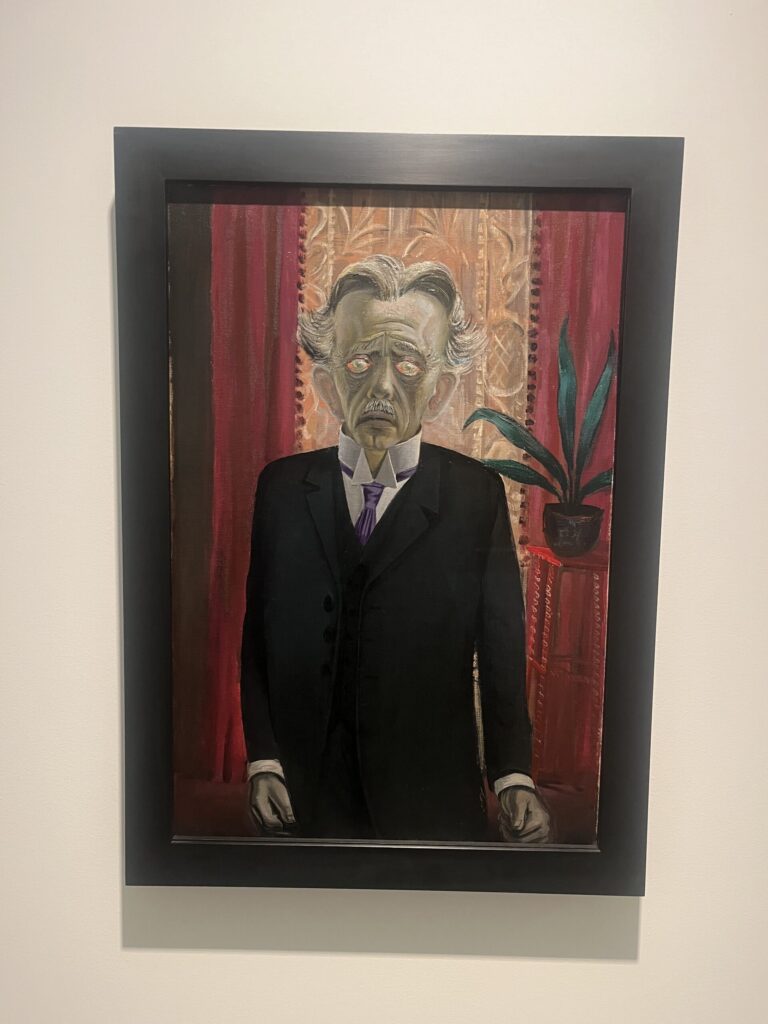
Art critic Theodor Adorno tells us that art is where society meets itself. Monsters, then, are cultural reflectors. They represent all that a society is afraid to acknowledge.
PART II
Monsters in Art
1. Marina Abramović Rhythm 0
Let’s start with real life instead than fiction. In Rhythm 0, Marina Abramović lay out 72 objects: roses, chains, scissors… and a loaded pistol. She let the audience to do anything they pleased for six hours.
Idea: Painful and pleasurable objects were arranged to be used on Abramović.
What: The audience turns into the monster.
Why: As soon as the repercussions vanished, violence broke out. This act revealed that monsters are not supernatural. When no one is looking, it’s just regular people.
2. Hans Bellmer The Machine-Gunneress in a State of Grace
Concept: Fascist notions of bodily control and purity are confronted by disassembled doll-like female forms.
What: The monster’s body is designed to represent political aggression, fetishization, and cultural fixation.
Why: Bellmer shows how repressive governments, particularly fascism, try to control people’s bodies. In his works, monsters are manufactured by culture. The sculpture is unsettling because it depicts what society does to the bodies it fears, not because of its form.
PART III
The History of Monsters (Across Cultures)
To understand monsters in the media, we must trace their evolution.
Across time, every culture created monsters to navigate chaos.
THE ANCIENT WORLD Explaining Danger
Before science, earthquakes, storms, disease, and death were all explained by monsters.
Wendigo (Algonquin): Born from starvation, greed, and colonial trauma. a creature produced as humanity collapses.
Humbaba (Mesopotamia): Guardian of the Cedar Forest, signifying nature’s power against human arrogance.
Sirens: (Ancient Greece): served as warnings about the perils of desire, shipwrecks, and temptation. These creatures weren’t merely frightening, they explained.
THE MIDDLE AGES
Monsters as Moral Punishment
As Christianity grew, monsters became emblems of sin.
Adze (West Africa): A transformation myth used to explain disease or outsider behaviour.
Witches (Europe): Women who were accused of being monstrous for being independent, knowledgeable, or just existing in a different way.
Yōkai (Japan): Spirits that represent societal anxieties such as loneliness, resentment, and natural calamities. In this era, monsters policed behaviour. Anyone beyond the social norm could become ‘monstrous.’
THE 19TH CENTURY
Science, Otherness, and Technology
This was the age of industrialization and the genesis of contemporary monsters.
Cannibals: In travel literature, cannibals were used to degrade colonial people.
Vampires: reflected anxieties about disease, sexuality, and immigration.
Automata (mechanical dolls): expressed worries about technology replacing humans.
The beast shifted from the woods… to the laboratory.
THE 20TH CENTURY War, Trauma, and Upheaval
After two world wars, monsters embodied global trauma.
- Godzilla: Radioactive fear of nuclear destruction.
- Zombies: Represented pandemics, mass death, and societal collapse.
- Aliens: Anxiety about invasion, espionage, and Cold War paranoia.
THE PRESENT
Fear of Everything
Today’s monsters reflect:
- Climate anxiety
- Digital surveillance
- Pandemics
- Political extremism
- Loneliness and mental illness
In our age, where everything is watched, measured, and exposed…
We fear anything and everything.
PART IV
Frankenstein: Fear of the Other & Ambition
In Frankenstein, the Creature is feared for being different.
But the true monster is the creator.
- Victor Frankenstein creates life but abandons it.
- The villagers attack the Creature not for violence but for difference.
- The story warns against:
- Reckless ambition
- Social prejudice
- Science without ethics
- Creating “others” instead of understanding them
Modern Parallel:
Writers compared Charlie Kirk to a “Frankenstein monster” created by extremist rhetoric that spiraled beyond control (The Wire; Roth).
Society fed ambition until it created something it could not contain.
PART V
Brundlefly: Fear of the Body
In Cronenberg’s The Fly, Seth Brundle merges with an insect — a metaphor for illness, aging, and loss of power over the body.
It reflects:
- Degenerative disease
- Addiction
- Disability
- Mental health struggles
- Loss of identity
- Shame and isolation
Modern Parallel:
Britney Spears (2007–08).
Her public breakdown became a spectacle — a transformation exploited and misunderstood.
- Brundlefly=body deteriorates
- Britney= body scrutinized, autonomy stripped
- Both lose control, one biologically, one socially and legally
- Both become “monsters” in the eyes of the public
Monstrosity becomes a label slapped onto suffering.
PART VI
Count Orlok: Scapegoating & Repression
In Nosferatu, Count Orlok is a creature of forbidden desire, a blend of fascination and repulsion.
He symbolizes:
- Sexual repression
- Xenophobia
- Women’s autonomy
- Disease panic
- The weaponization of purity narratives
Some interpretations see Orlok as connected to anti-Semitic imagery which matters, because scapegoating occurred both in the film and in history.
During the AIDS crisis, gay men were blamed like medieval townsfolk blaming vampires for plagues.
Modern Parallel:
Figures like Lil Nas X are demonized for challenging dominant religious narratives.
His “Montero” visual was praised by some but treated as monstrous by others.
PART VII
Why Monsters Matter
So why do we keep telling monster stories?
Because monsters let society confess without admitting guilt.
They reveal:
- Who we fear
- Who we scapegoat
- Who we exclude
- And who we refuse to understand
Cohen writes:
‘The monster always escapes.’
Fear denied grows teeth.
Trauma unspoken becomes claws.
We don’t create monsters because we are afraid…
We create monsters because we refuse to face ourselves.
CLOSING
The Mirror With Teeth
When we talk about Frankenstein, Nosferatu, or the Brundlefly…
we’re not talking about creatures.
We are talking about:
- ambition
- shame
- trauma
- desire
- bodies
- politics
- and the shadows of ourselves
Every era. Every culture. Every society…
creates monsters.
And the monsters always point back…
to their creators.
Look closely tonight.
See the teeth.
See the shadow.
See yourself.
Proposal:
“Art is the social antithesis of society, not directly deducible from it. It is the process in which society confronts itself,” says German philosopher and critical theorist Theodor W. Adorno, in his work Aesthetic Theory (Adorno 3).
Art holds a mirror to ourselves and makes us see the truths. This goes especially for monsters. Monsters are a reflection of social fears, anxieties, stigmas and all around the dark side of humanity. In my presentation I will be discussing the horrors of humanity portrayed by artistic creation.
My presentation will combine theory, performance and sculpture. I will be connecting monsters such as Frankenstein and the Brundlefly to a sculptural live performance act and a manifesto. I will use paper mache to make masks for my peers to wear in my presentation. I will find footage from movies, live interactions and play them in the background. I will look into Hans Bellmer’s The Machine Gunneress, in a State of Grace (1937) which depicts social norms of the Nazi regime, fetishization and obsession, expressed through surreal, disarticulated doll forms. I will look into Marina Abramovic’s Rhythm 0 (1974) to convey the monstrosity of humanity, where the audience became sadistic.
Then, I will speak of the modern monsters portrayed in films. I will explain Frankenstein and the horrors of ambition, neglect/abandonment and otherness. I will explain how in The Fly (1986), the fears root in degenerative illness and aging that leads to physical, psychological, and social disintegration. I will explain how Nosferatus sexuality both repulses and fascinates viewers due to hidden shameful desires. And if time permitting, I will discuss antisemitism
Using this synthesis, my performance will make the case that violence and social structures are the source of monstrous, which is never limited to fiction. Monsters make us face things we’d rather ignore, like our own harshness, the ways we stigmatize difference, and the impulses we’re afraid to express. In addition to seeing these creatures, my project invites viewers to put them on, face them, and reflect on what they might say about us in the present.
ᴸᴵⱽᴱ ᴬᴿᵀ ᴿᴵᵀᵁᴬᴸ: ᴿᵉˡᵃᵖˢᵉ ᴿⁱᵗᵘᵃˡ𓊔꩜
Score:
Artist Statment:
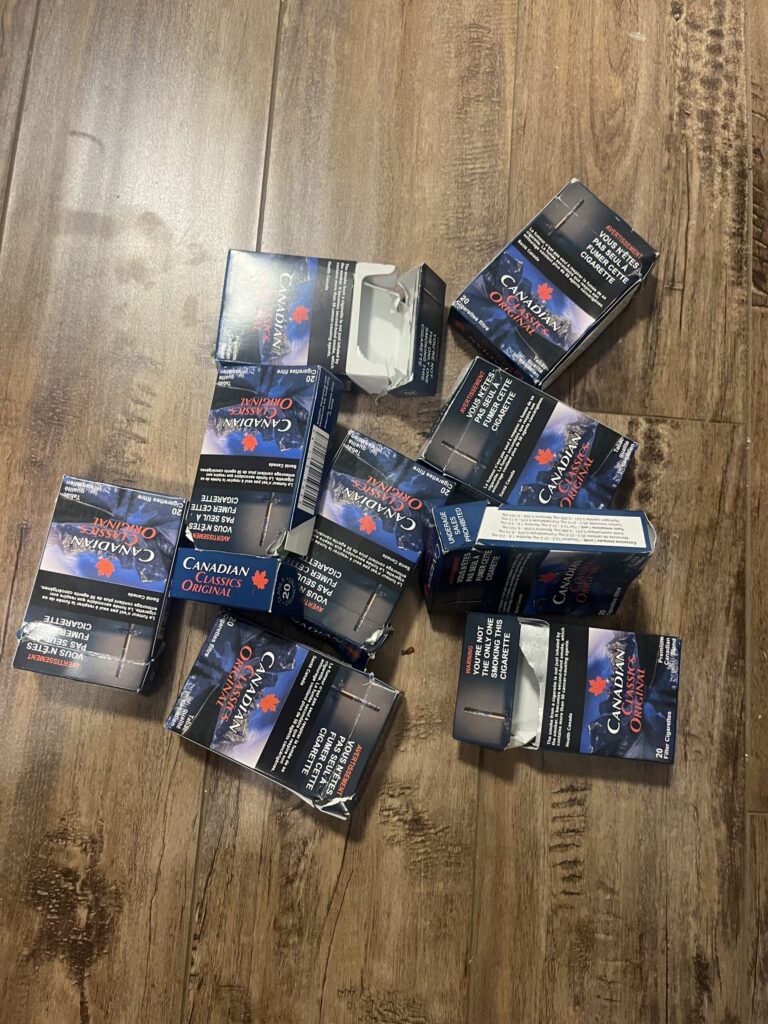
“My name is Breanna and I am an addict” is what I say every evening. I began my addiction issues when I was 17 and began to battle them when I was 21. I am now 24 and I am clean. Through my battles with addiction, there were slips and relaspes that almost felt ritualistic. A thing you hear in recovery is “One is too many and a thousand is never enough”. Like most addicts, I relate to that. It would begin with something legal or soft, then it would escalate to the harder stuff, until I said I’d stop. Then it would happen again and again like a ritual. Use, use something else, try a new drug, withdrawal and recovery. Until one day I woke up in my chaos and chose to change. Not for anyone, but for myself.
In this live art piece, I strive to convey the slippery slope and severity of addiction. This live art piece explores that dangerous rhythm ; the way addiction seduces, escalates, and eventually shatters. I employ shock as a tool, not for spectacle, but to make the hidden violence of dependency impossible to ignore. Through raw gestures, unsettling sounds, and symbolic substances, I reconstruct the relapse-to-recovery ritual while remaining physically safe. The audience is meant to feel unsettled, to sense the urgency of breaking free.
I will begin by turning off a lamp and sitting in the darkness. There will be an audio score, with notes descending and speeding up at each drug to depict the downfall. There will be terrifying imagery to convey the darkness in the mind while using. Then I will turn on the lamp symbolizing finding the light and I will do a reading about recovery.
The musical score starts off holding notes that descend. As the drug use becomes more intense, the faster the notes play and the more complicated the drums get; until silence. When it is silent, the noise stops and there is peace. Just like the peace I found when the chaos ended and I committed to recovery.
Documentation of Performance:
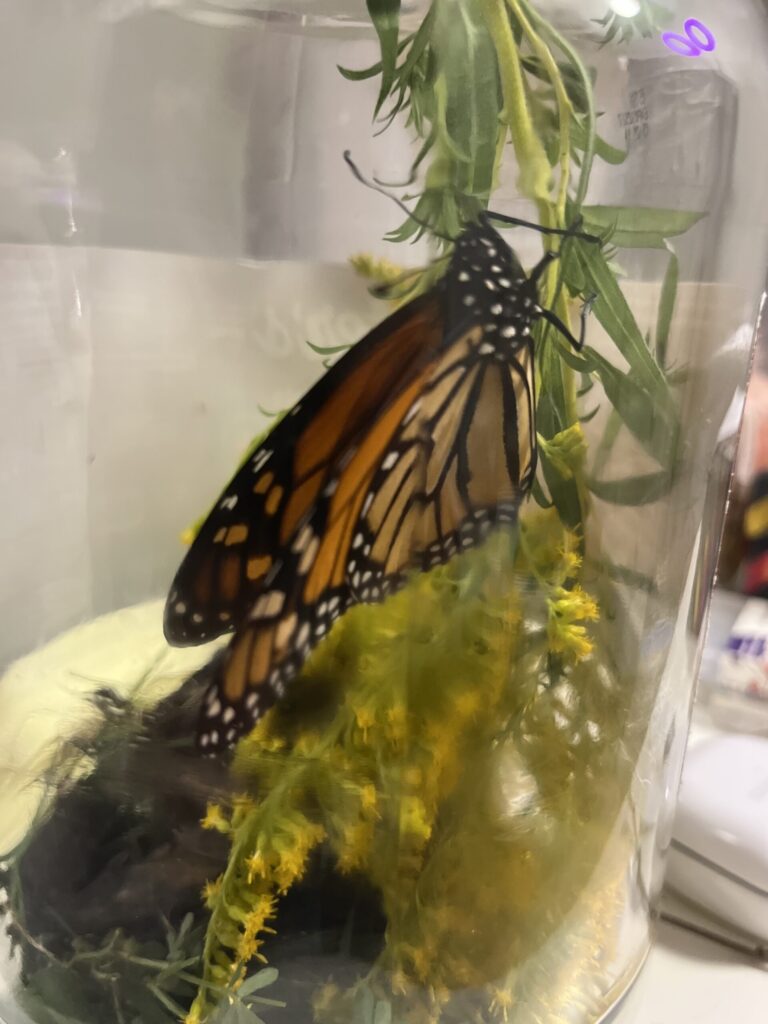
Moments of Magic:
☠︎︎ˢʸᵐᵖᵒˢⁱᵘᵐ: ᴮⁱᵇˡⁱᵒᵍʳᵃᵖʰʸ☠︎︎
Cohen, Jeffrey Jerome. Monster Theory: Reading Culture. University of Minnesota Press, 1997.
“The Fly.” 20th Century Fox, 1986.
Whale, James, director. Frankenstein. Universal, 1931.
Murnau, F. W., director. Nosferatu a Symphony of Horror. Prana-Film GmbH, 1922.
ıı||ıı||ı|ıı|ˢᵒᵘⁿᵈ ᴼᵇʲᵉᶜᵗ ıı||ıı||ı|ıı
Intro:
Artist Statement:
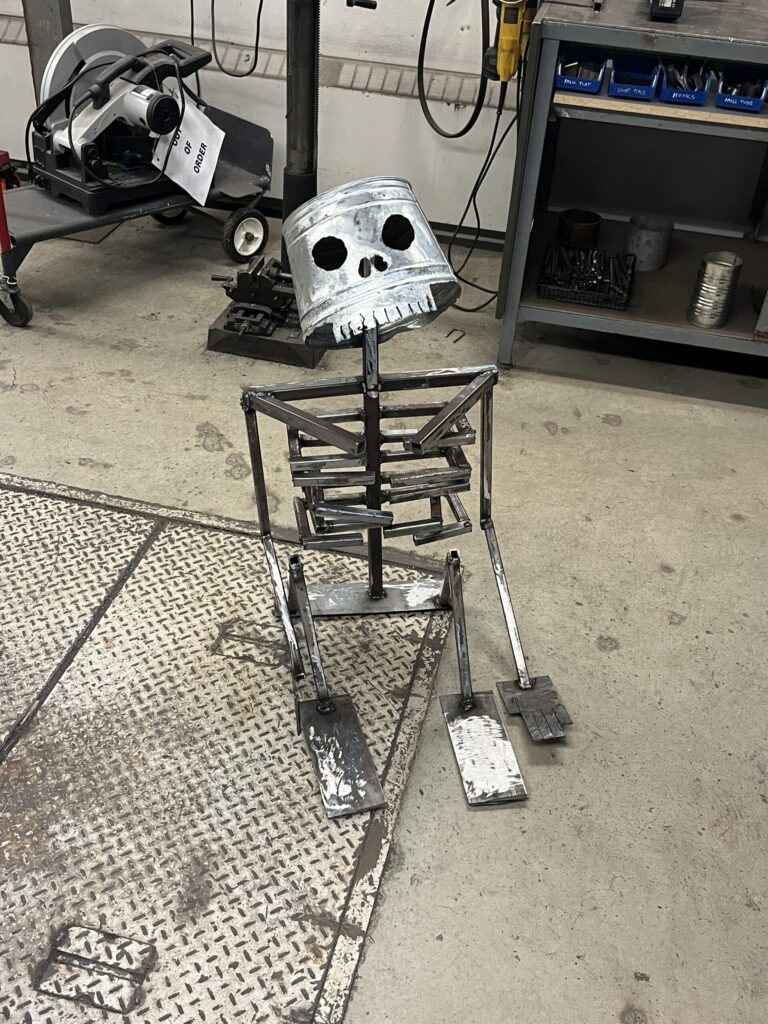
From the ashes of a future without us, Shit Box 1000 is my sound object. I play the final survivor, creating music out of whatever crumbs I can find in this 2048 setting, long after AI has taken over and most of humanity has been wiped out. This composition, which was made out of a ripped-up metal junction box, two guitar strings, a rubber band, and a metal rod, is my attempt to bring sound into a silent world.
When I was first assigned the project, I wanted to assemble a band inspired by experimental noise groups such as Nihilist Spasm Band, who created homemade instruments — but no one wanted to join. So I became a one-man post-apocalyptic symphony. I used a loop pedal and a microphone connected to a voice modulator to layer distorted beats and vocals to weave a story about isolation, glitching hope, and resistance.
Every sound that comes from the Shit Box 1000 feels broken, metallic, and human. It’s imperfect — it buzzes, screeches, and clanks — and that’s what makes it alive. In the world of the piece, the act of making sound from garbage is rebellion. It’s proof that creativity survives even when civilization doesn’t.
The lyrics to my song, “404 — Humanity Not Found,” evoke the emptiness of a digital wasteland: a lone voice attempting to contact someone through static. The Shit Box 1000 is more than simply a found-object instrument; it’s a message in a bottle from the last human on Earth.
the Performance and Process:
ˢᵖᵉᶜᵘˡᵃᵗⁱᵛᵉ ⱽⁱᵈᵉᵒ▹
Video:
Artist Statement:
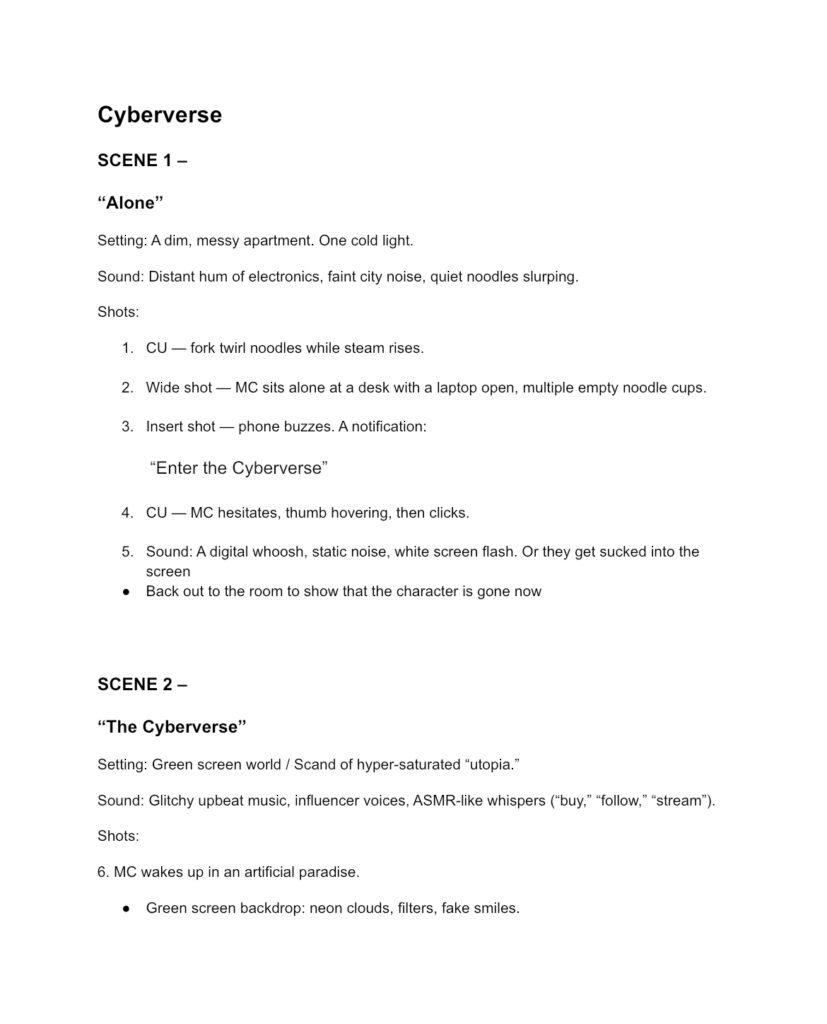
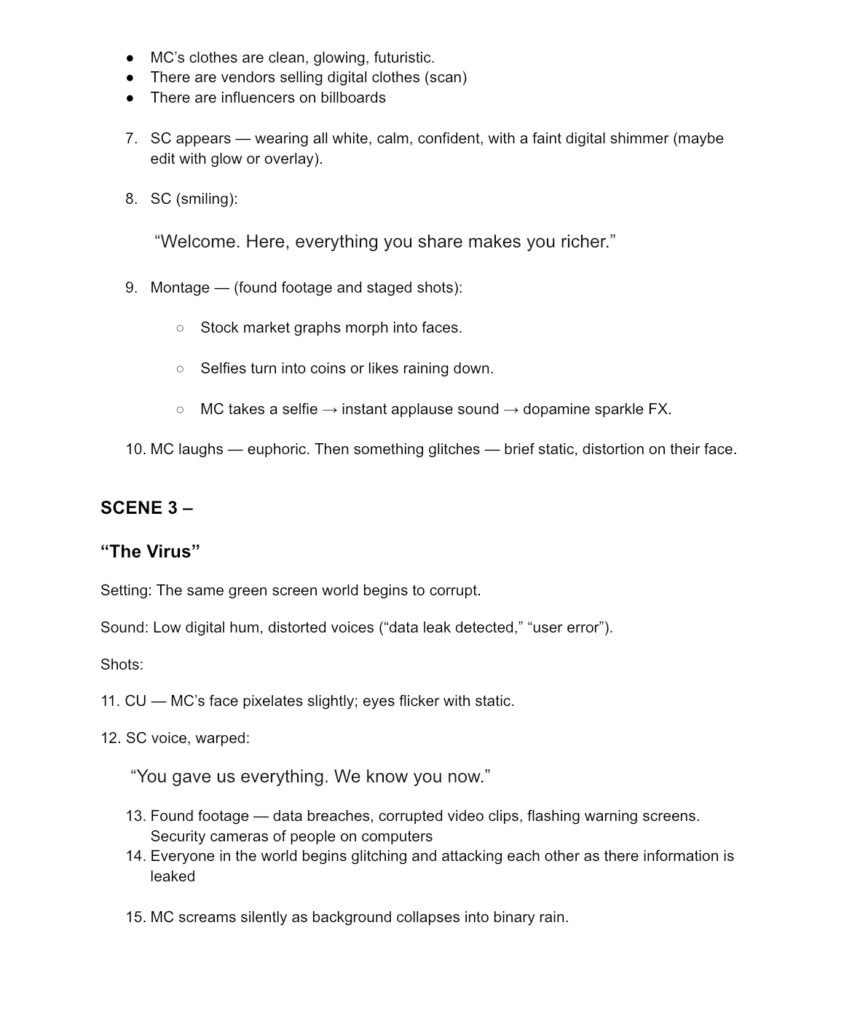
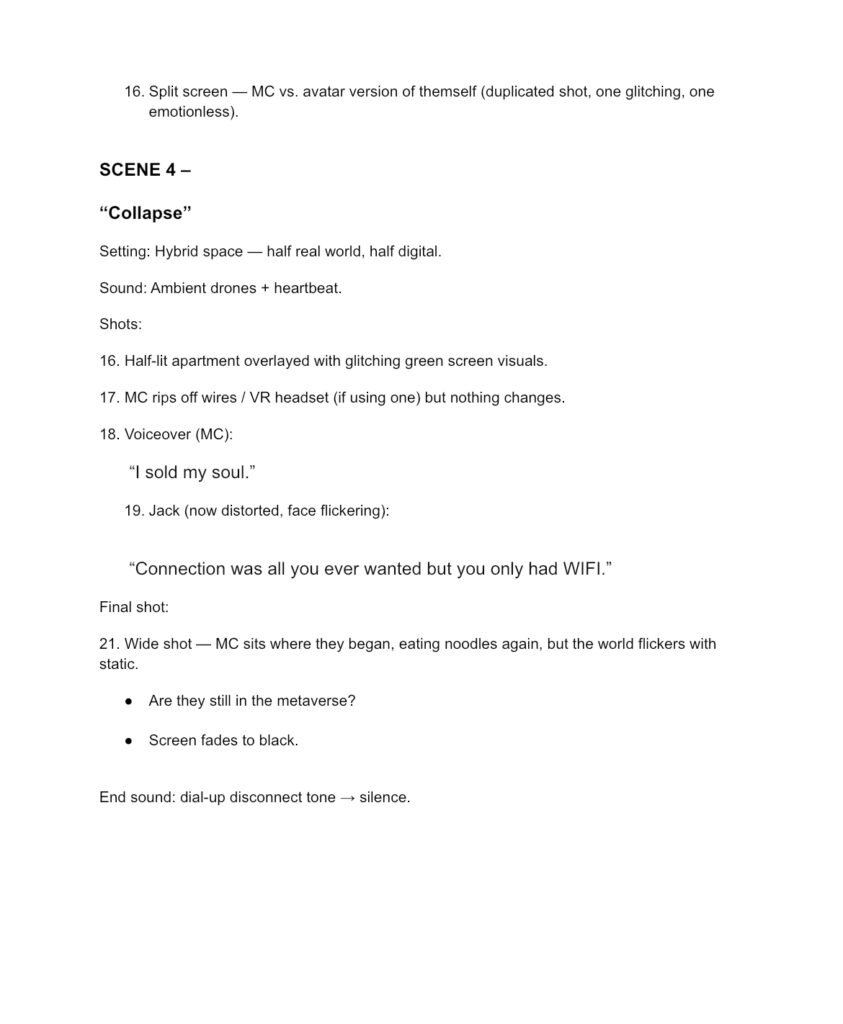
In our video, Jacks and I investigate a hypothetical future in which personal connection is replaced by digital connection and our identities are solely maintained through online contributions. I started with a straightforward query: What if WiFi was the only remaining true link in the world? From that “what if,” I created a metaverse that promises nirvana but is more like a dopamine minefield, where survival depends on visibility, cooperation, and constant engagement.
Before the main character gets pulled into the metaverse, the video opens with private, lonely moments like walking to the convenience store and eating noodles by themselves. To illustrate the character’s loneliness, it opens with silence and coldness. They display their melancholy and frantic search for happiness by donning a shirt that reads, “I heart Tequila.” Everything seems flawless in this digital world: flawless avatars with beautiful bodies, a never-ending supply of selfies and ads, and an economy based on engagement metrics, product promotion, and selfies. I tried to give a clue that this world is not as amazing as everyone believes by removing the eyes of the characters to convey a soullessness. I was motivated to study speculative design and fiction by the ways in which artists such as Ian Cheng, Hito Steyerl, and Wangechi Mutu employ world-building to reveal modern power structures. In my work, the metaverse functions as a mirror and a fantasy, showing how loneliness, poverty, and the need for approval influence our online activity.
Characters start to malfunction and become unstable as the digital world descends into an apocalyptic state due to a “data virus.” The protagonist’s discovery that they utilized the internet for greed, comfort, escape, and ultimately to fill a gap that technology cannot fill is analogous to this collapse. I was able to magnify these dynamics while staying rooted in the emotional reality of our contemporary interaction with digital life through the use of speculative imagining.
We created a fragmented visual language that represents the fragility of both the internet world and the individual using Blender, MakeHuman, green screen compositing, and discovered film. The metaverse characters are stylized and hyper-smooth, contrasted with the chilly, low-tech actual world. The music of the video, including glitches, alerts, and background hums, heightens the tension between fear and dopamine.
In the end, this piece is about the price of constructing identity on shaky ground. It is a meditation on digital labour, consumerism, loneliness, and the need to be noticed. I wish to shed light on the present by speculating about a future in which the internet becomes our only reality:
We are already living in a world where connection and collapse exist side by side.
Notes:
Leave a Reply
You must be logged in to post a comment.