Oracle Decks are a free-form, intuitive type of introspective guidance tool similar to Tarot cards. Unlike Tarot, which adheres to a set number of 78 cards divided into Major and Minor Arcana (arcana meaning secret or hidden knowledge), Oracle Decks can be highly personalized. They can be created with regards to a specific theme such as botany, angels, or Magic: The Gathering. Both Tarot and Oracle Decks tend to borrow from a wide cross-cultural array of mythologies, religions, celestial bodies, astrology, and folklore. By individually designing cards for a collective deck, this assignment invites you to consider collaboration and aggregation within art-making and knowledge-building practices.
The Magician
In traditional French and Italian Tarot, Le Bateluer/Il Bagatto is a stage magician, a charlatan – a practitioner of sleight of hand trickery for personal gain. Other decks frame the same figure as an artisan – a skilled handcrafter. Looking at these variations from the Tarot de Marseilles, what symbolism can you draw from this card? What elements remain constant in each variation?
Now look at the popular Rider-Waite-Smith version of the card. What is the same? What is different?


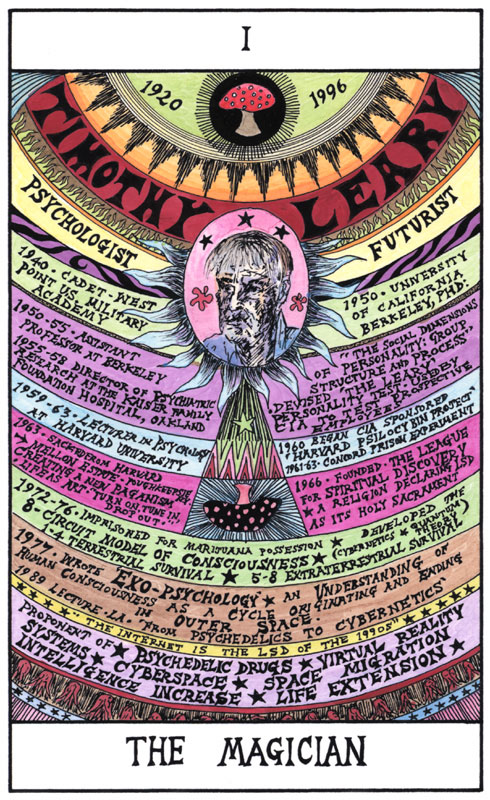

The above (Hexen 2.0 and Thoth Tarot) examples of The Magician offer even more varied symbolism. In Hexen 2.0, artist Suzanne Treister focuses each card on emergent technologies and the Internet. Her Magician is the late psychologist Timothy Leary, a figure best known for his research into and advocacy of psychedelic drugs. (Notice the phrase: “The Internet is the LSD of the 1990s.”) In the Thoth deck, occultists Aleister Crowley and Lady Frieda Harris connect The Magician to the Roman messenger god Mercury.
The Magician in Tarot represents the hermetic principle of “as above, so below” – a relationship between the macrocosm of the universe and the microcosm of an individual human life. It is a card of energy and manifestation. It can be read as a trickster figure (see The Powers’ “Shitty Wizard” card), a shaman, an artist, or a quack.

The Powers’ Oracle Deck brings symbols and characters from their collaborative cosmology in order to “dismantle hierarchical regimes of power.” I see the figure of the artist in the Squid card: a character with changing multicoloured and malleable flesh who lives in deep water, engaged in the dual creative activities of music and writing, and many-tentacled in order to multitask. Draw a card from The Powers’ Oracle Deck. What do you see in it?
This first assignment has a quick turnaround in order to get the creative squid ink flowing. Consider the symbolism of your design, but don’t get caught up in it. Use the tools that feel right in the moment of creation, whether that’s paint, collage, pencil, photography, polymer clay, macaroni, whatever. As you create your design, jot down what it means to you. Is there anything you want more of this semester? Less of? You can approach this with the seriousness of Rider-Waite-Smith’s Magician or the guile of The Powers’ Shitty Wizard.
Let’s start making a world together!