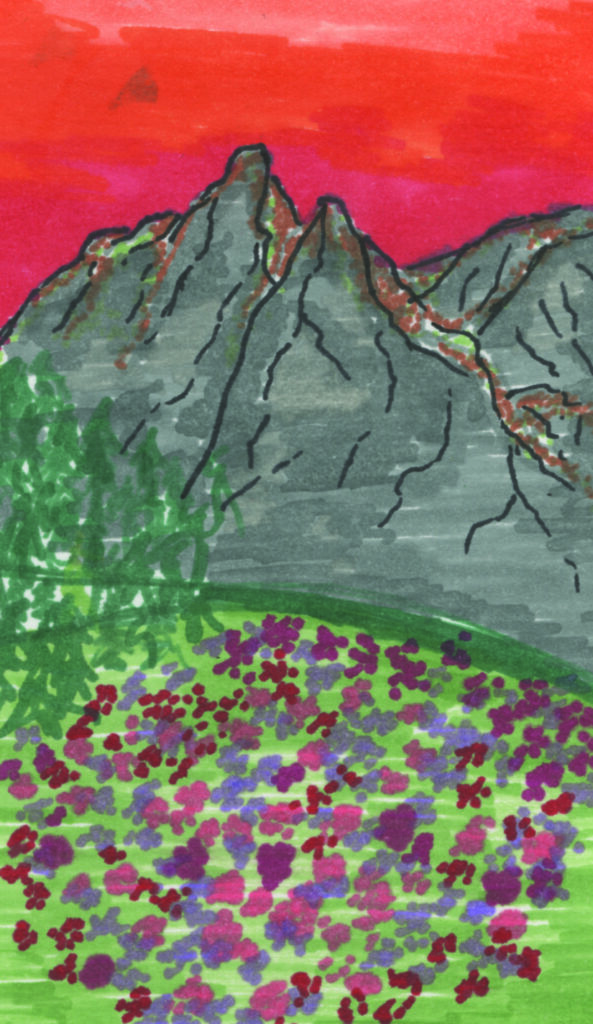
My card was made to represent the mountains in British Columbia where most of my family live. I hope to one day live out there and be closer to my family. BC is where I feel most inspired creatively and see most of myself in.
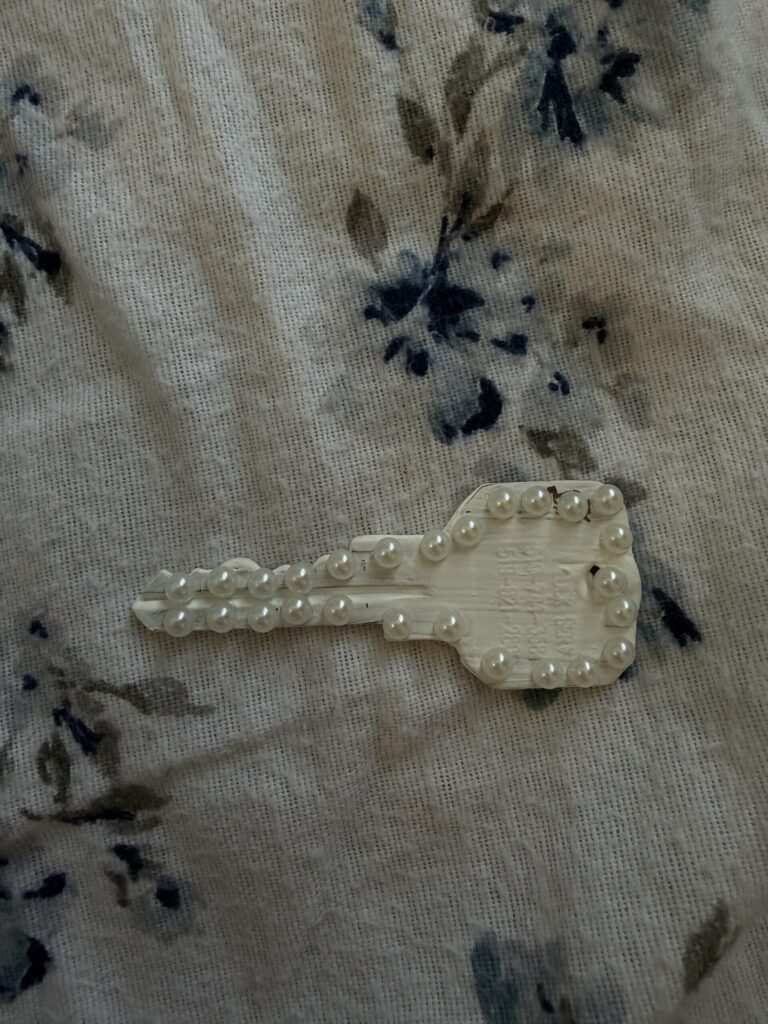
I chose a key to represent the Pope tarot card because the Pope isn’t just about religion, the card represents authority and control over belief. A key is a small object, but it holds a lot of power. It decides what gets opened and what stays closed, and who is allowed access. The key stands for control over knowledge of truth and is a symbol of quiet authority. The key is white because it symbolizes purity, goodness and trust. I wanted to keep my prop simple because our TV show is supposed to be super realistic, so I wanted something that could pass as an ordinary everyday object with a little bit of a twist
Is AI ruining art or is it the next best thing to?
How often have you seen a piece of art and wondered if it was really made by a human? As AI keeps advancing, this question is becoming more common. While AI can be a useful tool, it has also caused many people to lose their jobs and even their creative identity to machine-made content. For some, this feels like a real threat to human creativity, leading to boycotts of AI products and petitions to limit or remove AI from society. Others, however, have embraced it, using AI to grow their careers and explore new creative opportunities.
One example of this is AI voice-over work. Creators can use AI to give voices to fictional characters or real people, making them say things they never actually said or creating conversations that would never happen in real life.
Take the TikToker Eijogu Dennis, for example. He uses AI-generated voices of real people, Marvel superheroes, Dragon Ball Z characters, and even his own original characters. He inserts himself into these stories, often playing funny roles like Steven, a sports reporter. By combining AI voices with his live performances dancing, shaking hands, or striking poses, he makes these virtual characters feel alive. His work shows a positive side of AI, blending humor, storytelling, and creativity to build a unique and entertaining world.
Still, the rise of artificial intelligence in the arts comes with downsides. AI-generated art can flood the internet with cheap content, but much of it lacks the depth, meaning, and emotional impact that comes from real human experience. Since AI often learns by using existing artwork without permission, artists who have spent years perfecting their skills may see their work undervalued or even stolen. This raises serious concerns about fairness, ownership, and plagiarism. On top of that, because AI relies on the same data sources, its creations can become repetitive and predictable, reducing the diversity and originality of art.
Most importantly, art has always been a deeply human form of expression. It reflects personal struggles, emotions, and cultural experiences. If AI begins to dominate the creative world, we risk losing that human connection. What happens when stories, songs, and paintings are shaped more by algorithms designed for clicks and views than by genuine human experiences?
Dennis’s work shows that AI can be a powerful creative tool, but it also reminds us of the bigger questions about the future of art, creativity, and human expression.
Live Art Ritual
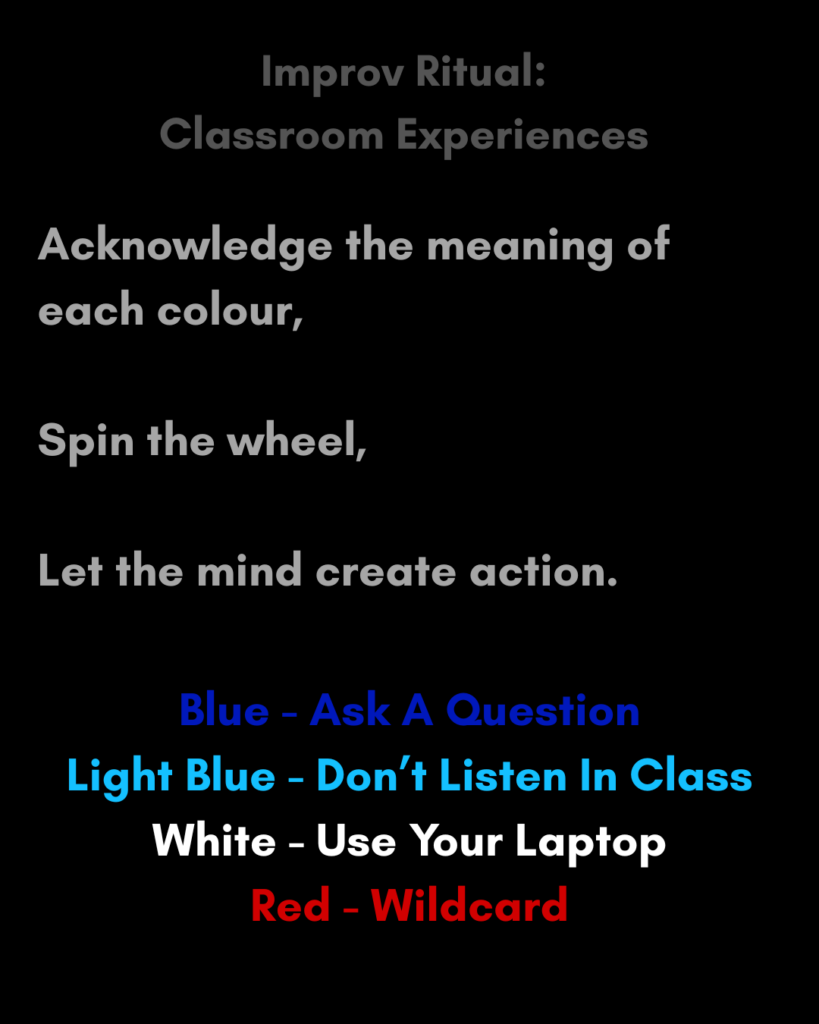
When we go to class, we often fall into a repetitive cycle, raising our hands to ask questions, taking notes, using our computers, and doing simple tasks like washing our hands. But what if things were left to chance? Imagine being given a task with no plan, where everything happens naturally.
We wanted to portray a sense of randomness with the common actions we do on a near daily basis using the subject of the classroom and the wheel as our median. Drawing inspiration from Rirkrit Tiravanija. An artist which created experimental and live art ritual pieces which included cooking meals. His works, Untitled 1990 (pad thai) and Cafe Deutschland (1993) allow for unplanned environments based on specific tasks, repetitive in nature, surrounding specific locations/subjects (Food).
The goal of the wheel was to create separation between scenes and build suspense, leaving the audience curious about what would happen next. It also highlighted that, even though all the scenarios took place in the classroom, they weren’t connected to each other. We also added a wildcard option. Since red was the rarest color on the board, landing on it gave us the chance to perform unique scenes that acted like “memory portals.” These stood apart from the usual tasks, which were linked to the more common colors.
Artist Statement
Our classroom experiences are reflected in this live art ceremony we created. The way we respond to unexpected events is shaped by our past experiences.
We used the color wheel as a symbol, treating it like a cycle of repeating behaviors. Its circular form represents consistency and repetition, showing how patterns shape our lives.
Even though each task was completed differently and often at random, we all thought carefully about how to approach the work. This process made us reflect on our own lives and past experiences while creating something physical. Because these activities are familiar, the audience is encouraged to think about their own habits and interpret how they might create their own version of the ritual.
Since preschool, we’ve repeated daily routines without questioning why. In many ways, we act almost like machines, following the same habits: asking questions, Googling information, taking notes on laptops. These actions are so ingrained in our lives that they feel automatic. When we perform these routines at unusual times or without clear purpose, they transform into an experimental form of art.
Classroom Experiences is a psychological. It highlights our humanity, challenges how we view routine, and shows that even familiar tasks can take on new meaning when performed differently.
Score
Speculative Assignment: Greys Anatomy
White halls and uncomfortable chairs for the half of my childhood, the walls of clinics and hospitals wasn’t an uncommon sight for me. Due to a weak immune system as well of other health concerns my mothers maternal instincts was so great that upon the first sign of my diminishing health she would take us to a doctor. I appreciate it now that I am older but back then I hated the hospitals, they had an eerie and robotic sound to them that i grew a custom to but still disliked it nonetheless. This video is thought process and feelings I held while in these places as well as the vitamins I consume on a daily basis. the mind can play tricks on us making nightmares of dislikes and dreams out of joys this was my goal, to embody a nightmare.
I’m making a 10-minute piece of music portraying trauma and it’s aftermath; I was hoping to split this idea I have into four parts, each section being 2.5 minutes. Splitting it up into “the before”, “the come-up”, “the peak (ie. traumatic moment)”, and “the after”. My creative goal in all of this is to create a mixed piece of multiple artists’ music, as well as incorporating sound clips from my life and the internet; to create an entirely new piece in itself.
1. The Before (0:00 – 2:30)
Mood: Normalcy, safety, or even monotony.
The same repeating beats at the same bpm, creating a comfortable setting that the audience may grow used to, or even potentially tired of.
Learning Focus: Establishes a baseline of “ordinary” to contrast with what’s coming.
2. “The Come-Up” (2:30 – 5:00)
Mood: Uneasy/tension building, chaotic
I’d really like to include sound clips from some of the parties I used to attend, and the kind of life I used to live, not by seeing, but by listening.
I like to put in clips of arguing and fighting over top of the artist I choose, probably not my own, since that’s a bit much
Sound Choices: Increasing dissonance, distorted echoes, off-kilter rhythms, sounds that “don’t belong” quickly rolling in, climbing up, like a rollercoaster climbing to the very top
Learning Focus: Teaches the audience that making bad decisions is the cause of your own actions
3. “The Peak” (5:00 – 7:00)
Mood: Intense, overwhelming, big drop
Sound Choices: Abrupt volume changes, harsh noise, distorted voices or instruments, fragmented beats, sudden silence or cut-outs could hit harder than constant sound. I really wanna make this part a surprise more or less, and I still don’t really have it fully figured out yet, I might create a drop by combining a bunch of other beat drops together from different songs, and score it together with vocals on top.
Learning Focus: Gives the audience a visceral, embodied sense of how trauma feels in the moment (confusion, sensory overload, loss of control)
4. The After (7:30 – 10:00)
Mood: Hollow, fragmented, repetitive
Sound Choices: Sparse textures, fading sounds, broken repetition of “the before” (like distorted memory). Possibly end unresolved, leaving tension hanging.
Really want to have a repeat of a voice from the “come-up”, maybe even sound clips of parties again, really kind of giving a lost atmosphere
Learning Focus: Demonstrates the long-lasting impact of trauma—the way it reshapes experience, not just in the moment, but also afterward.
Bibliography:
Tame Impala – End of Summer
Parker, Kevin. “End of Summer – Tame Impala.” YouTube, July 25, 2025. https://www.youtube.com/watch?v=ulkdUfItyxI.
Slayyyter – BEAT UP CHANEL$
Carter, Catherine Grace. “BEAT UP CHANEL$.” YouTube, August 1, 2025. https://www.youtube.com/watch?v=hhvW8qB-W3M.
Ben Lukas – Boysen
Boysen, Ben Lukas. “Medela.” YouTube, May 6, 2020. https://www.youtube.com/watch?v=VE7qCA6koWU.
Research
To be honest most of the research for the piece came from my own ideas that I’d been sitting on for quite sometime, so not a lot of research was necessary when creating the piece, nonetheless I do have bits and pieces of reading and lecture materials that helped inspired my idea to come to fruition.
Audio/Piece:
Artist Statement:
This piece was mainly inspired by our past lectures relating to music and sound. I’ve always loved music and consider myself very immersed in it. The lectures you gave, especially the one focused solely on film and music, really brought my idea to life. I know you were a bit against the whole concept of a 10-minute symposium song at first, but I’m so happy I could send a message and have a “teaching experience” through music. I tend to find it difficult to express the exact feeling that trauma brings, it’s almost like grief, a kind of loss of self, but stating it that way almost feels a bit shallow, there are layers to it. I want to say what words cannot say, I want to create that feeling, or even a glimpse of what it felt like, without describing anything; I wanted to create a story with sound, and I feel like I achieved what I was aiming for. When creating the piece, I mainly followed the proposal’s outline only, like cutting the song off or fading it out when it hit the 2:30 mark. While I went a little over, I think it was worth it in the end. I really, really enjoyed creating this, and while I had a couple of technical difficulties on the day of the presentation, it was otherwise smooth sailing and a lot of fun.
(Thank you so much for giving me the ability to create this)
Live Art Ritual Proposal
This Live Art Ritual reimagines the act of stoning and what it would look like in a much more playful setting.
Historically and culturally, stoning has been tied to violence, punishment, and communal judgment
By transforming one act of collective violence into something simultaneously playful, humiliating, and catharic the piece explores themes of power, vulnerability and communal complicity.
Performance Description:
I’ll be placing myself in the middle of campus just like how the guilty would be brought to the town centre, or placed in a large gathering spot for all to see the spectacle; I’ll be in all white so the dye/blood will be easier to see, and will be making direct eye contact with the camera the entire video.
The audience will be provided with a bucket of water balloons, some with dye and others without, to give a more realistic display of stones that may hit the body, while others break the skin.
Once all of the balloons have been pelted, I’ll remain in the same position, still silent, continuing to stare at the camera.
Ritual Elements:
Preparation: Balloons filled with water and a couple of drops of dye
The Act: The throwing is a ritualized release of mass hysteria and aggression, guilt or complicity, echoing communal punishment practices
Aftermath: The silence and dye highlight the residue of violence and the vulnerability of the marked body, which can translate to many other different scenarios as well, such as trauma and even symbolizing sexual assault.
Safety:
Audience/participants will be instructed to avoid the face!
Video:
Artist Statement:
Wow, this assignment was so much fun, I actually still can’t believe I made myself do this. What I’m really upset about is the fact that I never got an angle of the campus and only got an angle of me 🙁 too bad I’ll have to do it again I guess! This assignment really made me step out of my safe space in probably one of the best ways I can think of, when you mentioned this assignment I could only think of literal live art, which is paint splatter art, which I’m a huge fan of myself if you’ve watched the Princess Diaries. From day one my mind was set on this idea, you really helped my idea come to life when you gave me the idea of encaspulating a stoning within a much more fun context. It is a fact that wom en are more likely to be stoned in different parts of the world; it is a horrifying reality that women are still disproportionately subjected to stoning and other forms of gender-based violence in different parts of the world. Even acknowledging this fact felt heavy, but ignoring it would have felt far worse. By embedding this violence within a performative, colourful, and almost celebratory framework, the project confronts how normalized or invisible such brutality can become when it is culturally or socially distanced from us. The discomfort I felt performing and documenting the piece mirrored the discomfort I hope viewers experience when they realize what the work is actually referencing.
Sound Object Assignment
For me, creating a music piece to go with my art just makes sense, whenever I create something, I always try to get a feel or a vibe going, I’ll watch certain movies, or listen to certain music as it helps with the creative process.
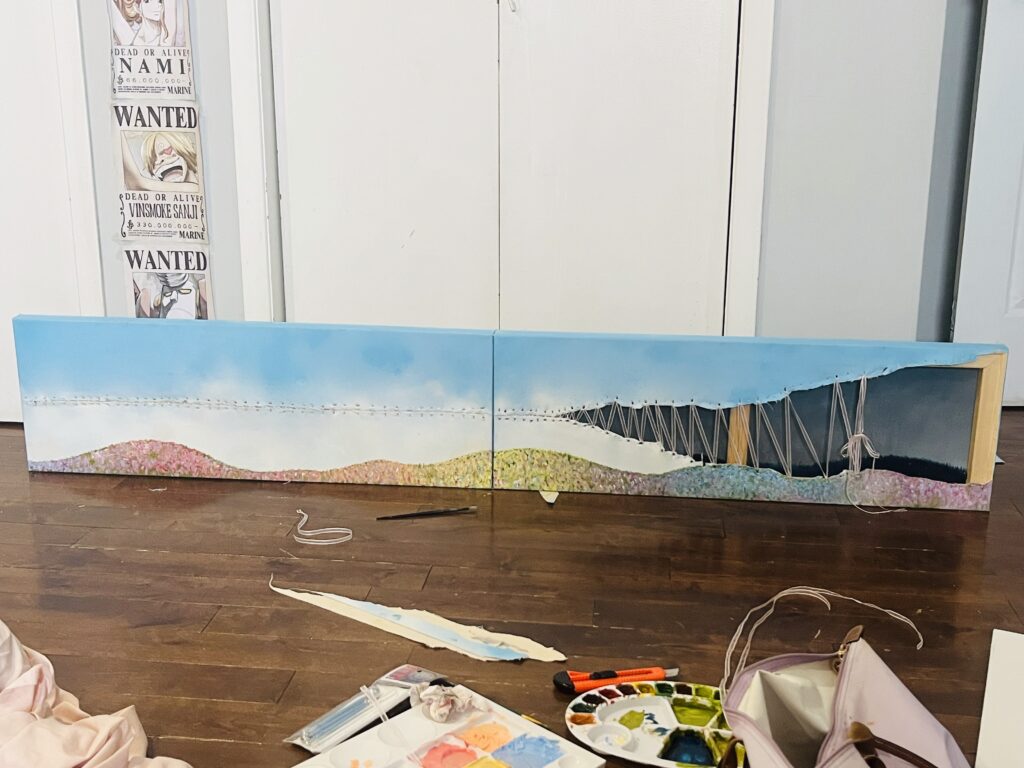
I’ll be using an art piece I made last year as a “vessel” through which sound files are played through a speaker
This is the painting I made for my final assignment last year
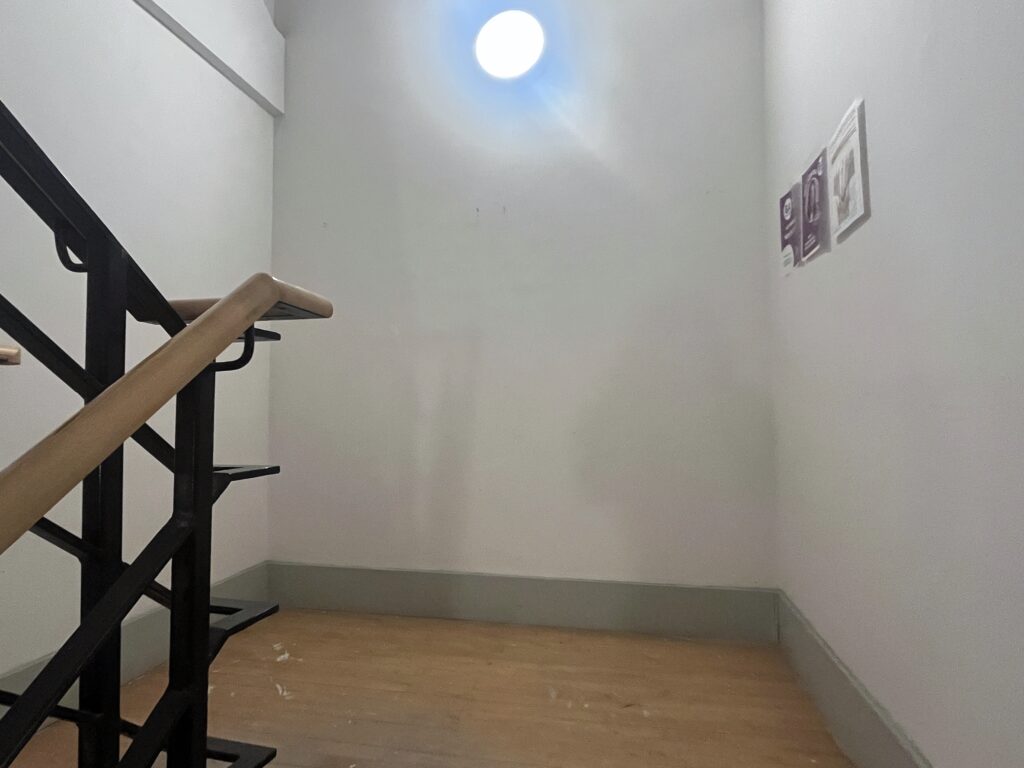
I unfortunately took down the piece before I could take a picture of it, but here’s where it was prior :,)
I took the song “Silver Soul” by Beach House since I felt it really fit with the idea I was trying to portray within the piece, for those who don’t know the meaning of the piece, I wanted the music to feel nostalgic and remind the viewer of their childhood.
Performance Description
The piece is a diptych, I wanted a good place that wasn’t too big and wouldn’t drown out the piece itself, and decided to go with a corridor in the staircase in Zavitz.
The plan was to place the painting in between the 3rd and 4th floor corridor, and place my phone inside the painting itself as it has two layers and would be able to hold my phone as well as have an exit point for the earbuds to hang out.
The audience is expected to wait their turn to use the earbuds
While everyone can view the piece of course, only one person is actually experiencing the full-piece which also delivers the message about trauma, while everyone can hear about your struggles and the things you’ve seen, you are the only one actually facing the music.
Audio for the Piece:
Artist Statement
For this assignment, I wanted to create a piece of music to complement a painting inspired by trauma, as well as something I felt very strongly for while painting. I named it “Lily” to give the piece a vague meaning for those who know what the lily stands for. Lilies are often associated with purity, renewal & transience, and youth; they can also be seen as signs of joy, fertility & rebirth. “Lily” is supposed to be a visual glamourization of my childhood trauma and what was ruined by the hands of another. A rainbow field of lilies represents the beauty of childhood, playfulness, youth, and purity. The tear forcefully ripped open and destroyed my lilies too soon; a gray sky and dead grass peak out of the rip; my lilies deflowered. As I try to fix it with all my might, I cannot close this gaping wound; the lacey pink ribbon used to distract others from what is underneath, creating a physical tension on the original beautiful field, or what was once beautiful, now ruined, and an attempt to fix it.
Speculative Video Proposal
I had so much fun creating the outline and idea for this assignment! I wanted the idea to be perceiving being perceived.
Perceiving Being Perceived relates back to the digital self and the real self and how those two people are different. You are not the person people see online, and when you die, you won’t really ever be gone, the internet is forever and you’re on it.
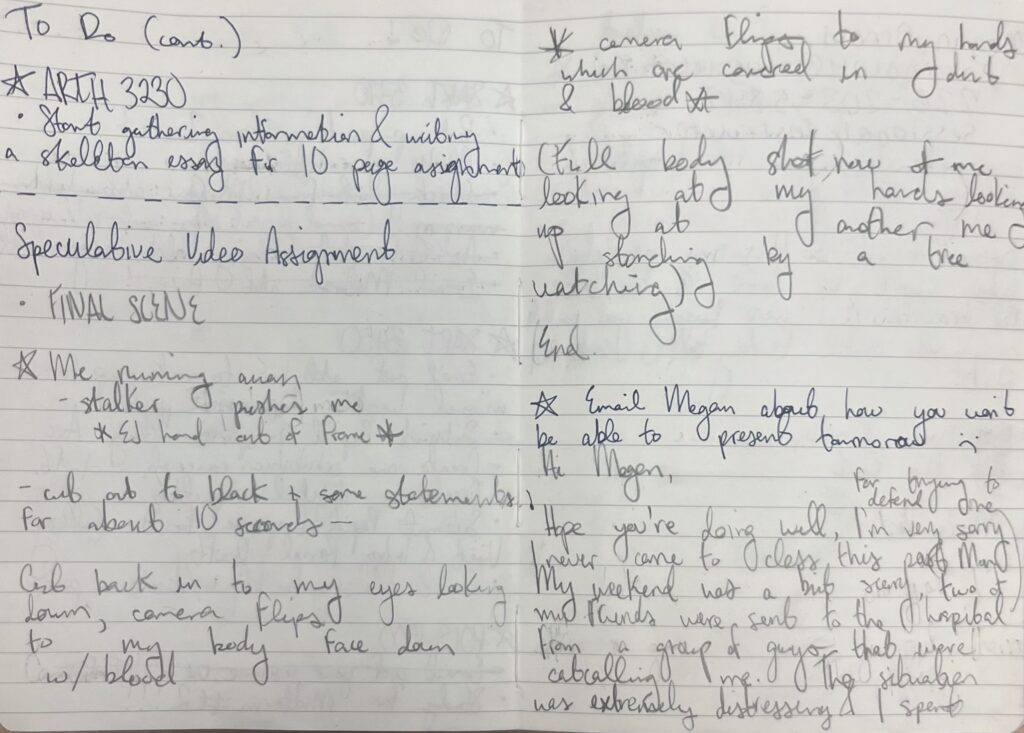
The idea at its base is me stalking me, except “stalker” me is a digitally rendered AI model, kind of like how those online disfigure and change themselves to fit the socially accepted beauty standard; except my form will be ever-changing and not-human at all times. I really want the film to be seen as something like “found footage” like the Blair Witch Project, or Incantation.
Final Scene Footage
✰ Planning of Final Scene
Artist Statement
The central concept can be described as me stalking myself. However, the “stalker” is not human. It is a digitally rendered, AI-generated version of my form—one that is constantly shifting, mutating, and refusing to settle into a fixed identity. This figure reflects how online selves are often manipulated to conform to socially accepted standards of beauty and legibility, yet never fully succeed in becoming “real.” Unlike a polished avatar, this version of me is intentionally unstable: disfigured, fragmented, and perpetually in flux. It exists in a space between the human and the non-human, between presence and absence. While the assignment didn’t go entirely to plan, and was honestly quite difficult to make, it still feels as if I’m able to see the fruits of my labour through the cinematography. I also made the artistic decision not to add a 3D image, even though I know it was one of the requirements for the video. After creating it, adding a 3D image anywhere in the video threw me off; it just didn’t feel right. It felt almost comedic, given the topic and the meaning I was trying to get across.