I aspire to do so many things. It always feels like my brain is moving so much faster than my body and that I can never accomplish everything I want to do. I get into paralysis, and end up not doing anything . There are so many skills I’ve always wanted to learn, but I never actually commit to them. I began this project with a desire to simply start somewhere, so I decided to choose one from the list: shuffling cards cool. My proposal emphasized play and curiosity, which ended up guiding the rest of my process.
As you might have noticed, if you’ve been observing the pristine state of the cards I’m holding, and assuming correctly that I wouldn’t buy a new deck (and therefore would stick to the same pack for my whole process), I have not learnt how to shuffle.
On paper, my topic was teaching myself the practical skill of shuffling cards and learning some tricks. In my practice, however, my mind was elsewhere. The part of my brain resisting action was being persistent and no part of me wanted to pick up those cards! So I decided to trust myself and venture elsewhere.
I stuck to my commitment to learn cardistry theory and ensured that even if the results of this exploration did not end in a perfect shuffle performance, my knowledge on the topic would be broadened and could contribute to future pursuits, whether this skill specifically or others. The research I’ve done has improved my understanding of my own core methodologies, how the wandering and reroutes I am always partaking in can become forms of research rather than obstacles to it. My experiences shape my desires and pleasures and therefore what constitutes play. I anticipated this in my initial proposal, encapsulating my entire point in its closing sentence, “I will surrender myself to the process!” I did in fact do that.
It’s also worth highlighting the things I have learnt and achieved in the process, even though they aren’t what I set out to do.
My primary goal was to understand, and I do. I now understand how essential wandering and play are to my methodologies. I learned how to recognize the value in my detours, According to the National Institute for Play (2025), play is actually a state of mind, one in which a person becomes absorbed, intrinsically motivated, and able to lose track of time. That description aligns so closely with how I experience my own creative process.
My methodologies centered play, and following my creative instincts without being constrained by predetermined outcomes. According to the Ontario Psychological Association (2025), play for adults can be “any activity that feels joyful, spontaneous, creative, or restorative. It can be structured or free‑form, social or solo, physical or imaginative.” Adult play is intrinsically motivated, focuses on the process rather than the outcome, and involves a non-serious approach to activities (Lubbers et al., 2023). This validates the way my detours have become part of my research.
Something these texts really emphasized was that all play means something, even when it looks like wandering or silliness, even when it looks like failure. This is hard to fully accept, to be honest. The Ontario Psychological Association notes: “The difference lies in intention and engagement. Is the activity leaving you more energized or more drained?” They also offer the reminder: “If you are feeling stuck, depleted, or disconnected, consider this a gentle invitation: make room for play”(2025). That sentiment guided my process.
The National Institute for Play describes a “play state” as a condition in which the brain’s mid-regions literally “light up,” sparking activation through wider neural circuits. Play actually engages multiple regions of the brain simultaneously, connecting emotional, cognitive, and sensory pathways. These “play circuits” are shaped by our individual development, emotions, and desires. Each of us has a unique way of entering a play state, informed by our personal experiences and what we find motivating and pleasurable.
One might say I “failed” to learn how to shuffle cards, but my research plan was achieved, and I was able to tell the narrative of my wanderings. I simply surrendered myself to a mode of working that felt authentic to me. And while I might not have mastered shuffling cards yet, my interest in cardistry has certainly deepened, and the theoretical knowledge I gained will likely make it more attainable the next time I have the incling to try.
That’s really what this whole course has been about for me, learning to trust my own artistic process in embracing an authentic process. Play nurtures imagination, experimentation, and problem-solving, pillars of experimental art. I want to see more purposeful incorporation of play in artist’s methodologies, to willingly surrender to the process, to be unafraid of wandering. We’re all doing that already by just being in this class, literally in the name isn’t it, “experimental”.
♠♣♥♦VIDEO♦♥♣♠
This video is a “shuffled” compilation of my wanderings (haha get it? the clips are out of order!) It shows seemingly mundane parts of life as moments of play that are essential to my wellbeing and largely contribute to my process. The things I see and learn along the way matter just as much !!!!
“Rosewater” by Enstancy (2021, July 26), Internet Archive:https://archive.org/details/in-substance-wnb76w.
⟿ artist statement ⬳
initial methodologies: entertaining uncertain futures, imagining ways of being, situating oneself within the universe .
What do I want? I didn’t expect to feel so hesitant to answer. When faced with such open ended possibilities the question felt overwhelming. I could certainly think of many things I did want, but would any of these options truly strengthen my will to imagine? Thankfully, speculation as a form of perseverance is something I’ve dabbled in before. #hopecore a familiar genre.
In imagining a different reality, I found it important to recognize systemic conditions and explore possibilities outside the constraints of normative structures. I wanted to focus on the inherent hope that comes with imagining the future, speculation as its own form or resistance. I thought of the media I have been consuming lately and their influence on my process. An Upstream podcast I listened to about degrowth, the aim to downscale production and consumption for environmental and societal reasons, basically preaches a “slowing down” of the economy. Fittingly, Timothée Parrique’s book on the concept is titled “Slow Down or Die”. These words struck me. It does feel like I’ll die if I don’t slow down. Agreeing with the leftist ideologies, I also drew on my own experiences of disability and productivity under capitalism. As a neurodivergent person in chronic pain, I constantly feel like I am overworking myself and exceeding my capacities and still can’t keep up. My deep need to slow down and have time to rest doesn’t change the fact that I have to keep going. In the brainstorm process for this piece, whenever I would try to think of the future all I could think about was how much pain my legs were in and how much I wanted to not be in that pain.The anti-capitalist and disability theory I was interacting with helped me conceptualize this and strengthened my imagination.
As a huge enthusiast of physical collage using various materials, I wanted to create a video collage using techniques already intuitive to my practice. This was done in my editing techniques, where I was only able to trudge through the horrors of editing a video because of this form of play: tinkering around as I wished and discovering how to create what I envisioned. I made myself a greenscreen situation where I could move around my dolls and limbs. I then keyed out the greenscreen very badly and edited the videos together, overlapping them over found footage and videos of myself sleeping in further collaging. The quality of the found footage I used recalls “slow media” to further emphasize slowing down, which also creates a visual aesthetic that is reminiscent and nostalgic. The forms of the overlayed limbs are visibly “deteriorating”, due to the awful key out, which represents the deterioration of my legs and deterioration in disability. My somewhat unpredictable level of pain and functioning is represented by the change in density and opacity of the doll limbs. When searching for the right sound to narrate my video, I came across vaporwave, a music genre that critiques consumerism and idealistic futures of capitalism. Not only did I find a song that felt right with my video and helped convey the calmness , it also aligns with and supports my concept, which I am pleased about.
My slow down or die is about disability, hope, and survival. It projects my pain in a way that I can externally fathom and helps me come to terms with resting.
⟿ speculation ⬳
I encountered many sources of subtle inspiration on my speculative journey. Simply consuming these forms of media involves them in the creation and conceptualization of this piece.
Eales, L., & Peers, D. (2021). Care haunts, hurts, heals: The promiscuous poetics of queer crip Mad care. Journal of Lesbian Studies, 25(3), 163-181.
Enstasy. (2021, July 26). Rosewater. https://archive.org/details/in-substance-wnb76w
Gates, C. (2007). VJ Clips of Deer – By Carrie Gates. In Internet Archive. https://archive.org/details/VjClipsOfDeer-ByCarrieGates
inquisitivebiologist. (2025, August 15). Book review – Slow Down or Die: The Economics of Degrowth. The Inquisitive Biologist. https://inquisitivebiologist.com/2025/08/15/book-review-slow-down-or-die-the-economics-of-degrowth/
Nature Therapy. (2013). Spring Video. In Internet Archive. https://archive.org/details/Flickr-8725131985
✷ SOUND OBJECT ✷
documentation
audio file
artist statement
When I was conceiving this project I felt really burnt out and overwhelmed, which made me drawn to exploring themes of comfort & calm to help in regulating myself. As often happens when I get burnt out, I found myself turned off by the idea of going on my phone, its loudness and overstimulation felt contradictory to how I was seeking to soothe myself with sound. I wanted a tool to access the serenity that sound has the ability to induce in me without being pulled to my phone for that. I knew the sounds I was searching for were already around me: white noise from the dryer running, the rain pouring down, my roommate playing guitar from his room, these are the ambient noises I really wanted to be listening to to make me feel better. The personal context of these ambient noises is what really was able to reach me and ease my mind. I decided to create something I could hug and hold and listen to that would keep these sounds safe for me.
I remembered an instagram reel of a coding project with sound, and I got really interested in the idea of doing something similar. In my research, I looked into Eirik Brandal, who makes electronic sound sculptures using circuits. Reading about his practice really inspired me to develop this idea further, and I latched onto learning how to code for this. He purposely uses the word “craft” to describe both music composition and circuitry, components that make up his electronic sound sculptures. He points out the gap between his pieces and the most traditional interpretation of the word “crafts”, but that their process and methods of creation have similarities. This stood out to me as a big “craft” enthusiast and advocate myself. I decided the perfect way to create a vessel for my soothing sounds would be sewing one by hand, a hobby of mine I’ve been neglecting lately that can also be considered a craft. I was also thinking about how the word “craft” often has negative connotations in the art world, and I wanted to oppose that by creating this piece of art in the craftiest way I could. I’ve already been using the word “craft” more as a word to describe a lot of my art, not in the reductionary way like it is often done, but in a fond way, because crafts are valid as a form of art.
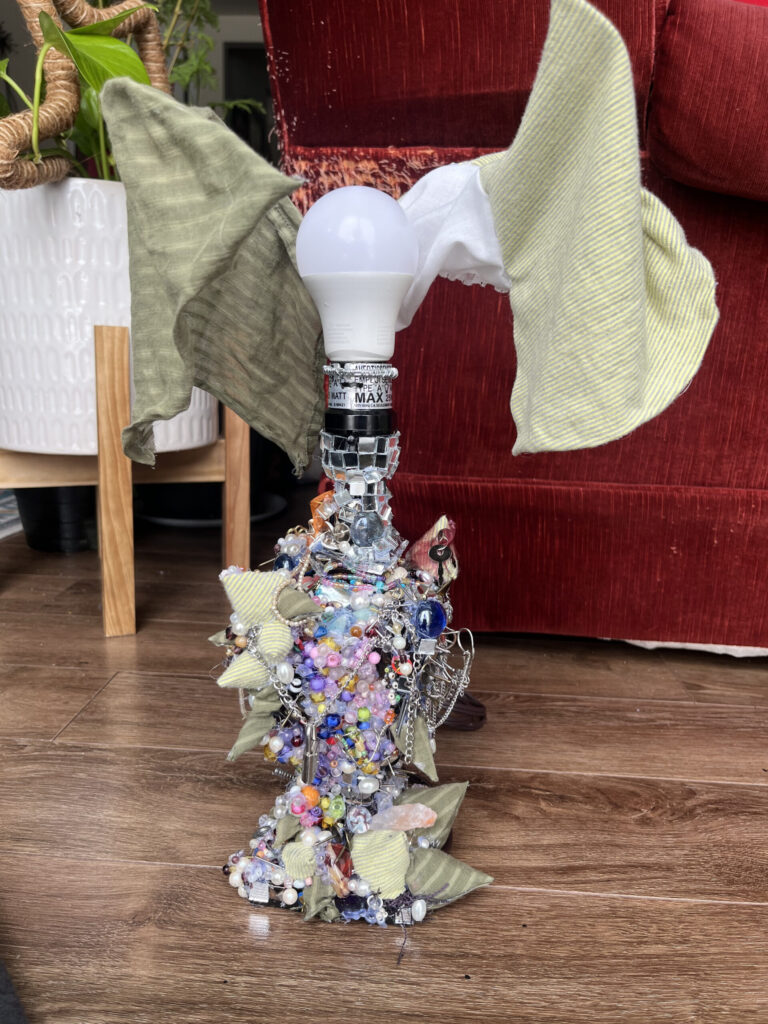
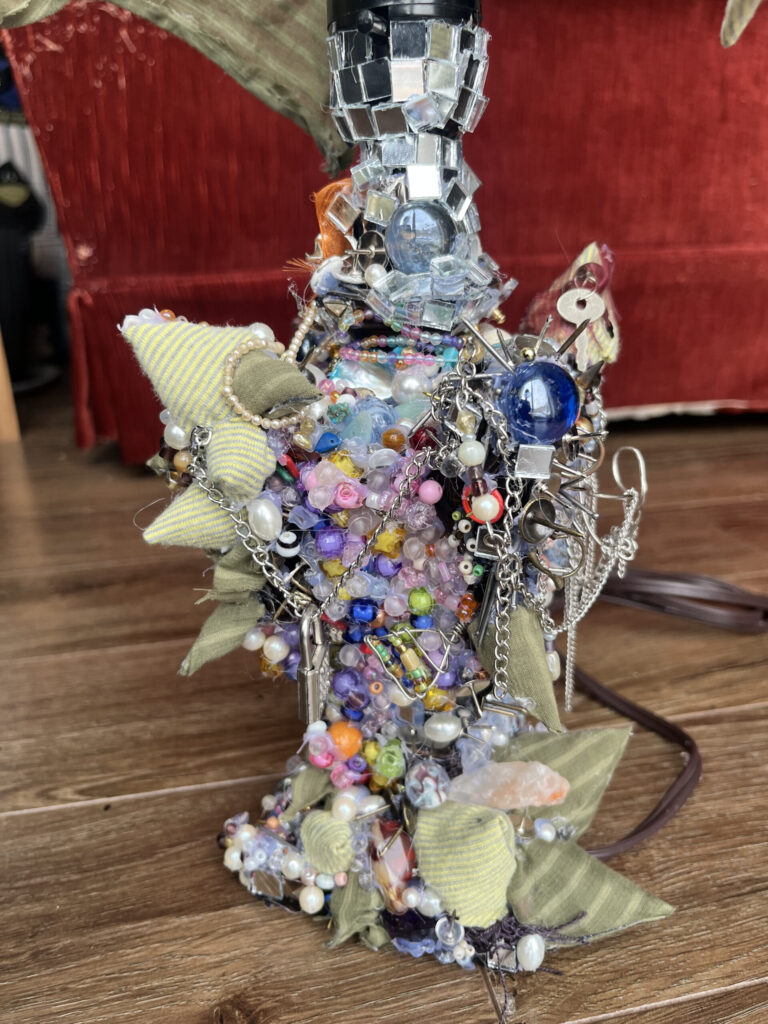
I wanted to make a doll that could represent a part of me somehow. At first I was considering making a simple but recognizable version of myself, but this became more abstract as I thought of comforting sounds and how they make my body feel. I didn’t feel like this needed to be confined to the limits of interpretable human form. While brainstorming, I wrote down terms like “whimsical looking”. “tree like” and “dream me”. I scoured my scrap fabric collection for the right patterns and textures. Because of this, each scrap has its own story and memories, which is something I love about reusing materials. I could provide so much background for each different fabric used by just looking at it or touching it, they have each had long lives with me and before me. In this way, this piece is an assembly of parts of my life in the form of recollections and visible wear that succeeds in making up a version of me.
Eirik Brandal critiques the “finished product” and linear process that in digital design and composing, and he talks about the importance of following a workflow that is more aligned with your artistic visions. As I was creating the doll, I let my instincts guide me and I made every decision in the moment. I had a vague sketch of shapes, and a conceptual vision, but no plan or concrete rules for myself. I let myself create. I didn’t want to worry about neatness or perfection, I simply let myself be enveloped by the process. It kind of became like a fidget toy in a way, I was so unworried in my sewing that it was actually relaxing, so it became a take with me everywhere kind of thing. I sewed on the bus, in class, on my break at work, while waiting for water to boil, in bed, basically wherever I went. The hurriedness and roughness of my stitches makes the process remain visible in its “final” form. I really only stopped working on this for the assignment’s sake, I felt like I could have kept going for weeks, so that may be what I do, I don’t think it ever necessarily needs to be a closed project. It feels like the type of thing I want to just keep customizing and adding onto as I feel like it. But who knows, I’ve gotten attached to it’s current form now. I think the result of this feels very me, which is exactly what I had hoped for. It does its job in representing a part of me despite not being a literal human form, whether that be from the process it took to create it, the memories the materials hold, or the time and care dedicated to it.
The aspect of coding remained important to me conceptually throughout the development of the project, and I was determined to learn how to do this. I started watching as many youtube videos as I could, taking notes and researching different circuit & coding parts as I went. I needed the parts fast, and I didn’t want to have to purchase them, especially because the only accessible thing that was coming up in my search was amazon, which I did NOT want to succumb to. I was looking at what they had to lend out at the public library, but they only had a large selection of other things(https://www.guelphpl.ca/en/collections/library-of-things.aspx). Although they do have a few coding kits to lend out, they didn’t have what I needed. Far too deep into my search is when I finally came across the UofG Engineering Equipment Library. I was shocked it took me so long to find, something right on campus?! This was perfect, they had almost every part I needed and I could borrow them accessibly for free and support this great service! So I placed a reservation (any student can do this at any time btw, there is so much stuff you can borrow that is so cool, they have a website you can browse & reserve on https://geel.myturn.com/library/).
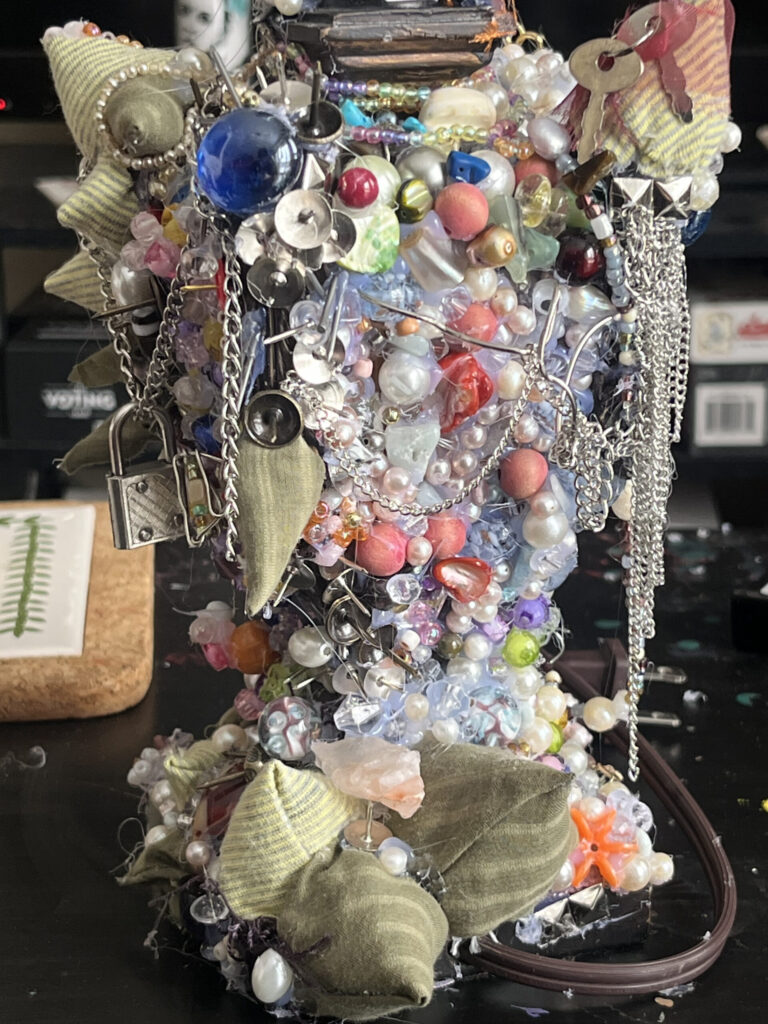
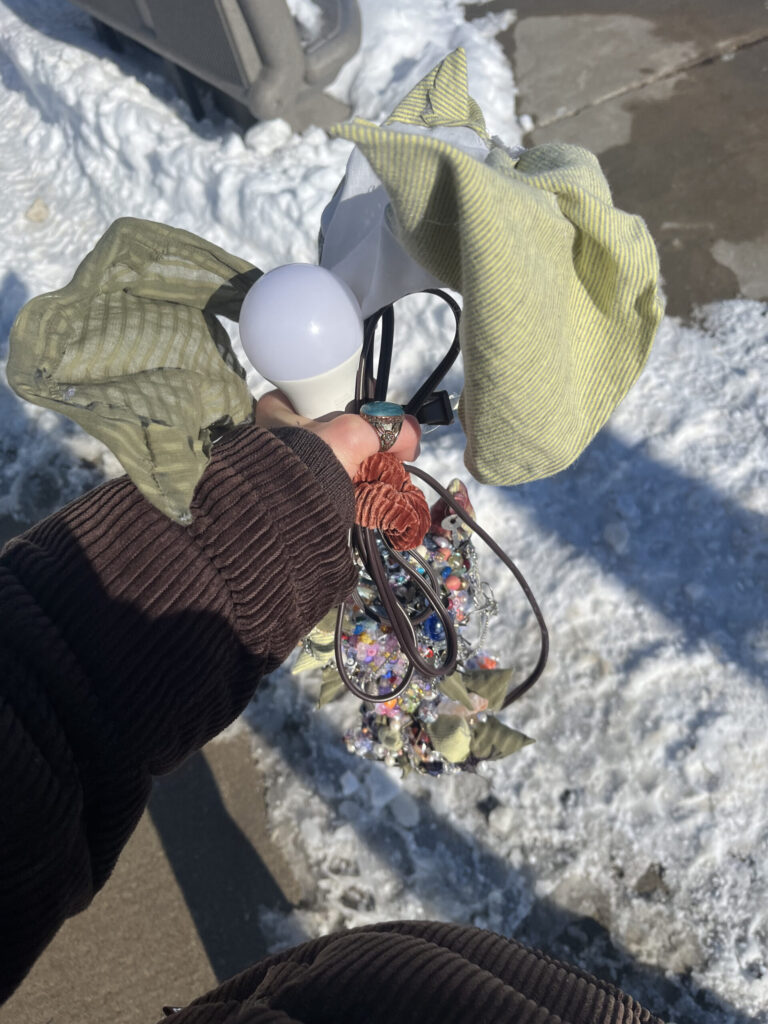
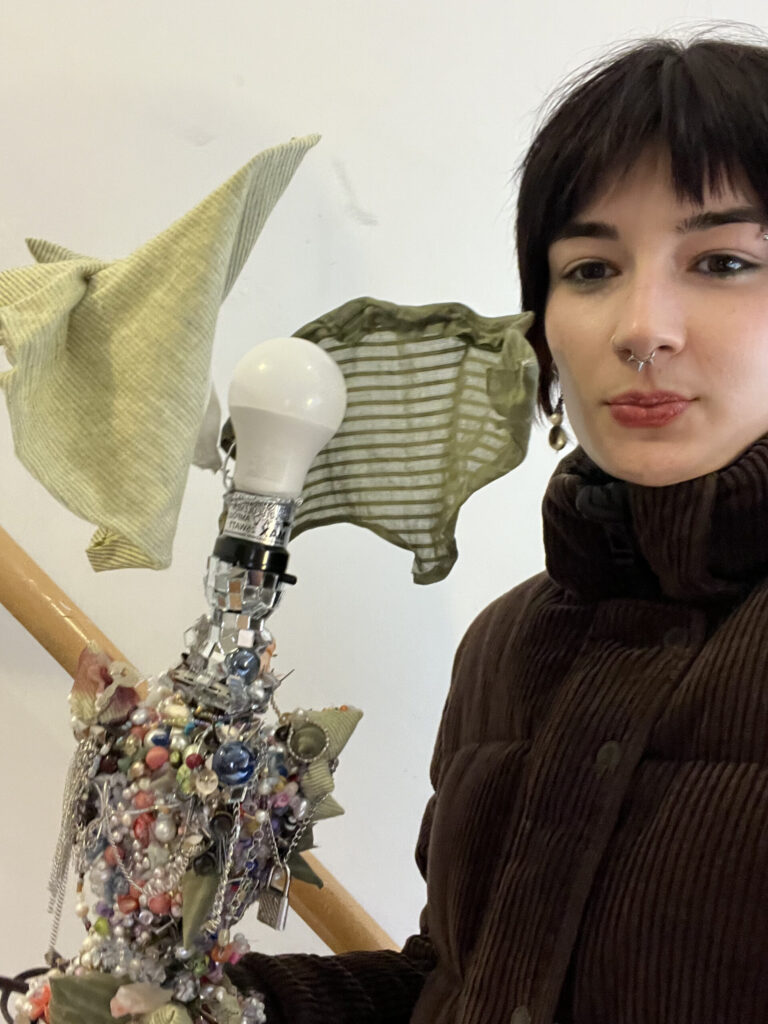
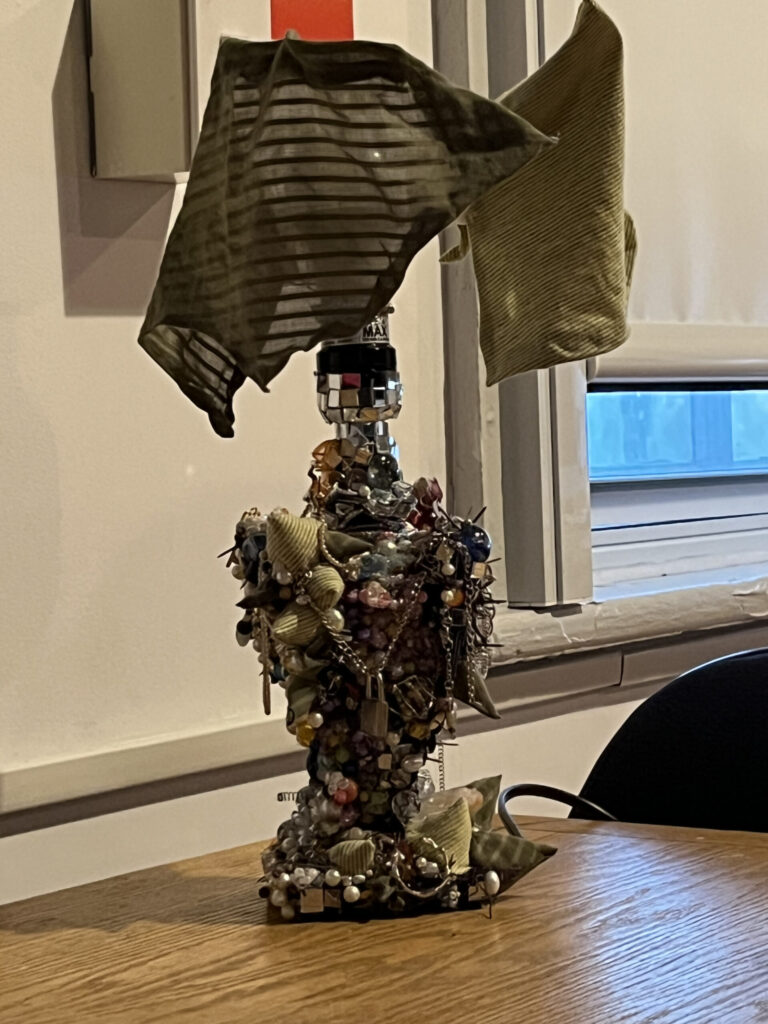
little bag that my supplies reservation came in !!the final version that should have worked ;(
I found out that my coworker, Tristan, is in an engineering masters program, so I asked him about my project. He was enthusiastic to help, even doing his own research for my plan and sharing it with me. We agreed to meet up and try to figure out the coding, so I met him in the engineering building on campus, where he brought me to a floor for masters students only accessible by keycard. He even brought his own notes and some supplies he had that he thought could contribute. I still hadn’t been able to acquire all the parts I needed yet, but with his knowledge we were able to assemble what we could.
He left me with simple instructions on how to connect the rest and I felt confident. I ran into a few issues on the way, what batteries to get (there are so many batteries, why are none of the batteries the one I need?), connecting batteries to each other or to wires without the proper tools or materials (what do you mean I can just make my own custom battery voltage?), soldering for the first time (using my roommate’s janky half broken soldering iron that he left a dozen warnings with… I was definitely scared & it was a frustrating process but it left me feeling inspired by its possibilities). I even electrocuted myself slightly but I accept that as a part of learning.
I was feeling confident. But, once everything should have been completed and good, something still wasn’t working! I spent hours trying to figure it out, Tristan was texting me excellent instructions, and when it still wasn’t working, he came to the rescue again and offered to take a look himself. We met up again, and this time he brought another engineering masters student to help. So me and these two engineering masters students get to work trying to figure out my project. We were very tight on time, but we were able to test each component to try to find the problem. When we thought the speaker was the issue, Tristan came prepared, and pulled out an old speaker of his he brought to take apart in case we needed it. He was really committed to helping me. We tried so many different solutions, as engineers do, but time was ticking. Unfortunately, we weren’t able to make it work with the time we had, there was likely an issue with connections or the main module. Even though coding didn’t make it into the current state of my creation, it definitely was part of the process and creation of this piece. I had a lot of fun working on this with my coworker and we have definitely gotten much closer during this. That alone makes all the hours and hours dedicated to it worth it. Anyways, I was able to prove to myself that I could learn how to code, even without the planned outcome. It was really really fun, I want to see if Tristan wants to do another coding project just for fun with me. This has inspired me to pursue more things outside of my usual areas, I want to learn so many things.
It was time to scramble to find a solution, so I went to Nathan. The piece was still conceptually secure without the side quest of learning about electrical engineering, so I just needed to find something to play sound fast that required minimal effort and time. I was able to borrow an iPod from Nathan that I just had to figure out how to conceal and be able to play and pause my sound. I sewed it closed in a fabric pouch made from an old sock to conceal it where I was able to still click the volume buttons to use as controls.Things actually lined up so perfectly for this, the way I had built the doll made it so easy to place the iPod in the most ideal place for concealment, secureness, and access. Everything came together, and I’m so proud of my creation and every part of the process. The iPod is easily removable from the doll and the potential for audio is very open ended. Once I have to return the Ipod to Nathan and the circuit supplies to the EEL (https://geel.myturn.com/library/), I will choose a replacement way to play my sound. I come to the end of this project feeling impassioned and eager. I want to create so many things. I feel like this has strongly influenced my practice, and I’m very excited to continue working with textiles and sewing similarly.
I started cutting my own bangs in my late teen years, something that is hard to avoid when you have bangs, but it quickly also became a grounding strategy for me. My bangs became an outlet in times of distress, and the precise maintenance task became synonymous with regaining a sense of control. Nowadays, I do all of my own haircuts. I know what I want, and I don’t like booking appointments, so I don’t see that changing anytime soon. Even more so, cutting my hair is often a way for me to cope with intense and unpredictable emotions and disregulation. Amidst feeling like everything is out of control, it is a small change I can make that feels significant in regaining a sense of self.
My hair cutting sessions are often very cathartic and consuming, and have been cemented as an important ritual of mine. I wanted to convey the quiet intensity and swaying unpredictability that consumes me in these moments in video form. To do this, I recorded myself cutting my hair, letting myself follow my instincts and purposefully capturing signature behaviours that reach a nearly satirical, yet realistic, form. I delved further into satire by exaggerating the editing to make it extra horrific and to continue balancing this dichotomy. The fallen hair is used to emulate the abjection of mental disorders and the accompanying loss of identity, and its stubborn presence on my skin conveys their recurring haunting.
In terms of sound, my lovely friend Ffi composed a mix of string sounds to sound like thrilling screeches to solidify the aspects of discomfort and fear. I deliberately placed these sounds over key visual moments to emphasize the link between the abject portrayal of my hair and the anxiety inducing sounds. In contrast, soft ambient sounds are concealed in the background that strengthen and slowly reveal themselves towards the end to signify strength and hope. Additionally, the original video audios are still heard faintly throughout, which conveys a humanity that reveals itself and grounds you. It asserts control and becomes evidence of identity persisting.
-ˋˏ✄┈┈┈┈score
The score shows how unpredictable and extreme my emotions are by graphing the fluctuation of my performance. Although this mapped instability may seem exaggerated when pulled from such a short timeframe, its form is representational of the broader scope of my mental turbulence.
-ˋˏ✄┈┈┈┈moments of magic
happy ffi, happy meblack tomatoes !!!!grapes we foraged
♣ SYMPOSIUM PROPOSAL ♣
There are so many skills that I have been wanting to commit to learning but never actually dedicate my time to, so I will go on a journey and document the process of teaching myself how to shuffle cards really well and learn some tricks! To do this, my research plan is to watch several youtube tutorials, to look into threads and posts on the topic, to attempt to find (and maybe join) online groups, and to conduct more complex research into technical theory. I want to dive deep into the how of this skill, I really want to comprehend how it’s done from the perspectives of different types of knowledge. Apart from that, the bulk of the research will be me practicing a lot. I’m committed to learning things that are outside of my regular wheelhouse, like math and physics. In shaping my performance, I want to find the right balance between the academic aspects of this project and my vision artistically. The structure of my presentation will attempt to tell a narrative of my wanderings and share what I have learned. I plan to not only include my successes and advancements, but also my failures and reroutes. It will likely consist of documentation of my progress, including practice videos, research and notes, and anything else I deem relevant. I will also have a demonstration of my newly acquired skills so I can show off (hopefully! If I fail it might be good art anyways so we’ll be okay). I think everyone should try to dedicate more time to learning random impressive skills, so I hope to inspire audience members to take on similar projects of their own. I think that seeing another person’s process for something makes the thing a lot less intimidating and gives it a conceivable starting point, which is definitely very beneficial for me, so I hope this has similar effects. I want my process to seem like an impressive thing I was able to accomplish, but I also want it to feel accessible and for audience members to think “oh wow I could do that!” If I am a natural and get the hang of it too quickly, I will complicate my goals to make sure the final presentation is still substantial and interesting. This could be challenging myself to learn even more elaborate tricks with the cards, or pursuing it from a different angle completely. I will surrender myself to the process!
I was definitely intimidated by the 44 page pdf at first, and I went in truly not knowing what to expect, but I really enjoyed reading Guillermo Gómez-Peña’s Brownout 2. I loved the absurdity of even just the prop list, and finding out what each one is used for as the performance goes on. I found it interesting how differently we experience the piece by reading it & having to picture the performance, yet even just the typed up words are so full of emotion and meaning. I like how the texts are written in first person and become somewhat like journal entries, even when spoken aloud and put on display for an audience. So many specific phrases delighted me and stuck with me from the performance script, as well as from Elaine Katzenberger’s introduction to the piece. I wrote them all down in my notebook, but I will only mention some here. “[…] faced the possibility of having to adjust permanently to what seemed like a puritanically disciplined and bland existence” (188). This wording struck me because of how familiar this fear feels. It must be particularly difficult for someone like Gómez-Peña to have such a drastic and sudden change in pace to his previous level of activity and production. Another impactful question asked is “what happens when an artist loses the medium used as expression?” (188). Again, I recognize the fear in these words. It certainly makes sense to me in an artistic context, but this concept seems pretty universal to me as well. It reminds me of when sports players get injured and have to stop playing their sport. They are losing their outlet!
Gomez-Pena, Guillermo. Ethno-Techno : Writings on Performance, Activism and Pedagogy, Taylor & Francis Group, 2005. ProQuest Ebook Central, http://ebookcentral.proquest.com/lib/uoguelph/detail.action?docID=243173.