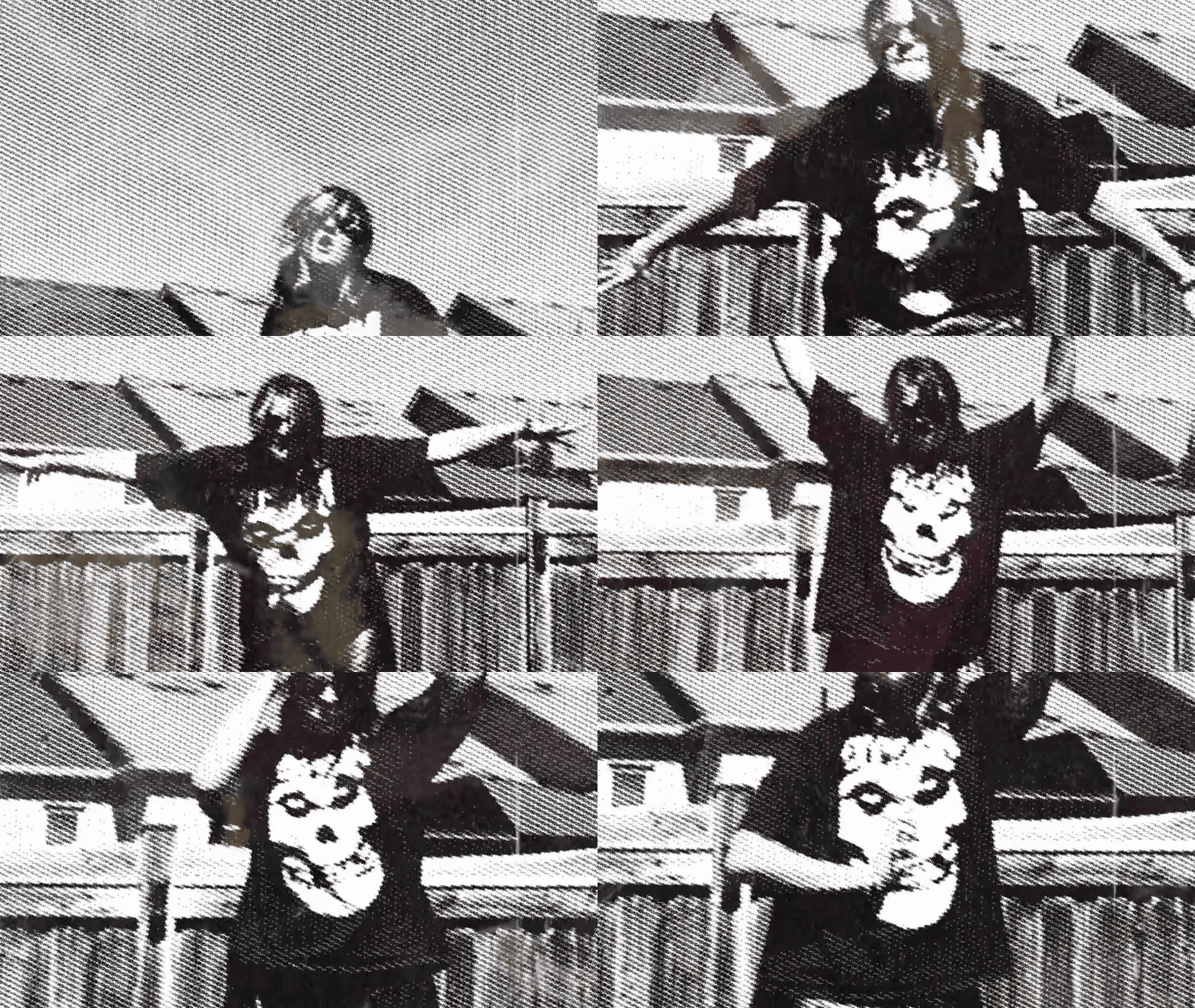
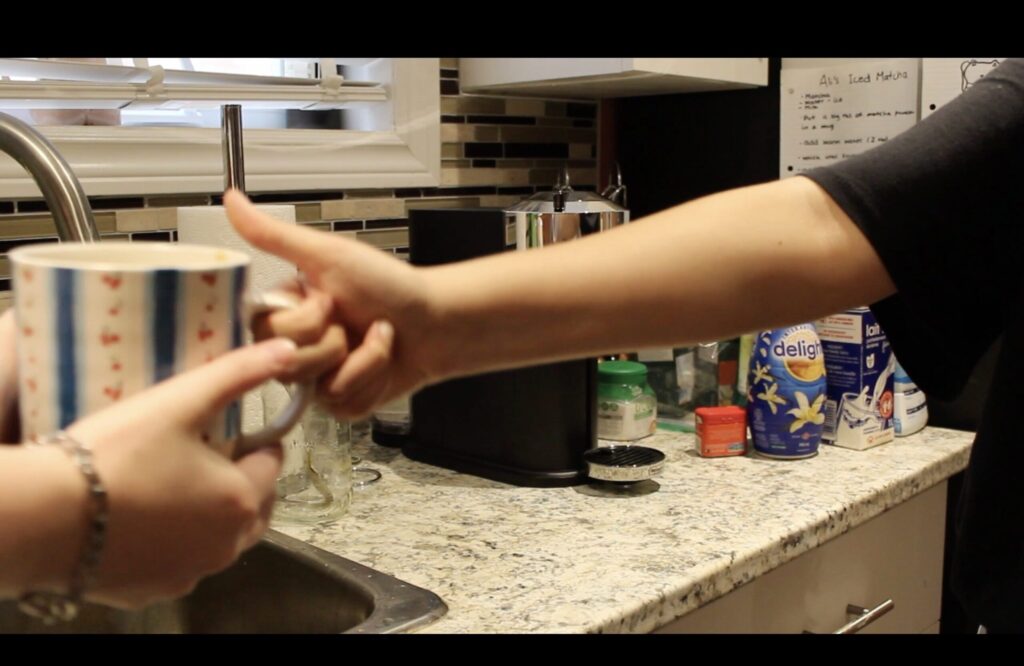
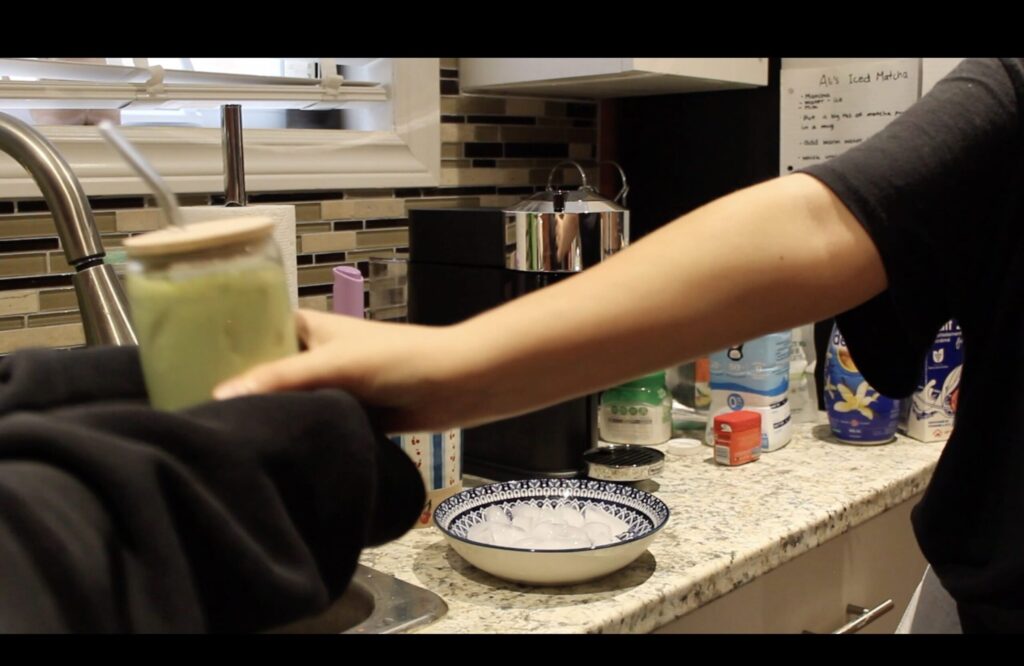
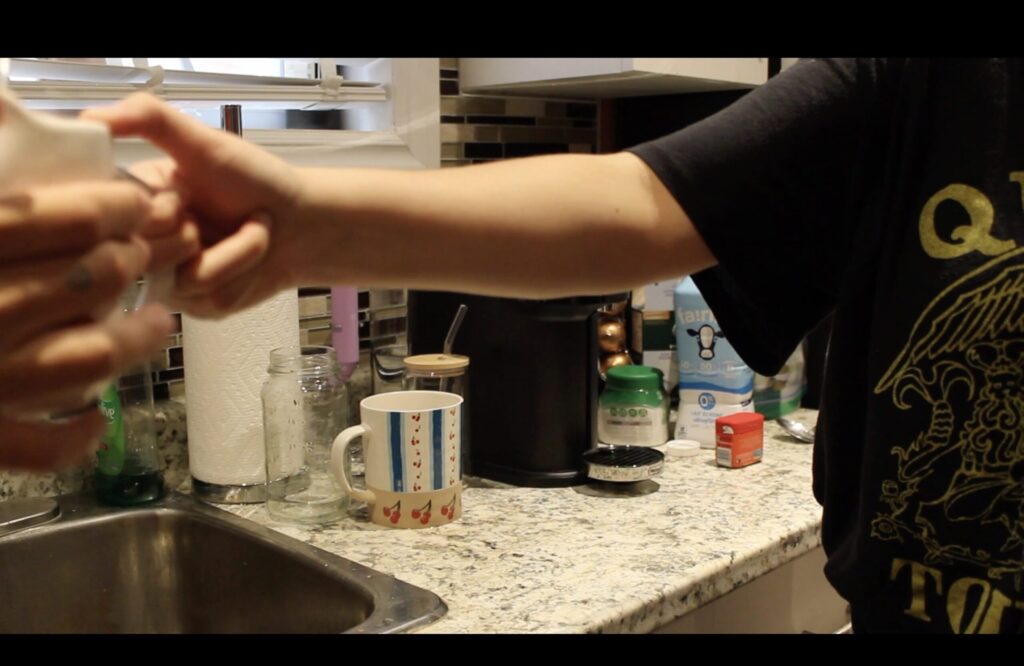
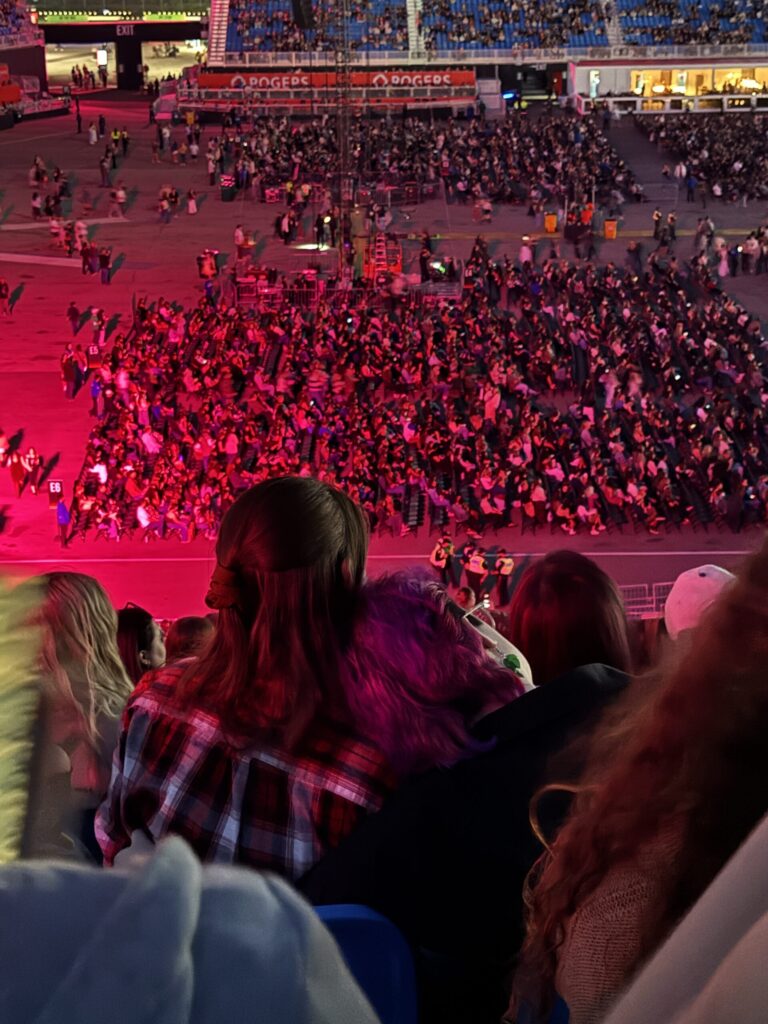
Script: Ride the bus. Keep bag on your lap. Lift and set down the bag at every stop.
Artist’s Statement:
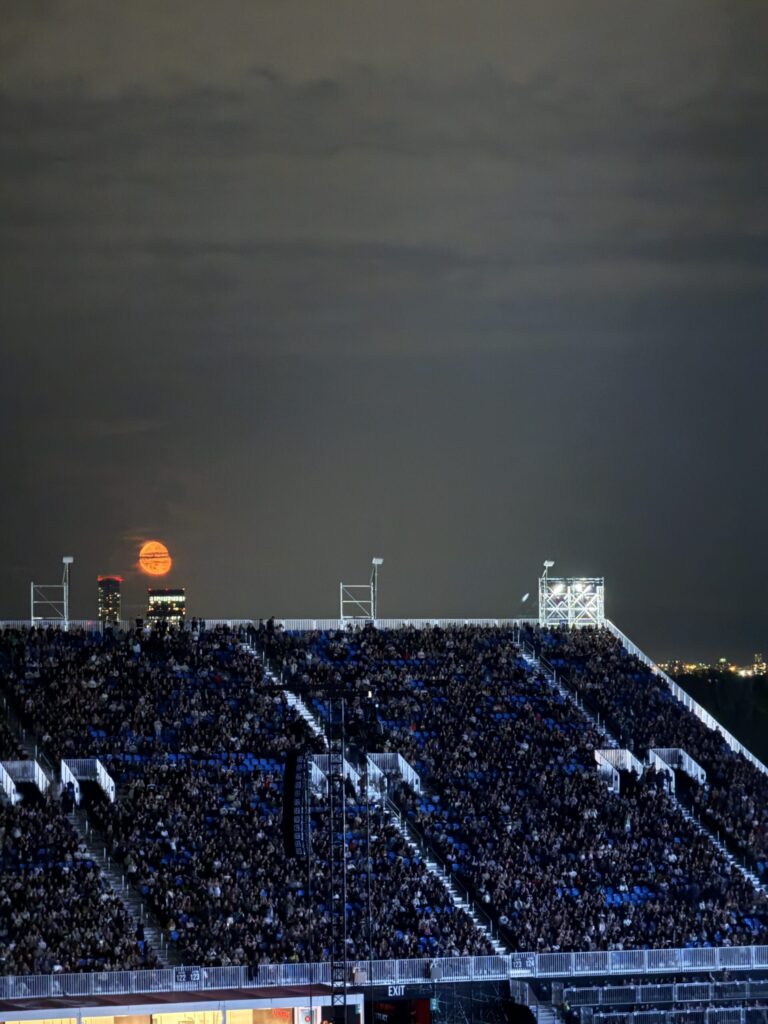
My commute typically involves me zoning out, staring at my phone or out the window, or mentally preparing for classes or homework. I interrupted this dissociative ritual of my commute by the intermittent displacement and replacement of my bag, which normally I keep on my lap. This process was an attempt to reground myself into the physical and auditory environment of the GO bus. Weight or pressure on the body is a technique known as deep pressure therapy, meant to engage the parasympathetic nervous system (known for it’s “rest and digest” function, in contrast to the sympathetic nervous system’s “fight or flight”). I found it difficult to break from my routine of ignoring my surroundings and instead focusing on the movements and sounds of the bus slowing down and stopping. Since there is only ever two formal bus stops on my route, I decided to interpret the script as every time the bus physically stopped, such as at a light or due to traffic. The audio format I chose to capture this ritual in helps to demonstrate the efforts of paying attention to one particular sense. Along with being able to hear the sound of the engine and people quietly talking, it captures the rustling and occasional click or tap of the bag moving against me and the side of the bus as I raised and lowered it.
Moments of Magic:
Sound Object – elastic fort
Planning Sketches!Testing the stretchiness of the resistance bands, and the difference in sound when they were folded.
I wasn’t one of those kids who couldn’t wait to be an adult, I enjoyed my childhood and was not eager for change. For this project, I wanted to create an instrument that engages with nostalgia, and was thinking about sound and memory as two things that are incredibly difficult to contain. I decided to enlarge an instrument I made many times over my childhood, a tissue box guitar. Entering the object physically is in a way attempting to re-enter the past, and I considered both a helmet version and the larger, full body box I ended up choosing. This larger design reminded me of forts I made as a child, and overall felt that it would facilitate a more transportive experience. I wanted to limit my materials and use tools and objects I already owned, the duct tape and exercise resistance bands, and using a base that is ultimately not permanent and is destined for the recycling. I didn’t want to be precious or sophisticated with the construction of the object, instead focusing on having fun with it and engaging with a less stressful way of creating. The sound the instrument makes is different from the classic tissue box guitar, it is deeper, harder to play, and (somehow) even less consistent with the noises it produces, mirroring how memories distort and change over the years. The instrument seeks to take the player back to an earlier space, but cannot do it exactly in the right way.
Symposium Bibliography
Dövencioglu, Dicle N., et al. “Seeing through Transparent Layers.” Journal of Vision (Charlottesville, Va.), vol. 18, no. 9, 2018, p. 25, https://doi.org/10.1167/18.9.25.
Gislén, Anna, et al. “Visual Training Improves Underwater Vision in Children.” Vision Research (Oxford), vol. 46, no. 20, 2006, pp. 3443–50, https://doi.org/10.1016/j.visres.2006.05.004.
Horváth, Gábor., editor. Polarized Light and Polarization Vision in Animal Sciences. 2nd ed. 2014., Springer Berlin Heidelberg, 2014, Ch. 1, 5, 7-10, 14, https://doi.org/10.1007/978-3-642-54718-8.
Sinclair, Kai. “Watch the Secret to a Squid’s Crystal Clear Underwater Vision.” Science (American Association for the Advancement of Science), 2017, https://doi.org/10.1126/science.aan7226.
Tanchez, Ashley. Series of Experiments Involving Water. October- November, 2025.
Speculative Video – Your Brain & Migraine ASMR (relaxing) (tapping)
This concept came about as I was trying to sleep. Why I keep a notepad on my nightstand! It ssasy”Speculative Fiction / ASMR Migraine vs. No migraine spec. video / buy or make brain thing and make noises on it using “bad” or “good” objects”Before I baked the brain (made out of Sculpey)Post baking, added darker pink paint in the folds and lots of shiny sealantAbout to film!
The concept came from speculating what it would feel like to have what was a thirty second pause in migraine symptoms be a complete end of them. In order to convey the absence of pain I felt it was necessary to also represent the pain, as the contrast would help make the difference more significant, and also relay a narrative. The ties to ASMR mainly came about from the noise sensitivity that occurs as a part of migraine, and my original observation that the lack of pain in those thirty seconds felt like “a nothing head” which upon research became tied to the relaxing, calming environments ASMR artists advertise in their videos. Inspiration also arose from Lizzy Rose’s Sick, blue sea, and the expression of an illness with an internet-y medium such as a Tumblr blog. I wanted to also include a sense of the passage of time, which I chose to do with a calendar feature on my phone, which can be to count down to or up from an event. The screenshots for days 590-595 were captured authentically, but for the ones before that I changed the date of the event to lower the number and edited the correct date overtop. This video was really an interesting experience personally, as I found that my own feelings about an end of migraine pain has changed significantly since the thirty second pause. It can be tempting to think about consistent pain as something that has an achievable ending, that you can picture yourself without one day, in many cases due to not always having it. With a chronic condition, I found that excessively hoping for a full ending of pain (even though hope can be a very nice thing!) can be more damaging than helpful, and recognition and a level of acceptance of one’s current state is a key part of living in the present. Rather than putting off things for a time I feel completely better, it has become important to seize and make the most of the easier moments between the more difficult ones. This speculative video process was pretty cathartic, and was an interesting way of exploring a possibility, to wonder about but not waste life waiting for.
I didn’t follow the script exactly, I mainly used it as a guide throughout my presentation! Here are some extra behind-the-scenes stuff:
Planning post-its: Left, planning the test sheet “frustration level / If I felt like a squid / Distortion level”, Right, list of potential lenses “Water experiments: sparkling, ice, puddle, mist, regular(sink?) tap water, steam, “rain” through shower, hot tub/pool”Clip from the making of the graphics for the test sheet. Squid image traced from:https://stock.adobe.com/images/squid/16755541Breaking off chunks of the ice lens in order to collect the sample!I have so many pictures of the collection of the steam sample… the majority of the droplets were gathering on the outside of the glass jar rather than the inside, which was super fun.Another slightly chaotic moment– I managed to balance the Tupperware and my phone to take the picture, but it was a close call!Just after the collection of the final three samples — I like that the bubbles from the sparkling water specimen are very visible here.Waiting for the teeny water droplets to dry!Taking a closer look at steam, at 24 times magnification! Each sample has at least one x30 and x24 image, and then I picked which one to display based on image quality and visual interest! The microscope was a later addition to my symposium, but I’m glad I got to take a closer look at the different samples I collected, and I feel that it tied in well with the silly science-y tone!
I aspire to do so many things. It always feels like my brain is moving so much faster than my body and that I can never accomplish everything I want to do. I get into paralysis, and end up not doing anything . There are so many skills I’ve always wanted to learn, but I never actually commit to them. I began this project with a desire to simply start somewhere, so I decided to choose one from the list: shuffling cards cool. My proposal emphasized play and curiosity, which ended up guiding the rest of my process.
As you might have noticed, if you’ve been observing the pristine state of the cards I’m holding, and assuming correctly that I wouldn’t buy a new deck (and therefore would stick to the same pack for my whole process), I have not learnt how to shuffle.
On paper, my topic was teaching myself the practical skill of shuffling cards and learning some tricks. In my practice, however, my mind was elsewhere. The part of my brain resisting action was being persistent and no part of me wanted to pick up those cards! So I decided to trust myself and venture elsewhere.
I stuck to my commitment to learn cardistry theory and ensured that even if the results of this exploration did not end in a perfect shuffle performance, my knowledge on the topic would be broadened and could contribute to future pursuits, whether this skill specifically or others. The research I’ve done has improved my understanding of my own core methodologies, how the wandering and reroutes I am always partaking in can become forms of research rather than obstacles to it. My experiences shape my desires and pleasures and therefore what constitutes play. I anticipated this in my initial proposal, encapsulating my entire point in its closing sentence, “I will surrender myself to the process!” I did in fact do that.
It’s also worth highlighting the things I have learnt and achieved in the process, even though they aren’t what I set out to do.
My primary goal was to understand, and I do. I now understand how essential wandering and play are to my methodologies. I learned how to recognize the value in my detours, According to the National Institute for Play (2025), play is actually a state of mind, one in which a person becomes absorbed, intrinsically motivated, and able to lose track of time. That description aligns so closely with how I experience my own creative process.
My methodologies centered play, and following my creative instincts without being constrained by predetermined outcomes. According to the Ontario Psychological Association (2025), play for adults can be “any activity that feels joyful, spontaneous, creative, or restorative. It can be structured or free‑form, social or solo, physical or imaginative.” Adult play is intrinsically motivated, focuses on the process rather than the outcome, and involves a non-serious approach to activities (Lubbers et al., 2023). This validates the way my detours have become part of my research.
Something these texts really emphasized was that all play means something, even when it looks like wandering or silliness, even when it looks like failure. This is hard to fully accept, to be honest. The Ontario Psychological Association notes: “The difference lies in intention and engagement. Is the activity leaving you more energized or more drained?” They also offer the reminder: “If you are feeling stuck, depleted, or disconnected, consider this a gentle invitation: make room for play”(2025). That sentiment guided my process.
The National Institute for Play describes a “play state” as a condition in which the brain’s mid-regions literally “light up,” sparking activation through wider neural circuits. Play actually engages multiple regions of the brain simultaneously, connecting emotional, cognitive, and sensory pathways. These “play circuits” are shaped by our individual development, emotions, and desires. Each of us has a unique way of entering a play state, informed by our personal experiences and what we find motivating and pleasurable.
One might say I “failed” to learn how to shuffle cards, but my research plan was achieved, and I was able to tell the narrative of my wanderings. I simply surrendered myself to a mode of working that felt authentic to me. And while I might not have mastered shuffling cards yet, my interest in cardistry has certainly deepened, and the theoretical knowledge I gained will likely make it more attainable the next time I have the incling to try.
That’s really what this whole course has been about for me, learning to trust my own artistic process in embracing an authentic process. Play nurtures imagination, experimentation, and problem-solving, pillars of experimental art. I want to see more purposeful incorporation of play in artist’s methodologies, to willingly surrender to the process, to be unafraid of wandering. We’re all doing that already by just being in this class, literally in the name isn’t it, “experimental”.
♠♣♥♦VIDEO♦♥♣♠
This video is a “shuffled” compilation of my wanderings (haha get it? the clips are out of order!) It shows seemingly mundane parts of life as moments of play that are essential to my wellbeing and largely contribute to my process. The things I see and learn along the way matter just as much !!!!
“Rosewater” by Enstancy (2021, July 26), Internet Archive:https://archive.org/details/in-substance-wnb76w.
⟿ artist statement ⬳
initial methodologies: entertaining uncertain futures, imagining ways of being, situating oneself within the universe .
What do I want? I didn’t expect to feel so hesitant to answer. When faced with such open ended possibilities the question felt overwhelming. I could certainly think of many things I did want, but would any of these options truly strengthen my will to imagine? Thankfully, speculation as a form of perseverance is something I’ve dabbled in before. #hopecore a familiar genre.
In imagining a different reality, I found it important to recognize systemic conditions and explore possibilities outside the constraints of normative structures. I wanted to focus on the inherent hope that comes with imagining the future, speculation as its own form or resistance. I thought of the media I have been consuming lately and their influence on my process. An Upstream podcast I listened to about degrowth, the aim to downscale production and consumption for environmental and societal reasons, basically preaches a “slowing down” of the economy. Fittingly, Timothée Parrique’s book on the concept is titled “Slow Down or Die”. These words struck me. It does feel like I’ll die if I don’t slow down. Agreeing with the leftist ideologies, I also drew on my own experiences of disability and productivity under capitalism. As a neurodivergent person in chronic pain, I constantly feel like I am overworking myself and exceeding my capacities and still can’t keep up. My deep need to slow down and have time to rest doesn’t change the fact that I have to keep going. In the brainstorm process for this piece, whenever I would try to think of the future all I could think about was how much pain my legs were in and how much I wanted to not be in that pain.The anti-capitalist and disability theory I was interacting with helped me conceptualize this and strengthened my imagination.
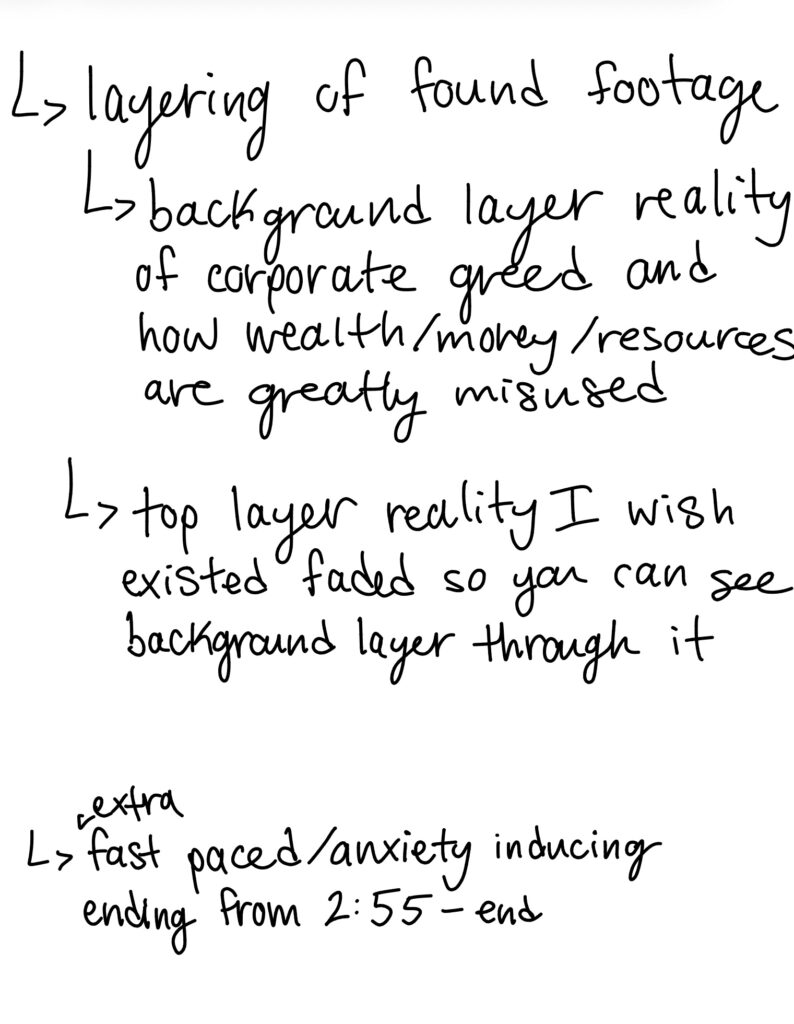
As a huge enthusiast of physical collage using various materials, I wanted to create a video collage using techniques already intuitive to my practice. This was done in my editing techniques, where I was only able to trudge through the horrors of editing a video because of this form of play: tinkering around as I wished and discovering how to create what I envisioned. I made myself a greenscreen situation where I could move around my dolls and limbs. I then keyed out the greenscreen very badly and edited the videos together, overlapping them over found footage and videos of myself sleeping in further collaging. The quality of the found footage I used recalls “slow media” to further emphasize slowing down, which also creates a visual aesthetic that is reminiscent and nostalgic. The forms of the overlayed limbs are visibly “deteriorating”, due to the awful key out, which represents the deterioration of my legs and deterioration in disability. My somewhat unpredictable level of pain and functioning is represented by the change in density and opacity of the doll limbs. When searching for the right sound to narrate my video, I came across vaporwave, a music genre that critiques consumerism and idealistic futures of capitalism. Not only did I find a song that felt right with my video and helped convey the calmness , it also aligns with and supports my concept, which I am pleased about.
My slow down or die is about disability, hope, and survival. It projects my pain in a way that I can externally fathom and helps me come to terms with resting.
⟿ speculation ⬳
I encountered many sources of subtle inspiration on my speculative journey. Simply consuming these forms of media involves them in the creation and conceptualization of this piece.
Eales, L., & Peers, D. (2021). Care haunts, hurts, heals: The promiscuous poetics of queer crip Mad care. Journal of Lesbian Studies, 25(3), 163-181.
Enstasy. (2021, July 26). Rosewater. https://archive.org/details/in-substance-wnb76w
Gates, C. (2007). VJ Clips of Deer – By Carrie Gates. In Internet Archive. https://archive.org/details/VjClipsOfDeer-ByCarrieGates
inquisitivebiologist. (2025, August 15). Book review – Slow Down or Die: The Economics of Degrowth. The Inquisitive Biologist. https://inquisitivebiologist.com/2025/08/15/book-review-slow-down-or-die-the-economics-of-degrowth/
Nature Therapy. (2013). Spring Video. In Internet Archive. https://archive.org/details/Flickr-8725131985
✷ SOUND OBJECT ✷
documentation
audio file
artist statement
When I was conceiving this project I felt really burnt out and overwhelmed, which made me drawn to exploring themes of comfort & calm to help in regulating myself. As often happens when I get burnt out, I found myself turned off by the idea of going on my phone, its loudness and overstimulation felt contradictory to how I was seeking to soothe myself with sound. I wanted a tool to access the serenity that sound has the ability to induce in me without being pulled to my phone for that. I knew the sounds I was searching for were already around me: white noise from the dryer running, the rain pouring down, my roommate playing guitar from his room, these are the ambient noises I really wanted to be listening to to make me feel better. The personal context of these ambient noises is what really was able to reach me and ease my mind. I decided to create something I could hug and hold and listen to that would keep these sounds safe for me.
I remembered an instagram reel of a coding project with sound, and I got really interested in the idea of doing something similar. In my research, I looked into Eirik Brandal, who makes electronic sound sculptures using circuits. Reading about his practice really inspired me to develop this idea further, and I latched onto learning how to code for this. He purposely uses the word “craft” to describe both music composition and circuitry, components that make up his electronic sound sculptures. He points out the gap between his pieces and the most traditional interpretation of the word “crafts”, but that their process and methods of creation have similarities. This stood out to me as a big “craft” enthusiast and advocate myself. I decided the perfect way to create a vessel for my soothing sounds would be sewing one by hand, a hobby of mine I’ve been neglecting lately that can also be considered a craft. I was also thinking about how the word “craft” often has negative connotations in the art world, and I wanted to oppose that by creating this piece of art in the craftiest way I could. I’ve already been using the word “craft” more as a word to describe a lot of my art, not in the reductionary way like it is often done, but in a fond way, because crafts are valid as a form of art.
I wanted to make a doll that could represent a part of me somehow. At first I was considering making a simple but recognizable version of myself, but this became more abstract as I thought of comforting sounds and how they make my body feel. I didn’t feel like this needed to be confined to the limits of interpretable human form. While brainstorming, I wrote down terms like “whimsical looking”. “tree like” and “dream me”. I scoured my scrap fabric collection for the right patterns and textures. Because of this, each scrap has its own story and memories, which is something I love about reusing materials. I could provide so much background for each different fabric used by just looking at it or touching it, they have each had long lives with me and before me. In this way, this piece is an assembly of parts of my life in the form of recollections and visible wear that succeeds in making up a version of me.
Eirik Brandal critiques the “finished product” and linear process that in digital design and composing, and he talks about the importance of following a workflow that is more aligned with your artistic visions. As I was creating the doll, I let my instincts guide me and I made every decision in the moment. I had a vague sketch of shapes, and a conceptual vision, but no plan or concrete rules for myself. I let myself create. I didn’t want to worry about neatness or perfection, I simply let myself be enveloped by the process. It kind of became like a fidget toy in a way, I was so unworried in my sewing that it was actually relaxing, so it became a take with me everywhere kind of thing. I sewed on the bus, in class, on my break at work, while waiting for water to boil, in bed, basically wherever I went. The hurriedness and roughness of my stitches makes the process remain visible in its “final” form. I really only stopped working on this for the assignment’s sake, I felt like I could have kept going for weeks, so that may be what I do, I don’t think it ever necessarily needs to be a closed project. It feels like the type of thing I want to just keep customizing and adding onto as I feel like it. But who knows, I’ve gotten attached to it’s current form now. I think the result of this feels very me, which is exactly what I had hoped for. It does its job in representing a part of me despite not being a literal human form, whether that be from the process it took to create it, the memories the materials hold, or the time and care dedicated to it.
The aspect of coding remained important to me conceptually throughout the development of the project, and I was determined to learn how to do this. I started watching as many youtube videos as I could, taking notes and researching different circuit & coding parts as I went. I needed the parts fast, and I didn’t want to have to purchase them, especially because the only accessible thing that was coming up in my search was amazon, which I did NOT want to succumb to. I was looking at what they had to lend out at the public library, but they only had a large selection of other things(https://www.guelphpl.ca/en/collections/library-of-things.aspx). Although they do have a few coding kits to lend out, they didn’t have what I needed. Far too deep into my search is when I finally came across the UofG Engineering Equipment Library. I was shocked it took me so long to find, something right on campus?! This was perfect, they had almost every part I needed and I could borrow them accessibly for free and support this great service! So I placed a reservation (any student can do this at any time btw, there is so much stuff you can borrow that is so cool, they have a website you can browse & reserve on https://geel.myturn.com/library/).
little bag that my supplies reservation came in !!the final version that should have worked ;(
I found out that my coworker, Tristan, is in an engineering masters program, so I asked him about my project. He was enthusiastic to help, even doing his own research for my plan and sharing it with me. We agreed to meet up and try to figure out the coding, so I met him in the engineering building on campus, where he brought me to a floor for masters students only accessible by keycard. He even brought his own notes and some supplies he had that he thought could contribute. I still hadn’t been able to acquire all the parts I needed yet, but with his knowledge we were able to assemble what we could.
He left me with simple instructions on how to connect the rest and I felt confident. I ran into a few issues on the way, what batteries to get (there are so many batteries, why are none of the batteries the one I need?), connecting batteries to each other or to wires without the proper tools or materials (what do you mean I can just make my own custom battery voltage?), soldering for the first time (using my roommate’s janky half broken soldering iron that he left a dozen warnings with… I was definitely scared & it was a frustrating process but it left me feeling inspired by its possibilities). I even electrocuted myself slightly but I accept that as a part of learning.
I was feeling confident. But, once everything should have been completed and good, something still wasn’t working! I spent hours trying to figure it out, Tristan was texting me excellent instructions, and when it still wasn’t working, he came to the rescue again and offered to take a look himself. We met up again, and this time he brought another engineering masters student to help. So me and these two engineering masters students get to work trying to figure out my project. We were very tight on time, but we were able to test each component to try to find the problem. When we thought the speaker was the issue, Tristan came prepared, and pulled out an old speaker of his he brought to take apart in case we needed it. He was really committed to helping me. We tried so many different solutions, as engineers do, but time was ticking. Unfortunately, we weren’t able to make it work with the time we had, there was likely an issue with connections or the main module. Even though coding didn’t make it into the current state of my creation, it definitely was part of the process and creation of this piece. I had a lot of fun working on this with my coworker and we have definitely gotten much closer during this. That alone makes all the hours and hours dedicated to it worth it. Anyways, I was able to prove to myself that I could learn how to code, even without the planned outcome. It was really really fun, I want to see if Tristan wants to do another coding project just for fun with me. This has inspired me to pursue more things outside of my usual areas, I want to learn so many things.
It was time to scramble to find a solution, so I went to Nathan. The piece was still conceptually secure without the side quest of learning about electrical engineering, so I just needed to find something to play sound fast that required minimal effort and time. I was able to borrow an iPod from Nathan that I just had to figure out how to conceal and be able to play and pause my sound. I sewed it closed in a fabric pouch made from an old sock to conceal it where I was able to still click the volume buttons to use as controls.Things actually lined up so perfectly for this, the way I had built the doll made it so easy to place the iPod in the most ideal place for concealment, secureness, and access. Everything came together, and I’m so proud of my creation and every part of the process. The iPod is easily removable from the doll and the potential for audio is very open ended. Once I have to return the Ipod to Nathan and the circuit supplies to the EEL (https://geel.myturn.com/library/), I will choose a replacement way to play my sound. I come to the end of this project feeling impassioned and eager. I want to create so many things. I feel like this has strongly influenced my practice, and I’m very excited to continue working with textiles and sewing similarly.
I started cutting my own bangs in my late teen years, something that is hard to avoid when you have bangs, but it quickly also became a grounding strategy for me. My bangs became an outlet in times of distress, and the precise maintenance task became synonymous with regaining a sense of control. Nowadays, I do all of my own haircuts. I know what I want, and I don’t like booking appointments, so I don’t see that changing anytime soon. Even more so, cutting my hair is often a way for me to cope with intense and unpredictable emotions and disregulation. Amidst feeling like everything is out of control, it is a small change I can make that feels significant in regaining a sense of self.
My hair cutting sessions are often very cathartic and consuming, and have been cemented as an important ritual of mine. I wanted to convey the quiet intensity and swaying unpredictability that consumes me in these moments in video form. To do this, I recorded myself cutting my hair, letting myself follow my instincts and purposefully capturing signature behaviours that reach a nearly satirical, yet realistic, form. I delved further into satire by exaggerating the editing to make it extra horrific and to continue balancing this dichotomy. The fallen hair is used to emulate the abjection of mental disorders and the accompanying loss of identity, and its stubborn presence on my skin conveys their recurring haunting.
In terms of sound, my lovely friend Ffi composed a mix of string sounds to sound like thrilling screeches to solidify the aspects of discomfort and fear. I deliberately placed these sounds over key visual moments to emphasize the link between the abject portrayal of my hair and the anxiety inducing sounds. In contrast, soft ambient sounds are concealed in the background that strengthen and slowly reveal themselves towards the end to signify strength and hope. Additionally, the original video audios are still heard faintly throughout, which conveys a humanity that reveals itself and grounds you. It asserts control and becomes evidence of identity persisting.
-ˋˏ✄┈┈┈┈score
The score shows how unpredictable and extreme my emotions are by graphing the fluctuation of my performance. Although this mapped instability may seem exaggerated when pulled from such a short timeframe, its form is representational of the broader scope of my mental turbulence.
-ˋˏ✄┈┈┈┈moments of magic
happy ffi, happy meblack tomatoes !!!!grapes we foraged
♣ SYMPOSIUM PROPOSAL ♣
There are so many skills that I have been wanting to commit to learning but never actually dedicate my time to, so I will go on a journey and document the process of teaching myself how to shuffle cards really well and learn some tricks! To do this, my research plan is to watch several youtube tutorials, to look into threads and posts on the topic, to attempt to find (and maybe join) online groups, and to conduct more complex research into technical theory. I want to dive deep into the how of this skill, I really want to comprehend how it’s done from the perspectives of different types of knowledge. Apart from that, the bulk of the research will be me practicing a lot. I’m committed to learning things that are outside of my regular wheelhouse, like math and physics. In shaping my performance, I want to find the right balance between the academic aspects of this project and my vision artistically. The structure of my presentation will attempt to tell a narrative of my wanderings and share what I have learned. I plan to not only include my successes and advancements, but also my failures and reroutes. It will likely consist of documentation of my progress, including practice videos, research and notes, and anything else I deem relevant. I will also have a demonstration of my newly acquired skills so I can show off (hopefully! If I fail it might be good art anyways so we’ll be okay). I think everyone should try to dedicate more time to learning random impressive skills, so I hope to inspire audience members to take on similar projects of their own. I think that seeing another person’s process for something makes the thing a lot less intimidating and gives it a conceivable starting point, which is definitely very beneficial for me, so I hope this has similar effects. I want my process to seem like an impressive thing I was able to accomplish, but I also want it to feel accessible and for audience members to think “oh wow I could do that!” If I am a natural and get the hang of it too quickly, I will complicate my goals to make sure the final presentation is still substantial and interesting. This could be challenging myself to learn even more elaborate tricks with the cards, or pursuing it from a different angle completely. I will surrender myself to the process!
I was definitely intimidated by the 44 page pdf at first, and I went in truly not knowing what to expect, but I really enjoyed reading Guillermo Gómez-Peña’s Brownout 2. I loved the absurdity of even just the prop list, and finding out what each one is used for as the performance goes on. I found it interesting how differently we experience the piece by reading it & having to picture the performance, yet even just the typed up words are so full of emotion and meaning. I like how the texts are written in first person and become somewhat like journal entries, even when spoken aloud and put on display for an audience. So many specific phrases delighted me and stuck with me from the performance script, as well as from Elaine Katzenberger’s introduction to the piece. I wrote them all down in my notebook, but I will only mention some here. “[…] faced the possibility of having to adjust permanently to what seemed like a puritanically disciplined and bland existence” (188). This wording struck me because of how familiar this fear feels. It must be particularly difficult for someone like Gómez-Peña to have such a drastic and sudden change in pace to his previous level of activity and production. Another impactful question asked is “what happens when an artist loses the medium used as expression?” (188). Again, I recognize the fear in these words. It certainly makes sense to me in an artistic context, but this concept seems pretty universal to me as well. It reminds me of when sports players get injured and have to stop playing their sport. They are losing their outlet!
Gomez-Pena, Guillermo. Ethno-Techno : Writings on Performance, Activism and Pedagogy, Taylor & Francis Group, 2005. ProQuest Ebook Central, http://ebookcentral.proquest.com/lib/uoguelph/detail.action?docID=243173.
I have always been fascinated by dreams and their ability to distort and enhance our reality. My speculative video considers a future in which humans have figured out how to become fully conscious while dreaming. This advancement is revolutionary at first, but quickly renders our own reality meaningless as it blends together with our dream reality. No longer able to discern what is “real”, people are unable to trust their own minds and senses. Paranoia, disassociation, and confusion ensue…
With my speculative concept in mind, I knew I wanted to make a glitchy, trippy, distorted, disorienting, eerie, hypnotic, and confusing video. Immediately I was reminded of the video game, Mouthwashing, which is also a form of speculative fiction as it is follows a crew of 5 characters who work for a delivery company in space. This video game distorts time and reality, using a really cool video technique called datamoshing. Datamashing occurs when you intentionally corrupt video files, creating trippy transitions between clips. In order to achieve this effect, you must disrupt the I-frames and P-frames. I watched roughly 5 videos on how to datamosh, however, all of them required downloading sketchy programs to my computer… and I was not prepared to contract a virus! Luckily, I found this video (https://www.youtube.com/watch?v=tTm7w461OEU), suggesting the app MoshUp which allows you to take videos within the app itself, datamoshing them! Regarding my video’s audio, I wanted all the sounds to either be muffled and distorted or sharp and piercing. I created my own videos and audio in addition to using found footage and audio from online. I created 3D scans using Scaniverse and Kiri.
For a full breakdown and explanation of EACH AND EVERY video clip, scan, audio clip, and image, please go to the “Video Analysis” and “Audio Analysis” sections below!
The title of my video piece, My Dreams Started Breathing, is meant to signify the moment when consciousness is gained within one’s dream; when one becomes fully alive within their dreams. As I see it now, when I dream, I am not fully alive… rather I am a fake actor in fake scenarios. However, in this speculative future where humans can become conscious in their dreams, I believe we would become fully alive, lungs breathing and heart pumping, just as we are alive in our “true” reality. At the same time, if we are now fully “alive” in our dreams, our dreams themselves become alive, or maybe a more fitting term would be “awake”. I also intentionally made my video 3 min and 33sec because 3:33am is considered witching hour, a time of day when spiritual and supernatural activity is at its highest.
My ultimate goal with this video was to create an intriguing world which viewers simultaneously want to experience and understand yet at the same time are deterred and unnerved by it. I mixed calming audio, such as the low hum of my humidifier which I associate with sleep, with visuals aiming to generate paranoia and confusion.
Datamoshed video of the view from my window, transitioning to a metal sculpture of an eyeball which turns into my own eyeball! Title card reads: My Dreams Started Breathing
3D scaniverse of myself brushing my teeth. I was curious if I could scan myself, so I tried! As I took a scan of myself, I move my head alongside my camera, which resulted in multiple perspectives of my face similar to a cubist painting! To take the scan, I held my phone out as far as possible then slowly circled my body.
Two overlayed videos of a window looking into my garage and raindrops on a concrete wall I thought looked cool while walking around campus. I lowered the opacity of the raindrop video so you can see both videos together. I thought the textures worked well together and I loved the little stars on the window!
In the background, I inserted found footage of a 3-hour anxiety ASMR video I have watched at least 30 times… over top, I placed video clips of ads because often when I watch ASMR, random ads while appear onscreen and are MUCH louder than the ASMR video, ripping me out of the sleep, and the dreams, I had just entered. Very frustrating! Link to video: https://www.youtube.com/watch?v=JoPltZg7EE0
This is a scan of my favourite childhood book, Mr. Topsy-Turvy! I have been collecting these books since I was born and I have at least 40. The scan oddly turned all fleshy and organic, which luckily mimics the “aliveness” I am trying to convey with my video’s title, My Dreams Started Breathing. I took a screen recording of this scan, circling around the book before entering it, like a doctor placing a camera down someone’s intestines! Once inside the book, I revealed another scan of my Ashwagandha pills, which I have to take every night or I get really anxious the next day. I have included a video detailing how I achieved this semi-translucent effect on my pill bottle. In short, I scanned it, took a screen recording of it on my phone, placed the video of the pill bottle on top of another video, hit “green screen” on iMovie, hit “clean up”, then selected the white background. A lot of my video editing process is trial and error until I find the effects I am trying to achieve.
Datamoshed video of a coniferous tree turning into deciduous tree! This video was taken in my front yard.
Datamoshed video of a white lily turning into the hand of a different white Lily (haha get it). I wanted the stamen of the flower to look like my fingers! I also copy and pasted this video multiple times, reversing it so people get a better sense of the flower becoming my hand and vice versa.
A screen recording from scaniverse advising me that my scan is not following their guidelines… oops!
Green screened footage of myself walking on various terrains as often in my dreams, I am walking or running in random locations. Sometimes in my dreams I am not actually moving forward, or I am moving slower or faster than I should realistically be able to. I thought it would be cool to try using a green screen on the ground and I am very pleased with the results! Nathan helped me set up the camera and record the footage from above, telling me where to move and how fast. Nathan also gave me extra guidance when editing on DaVinci. All the found footage in this clip is royalty free from Pexels.
This clip is from my green screening footage and the effect occurred when I played around with the Matte Finesse – In/Out Ratio controls. To be honest I am not 100% sure how I managed this, if I had to guess, I think I may have selected my eyes to be green screened out by accident. Very odd but very cool! I find that the coolest effects come from playing around with buttons and seeing what happens!
Datamoshed video of a nighttime walk. I wanted to distort my own reality and I personally think street lamps are eerie in their own nature.
The next clip is found footage of people walking. For the first half of this clip, I overlayed the same video on top of each other, reversing one of the videos so half of the people walk forwards while the other half walk backwards. I then inserted one of my favourite images EVER, which is “Pale Blue Dot”, a picture of Earth. I love this picture because it makes my problems feel so so small in the grand scheme of the universe, which brings me so much relaxation. Also, it seems crazy that 8 billion people live on such a small dot in the great abyss which is the universe! Crazy shit. Here is a link to the full picture https://lowell.edu/astroalert-nasa-remasters-the-pale-blue-dot-photo-of-earth/
This is a Kiri scan I tried to take of my bear, but for some reason it got my whole room! I thought this was an intriguing distortion of my own safe space where I rest at the end of the day, so I decided to add it to my video. I then inserted a video I took at an aquarium into the background to displace my bedroom even further.
Datamoshed video of a candle turning into glass of milk. I glitched the ending of this video clip using the DataMosh app and placed a 3D scan of my sweater on top of the clip, which we as viewers enter, symbolically crawling into the cave of textile comfort!
Datamoshed video of cars on my drive to school. I wanted to make it look like I was going to crash or run into another car! This resembles how dreams shift locations quickly and randomly.
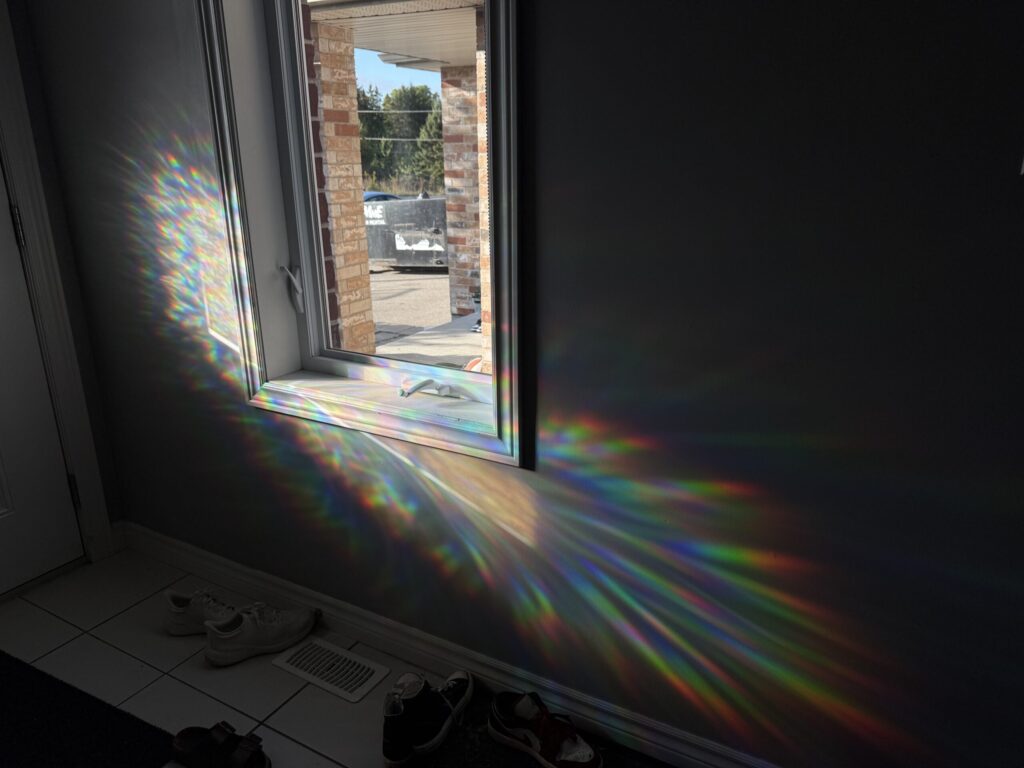
Split screen videos from my bathroom. On the left, my hand wiggles in a cloudy mirror which fogged up after I took a shower. I enjoy how you can only see the form and colour of my arm and may not initially know what it is. I also flipped the video to make it even less apparent. The video on the right is of my sink. I noticed an odd rainbow-like glisten that was happening as I washed my hands, so I filmed it.
The last video is found footage of a cat that got stuck on a baseball field. I wanted to portray the paranoia and disorientation I experience within some of my dreams as I often appear in locations which I feel I should not be in. The cat is supposed to represent the worry of being in a foreign environment and the feeling of being watched. In a reality where I can be conscious in my dreams, this paranoia would leak into my true reality as well! I emphasized the feeling of being watched through the use of my giant eyeball. The audio “what hurts more, a false memory or an impossible future” is explained in the “Audio Analysis” section. Link to video: https://www.youtube.com/watch?v=BTkBVNMD-VY
Audio Analysis
My Humidifier:
I recorded the sound of my humidifier and spanned it across the entirety of the video to place a sound that brings me so much relaxation and comfort into an unsettling environment. I relate this sound to sleep as I use this white noise every night to fall asleep. I also thought by using this audio across the entire video, it helps create a sense of cohesion and unity.
I wanted to incorporate a sparkle or bell sound into this video art and stumbled upon random kalimba. This instrument is already a little strange, but when paired with my video, I felt as though they were a perfect match! I slowed the audio down 45% to spread out the sounds. I think this audio helps keep my audience’s brains stimulated, as the dull sound of the unchanging humidifier may get boring…. and my dreams are anything but boring!
I wanted to bring even more attention to the floating Ashwaghandha bottle that appears on screen, so I paired it was this audio. I pitched this audio down because the original was WAYYYY too high pitched and hurt my ears! I also slowed the audio down by 75%. This audio gives the object and eerie yet whimsical aura. Just like the pill bottle, the audio quickly fades away.
I wanted to include muffled human voices because sometimes in my dreams, I cannot understand what people are saying and everything around me seems muffled and muddy. I found this audio and then slowed it down, put the “muffled” effect on it, and reversed the audio to distort it even further.
Guttural Sounds from my Bathtub Drain – 2min 09sec
Every time I have a bath or shower, my bathtub makes this strange guttural noise which I honestly really enjoy. Aside from sounding a bit like snoring, I wanted to use this sound to distract and break the focus of my viewers as they watch my hypnotic video.
“What hurts more, a false memory or an impossible future?” – 2min 57sec
The phrase “What hurts more, a false memory or an impossible future?” references the harm dreams can cause as they give you visions of false memories, things that did not actually occur in your life, and impossible futures, bending the truth of one’s reality. A false memory may show you an alternate, and untrue, version of your past in which you made different decisions and choices. An example of an impossible future would be receiving a vision of someone who has passed away in your regular reality still existing in your dream reality. If humans were able to gain consciousness in their dreams, they would experience multiple versions of their reality (one minute they are in a reality where someone they knew is dead, the next they are experiencing a reality where that person is still alive). These false memories and impossible futures would add to their confusion of what is actually “real”.
BRAINSTORM & PROGRESS PICS
Moments of Magic
BONUS VIDS!
Symposium Bibliography (Top 5 Sources)
Bakare, Lanre. “Please Do Touch: Sculpture Exhibition Curated by Blind People to Feature Tactile Works.” The Guardian, 14 July 2025, https://www.theguardian.com/artanddesign/2025/jul/14/please-do-touch-sculpture-exhibition-curated-by-blind-people-to-feature-tactile-works.
Brouwer, Olivia. “Touching Sound: A Nature Walk + Workshop.” Olivia Brouwer, oliviabrouwer.com/touching-sound-walk-workshop/. Accessed 8 Oct. 2025.
Jackson, Rachel Elizabeth, et al. “Touching the Invisible: Exploring Intracellular Host Pathogen Interactions through Multisensory Art.” Immunology and Cell Biology, vol. 103, no. 6, 2025, pp. 535–40, https://doi.org/10.1111/imcb.70019.
To Light started with the general concept of participation. As I have been researching participatory art for my symposium presentation, I have grown more and more interested in including interactive aspects into my own artistic practice as I believe it better engages audiences. I knew whatever I created, I wanted my audience to be involved somehow.
At first, I experimented with magnets and the idea of dreams, but then I became fixated on the “No Flash Photography” rule at most art galleries. My goal was to create a sculpture that would be displayed in a darkened gallery room. The sculpture would contain a hidden light sensitive sensor that would trigger a sound ONLY when it sensed a bright light. Thus, audience members would be invited to activate the sculpture by using flash photography within a gallery setting.
Once I ensured this idea would work, with the help of the amazing tech Nathan, I needed to work backwards and decide what materials and sound(s) would suit this concept best. As for the sculpture’s materiality, I wanted to make a reflective and iridescent sculpture that would also “activate” with the flash of a camera. People who take a picture of my sculpture will not only activate a sound, but it will activate the materials as well, creating bright flash effects within the pictures they capture. For instance, I used reflective safety stickers that are grey normally, however, when you use a flash on them, they turn bright white!
As for the sound, I wanted to create a simulated environment for my audience to experience. Since the location of my sculpture would ideally be kept in a dark room, and the materials of the sculpture are all reflective, silver, and iridescent, I mixed the sounds of spring peepers and cresting lake waves to create a similar experience to a moonlit stroll by a body of water. The front of the sculpture itself resembles the surface of a body of water while the back is similar to the face of the moon. I also wanted to include forms similar to the pattern found in water (see image below). The audio helps complete this simulated environment by letting my audience enjoy two of my favorite sounds, both of which hold many fond memories of taking late night walks down to the lake at my cottage.
Overall, this work requires participation from audience members, activating the sculpture through use of flash photography. These flashes reflect off the sculpture, producing unique photographs, while also triggering an audio to play. I challenge the rigid rules of galleries by involving my audience in my art and poke fun at the “No Flash Photography” rule.
Audio File: Spring peepers and Cresting Lake Waves
When the webcam inserted in the sculpture senses the bright light of my phone’s flash, it plays an 11sec audio. Audiences are invited to walk around my sound object, taking pictures and videos with flash, activating both the material and the sound!
Some of the material is activated through light! I used reflective stickers that are grey normally but turn white with the use of a flash photograph.
I aimed to create forms similar to those found in water.
Brainstorm!
Work in Progress Pics
Moments of Sound Magic
Pinecone Music
Destruction of Private Property
Annoying
Leaf Crunch
Squirrel Burying Their Food
SYMPOSIUM PROPOSAL
Topic:
Alternative Engagement with and Accessibility of Touch Based Art
Overview:
Historically art has been placed behind barriers and made accessible only to one’s sense of sight. As an artist who enjoys working with texture, materiality, and three-dimensional sculpture, as well as being an individual who processes information better through hands-on projects, I strongly encourage artists and institutions, such as galleries and museums, to consider the possibilities of tactile art. Tactile art provides audiences with an alternative way of engaging and connecting to an art piece, combining the sense of sight with one often not utilized in a gallery setting, touch. Forming a connection to a work of art through touch not only provides individuals with a unique experience, but it gives those with accessibility needs an ulterior method to enjoy art as well. Through touch, an individual is invited to connect indirectly to the artist themselves through the material which was used. Additionally, the audience may be invited to alter and contribute to the piece of work through the use of their sense of touch, giving them a sense of being a part of something bigger than themselves. Tactile art is an important first step towards breaking down the sterility of a “hands-off” gallery which isolates individuals from fully connecting with a work of art and helping bring back a level of human connection between artist and audience.
Potential Presentation Formats:
Video essay (uses sense of sight and hearing)
Programmed buttons that speak my presentation (mixing tactile/ hearing/ visual)
Everybody gets a numbered button with corresponding sections of the presentation
Each button has different textures
Use slideshow to show correlating images
Program an object to give my presentation
Invite class to touch my tactile art
Bring blindfolds, different textures and rating cards to experiment with how people feel and react to different textures
Sculptural pieces representative of my heart, time, and soul I put into my creations (so that others may connect with me, no barriers.)
Wear a custom designed piece of clothing with different sensory areas (cut an area to touch the skin of the artist aka me)
Include something the class can touch and contribute to (a material that retains form when pressed like playdough/ could be a representation of myself)
Research Avenues:
Feedback forms for class on how they felt touching different textures
Can also include my family + friends for more data
Research on experimental artist that deal with the sense of touch in their art
Formal and informal articles on accessibility of tactile art in museums/ galleries
Scientific research of how different senses react to art within the brain/ body
Topics:
Artists focusing on sense of touch within their works of art
Accessibility of touch-based work (multi-sensory museums/ visitor participation)
Feedback forms on emotional response to different textures in class
Content’s Importance:
Exploring the different human senses and their potential to connect people with art in new ways allows people to broaden how they think and engage with art.
Tactile art allows those with vision accessibility needs to still connect with art.
I personally process information better through hands-on learning and always appreciate when art is physical.
Classmates should consider their own artistic practices and explore highlighting senses other than sight within their works. This opens up new ways of engaging with art pieces.
LIVE ART– Four Cheeks
Artist Statement
Over the course of two years, I have been caring for a chipmunk in my backyard. I have enjoyed watching their daily rituals of sitting in certain areas of our outdoor patio chairs, drinking from our pond, and collecting food until their cheeks are full. Out of adoration for my animal friend, I wanted to take part in their daily ritual and create a collaborative live art piece in which we share multiple meals and store them for the winter.
I chose to store Werther’s in my cheeks to incorporate one of my own daily rituals. After school every day I ingest roughly 1-5 Werther’s to help myself focus while studying and to also treat myself to something yummy! Werther’s have always been my favourite candy since childhood, and I was called “grandma” in elementary school.
The set up of this live art involves two plates of food, two cameras, and four cheeks. Once me and my performing partner respectively fill our cheeks, we go to our respected safe spaces and store our food for later, coming back for more. After I finished my plate, I allow the chipmunk to keep feasting, which he continued to do for the rest of the day. After the live performance, I took the Werther’s I had spit out and melted them so that I may use it for winter baking, ultimately storing the food for winter.
I was initially inspired by the photograph of a musical performance given to the audience of a melting glacier (see image below) as it led me to think about non-human audiences. Eventually this led me to the realization that there are non-human rituals as well! Through participation, I gave new meaning to the enjoyment I get from visually watching a chipmunk’s daily ritual, similarly to ethnographic research.
BONUS CHIPMUNK FACTS:
Chipmunks can store up to 70 sunflower seeds in their cheeks!!!
As a goth queer person, I’ve always been drawn to the vampire. They’re scary, cool, stupid, and I found myself consuming as much vampire content as I could get my hands on from a very young age. Particularly, I was drawn to Anne Rice’s Interview with the Vampire and became fascinated with the different types of vampires written about in that story. They all held core similarities: a lust for blood, aversion to sunlight, and immortality, but otherwise were so incredibly different. This led me down a rabbit hole years ago involving research into the different vampire tropes in media, and I became really obsessed with categorizing the types of vampires I found across film, television, books, and folklore. My search resulted in three main tropes, with a couple off-shoots that were just different enough to justify having their own category.
On a completely separate note, I grew up with unsupervised internet access (duh) that led me, as a queer person, down some darker rabbit holes. As YouTube does to most if one isn’t careful enough, I found myself being pushed by the algorithm to watch LGBTQ+ conservative grifters throughout high school. I believed that it was important to try to understand different perspectives, especially from within my own community. What I got instead was a deep self-hatred regarding my own identity that took years to undo. When I found Interview with the Vampire, and read all of Louis de Pointe du Lac’s deep self-loathing over his vampiric identity, I felt very seen. Vampires are often an allegory for queerness, and I couldn’t help but feel like Louis’ rejection of his vampiric identity was symbolic of one’s rejection of their sexual or gender identity.
Combining these topics (my obsession with vampire archetypes and my absolute distaste for these Blaire-White-type-queer-grifters), I’ve created a presentation given by a self-loathing vampire, teaching their audience about each archetype and how to kill them. The presentation is mostly informative, but I thought there was a relevant commentary to be made about the kind of people who pander to those who want them dead in hopes that they’ll be deemed “one of the good ones”.
☆ Symposium: Documentation ☆
☆Symposium: Final Bibliography☆
Buffy the Vampire Slayer. Created by Joss Whedon, The WB, 1997.
Doyle, Jude Ellison S. “In Praise of ‘The Lost Boys,’ Everyone’s Favorite ’80s Vampire Movie.” Medium, 25 June 2020, gen.medium.com/in-praise-of-the-lost-boys-everyone-s-favorite-80s-vampire-movie-fd3f2e0ada2d.
Fhlainn, Sorcha Ní. “A Very Special Vampire Episode: Vampires, Archetypes and Postmodern Turns in Late 1980s’ and 1990s’ Cult TV Shows.” Horror Studies, vol. 8, no. 2, Oct. 2017, pp. 255–74. EBSCOhost, https://doi.org/10.1386/host.8.2.255_1.
Girl on Film. The Fashion of Horror: Vampires. YouTube, 25 Feb. 2024, https://youtu.be/QZmgu6igzyA?si=I4WHVkrhvc3qZjir.
Pyle, Jamie. Contacting Anne Rice’s Ghost via Ouija Board. Research Experiment. Conducted 4 Oct. 2025.
Rice, Anne. Interview with the Vampire. Alfred A. Knopf, 1976.
Rymer, Michael, director. Queen of the Damned. Warner Bros. Pictures, 2002.
Stepanic, Stanley. “More ‘disease’ than ‘Dracula’: How the Vampire Myth Was Born.” UVA Today, 19 Oct. 2022, news.virginia.edu/content/more-disease-dracula-how-vampire-myth-was-born-0.
Sumra, Husain. “The Legend of Jure Grando, the First Person Described as a Vampire | by Husain Sumra | Medium.” Medium, 17 Mar. 2015, medium.com/@hsumra/the-legend-of-jure-grando-the-first-person-described-as-a-vampire-13a0e879d6b5.
Schumacher, Joel, director. The Lost Boys. Warner Bros. Pictures, 1987.
☆ Speculative Video ☆
☆ Speculative Video: Artist Statement ☆
The way we currently decipher the everyday lives of long dead societies and peoples is incredibly interesting to me. Perhaps it’s the way that seemingly small objects can tell us so much about what life was like in an era unimaginable to us, the glimpse we can catch into a world as if we’re time travellers, or the fact that we could be so, so, wrong in our analyses. With this concept in mind, I created a video speculating on what it might look like if an alien species tried to understand the culture of Earth through an extremely limited lens: my old Littlest Pet Shop YouTube videos from 2010. As a 7 year old, my understanding of jobs, crime, advertising, and the way people interacted with each other was heavily influenced by what I would see in TV shows, movies, and other people’s “LPS” videos on YouTube. This created a broken telephone effect due to my child self’s limited understanding of the way my own world functioned, and resulted in some truly hilarious videos in retrospect. These videos, still existing on a hard drive, may outlive me due to the digital realm’s increased dominance in our world, so speculating on what a complete outsider might take away from them was an incredibly fun thought exercise. If alien anthropologists could only use a 7 year old’s toy videos to comprehend life on Earth, what would they conclude? When we discover centuries-old artifacts now, could their explanations be as simple as remnants of a child’s understanding of their world?
Fhlainn, Sorcha Ní. “A Very Special Vampire Episode: Vampires, Archetypes and Postmodern Turns in Late 1980s’ and 1990s’ Cult TV Shows.” Horror Studies, vol. 8, no. 2, Oct. 2017, pp. 255–74. EBSCOhost, https://doi.org/10.1386/host.8.2.255_1.
Girl on Film. The Fashion of Horror: Vampires. YouTube, 25 Feb. 2024, https://youtu.be/QZmgu6igzyA?si=I4WHVkrhvc3qZjir.
Pyle, Jamie. Contacting Anne Rice’s Ghost via Ouija Board. Research Experiment. Conducted 4 Oct. 2025.
Rice, Anne. Interview with the Vampire. Alfred A. Knopf, 1976.
Stepanic, Stanley. “More ‘disease’ than ‘Dracula’: How the Vampire Myth Was Born.” UVA Today, 19 Oct. 2022, news.virginia.edu/content/more-disease-dracula-how-vampire-myth-was-born-0.
☆ Sound Object: Documentation ☆
(Left to right, up and down: me holding the cassette tape, the loop of tape hanging from the door because it was so long, the open casing, the hole carved into the side of the case, the tape put back into the case, and then the case closed, recording my epic synth playing skillz, the tape loop in the tape player, the final setup, the community activating the piece, and video documentation of the work being activated)
☆ Sound Object: Artist Statement ☆
It is my belief that community is a vital aspect of music. We band together as a community to make music, we come together in droves to listen to people play music, and now with streaming services, we treat music listening activity like social media. We look in on what each other are listening to, adding to playlists, and thus community is brought into music listening once again. However, one area that hasn’t seemed to tap into this community aspect is analogue forms of music. In my experience, analogue music listening feels like a personal, private, intimate activity — there is a physicality to it, a ritual involved with putting a record on, or playing a CD — and though it’s my personal favourite way of listening to music, there is still that community gap. With my sound object, that gap is filled. The cassette tape loop expands across a large table, inviting the viewers to interact with the object, engaging in the activity of listening to an analogue form of music, while also taking part in the community act of making music itself. Each touch of the tape creates a unique sound, and when everyone plays together, they are creating a song that can only exist through this joint act. Additionally, the tape loop’s tension is held by an Apollo bust (representative of music) and a mushroom (representative of community), and the sound recorded onto the tape is the chord arrangement of a song belonging to the very first album I owned on a physical format.
When I was… A young boy… My mother… introduced me to My Chemical Romance, and I was never cool again. At the age of 12, I broadened this interest to include other bands like Fall Out Boy and Panic! at the Disco, and subsequently engulfed myself in a niche subculture of the internet that is now referred to as the “yeemo” era of 2015-18. We all listened to the same bands, watched the same YouTubers, and were all undeniably cringe. Concurrently, I was losing faith in my Catholic upbringing and education for a myriad of reasons, and emo bands were, at the time, my new religion. I no longer read the Bible alongside my religion class, instead sneaking onto fanfiction websites on my phone under my desk. I looked up to the members of these bands, or the people behind these YouTube channels as though they were my Gods, and I was their most devoted follower. As I grew up, I felt incredibly embarrassed of my pre-teen self and the passion they exhibited for these public figures. But now, as an adult, I continuously find myself drawn to the things I was very not normal about in 2016. With this piece, I am inviting the audience to partake in a distorted, mashed up performance of my 13 year old self’s daily ritual through what I have called “Yeemo Church”. All are welcome.
☆Moments of Magic☆
☆ Symposium Proposal ☆
In my symposium presentation, I aim to explore the topic of consumption as intimacy within the context of The Vampire Chronicles novel series by Anne Rice. These books are truly wild, and there’s so much to explore within them! But, I figured that in order to make my presentation fall within the 10-minute time constraint, I should find a super niche subtopic within the books. I’ve always been very fascinated by the use of cannibalism as a metaphor for love within media, and as a lifelong goth, I also love vampires. This topic combines both interests as vampires eat people to survive.
While presenting my topic, I will dress up as and act as though I am literally the vampire Lestat, the main character of the novels (I haven’t decided yet though if I will attempt a French accent – it would be absolutely rotten if I did, but that could add to the bit) and give a slideshow presentation of the following: I will first briefly give context to the books, explaining a basic synopsis of each book (about 1-2 sentences) so that the audience has some background information about characters and themes. But Lestat is a philosopher; he spends the majority of these books pondering questions like: “what is the meaning of immortal life?” or, “what makes someone good or bad?” or, “Why did readers hate book 5 so much? Do they hate me?” Thus, in the spirit of Lestat, I will then propose a question: Is consuming your loved one the height of intimacy? I will look through my various sources of research and in-slideshow examples before coming to my conclusion.
In terms of research, I plan to look at non-vampire based media about cannibalism, academic sources examining vampires and sensuality, as well as some less conventional methods. For example, perhaps making a vampire sim in The Sims 3, finding a lover, and seeing if drinking “plasma” from that sim increases their relationship. One way fans would find out information specifically about the vampires in this book series was by asking Anne Rice herself on her FaceBook. Anne Rice passed in 2021 however, so I might contact her spirit via ouija board to ask. She loved answering questions about her universe, so I’m sure this will yield flawless results!
☆ Brownout 2 and ItalicsResponse ☆
After reading both Guillermo Gomez-Peña’s and Stacy Makashi’s live art scripts, I found myself both inspired and impressed. They both create such a clear image of their performances by just using words and action cues, allowing me to not only visualize what this performance may look like, but to also imagine what it may sound like. There’s a level of care and detail present, but there’s still room for improvisation and audience interaction, and I really appreciate that balance. As a former theatre kid, the way these scripts are laid out reminded me a lot of the monologues I’d read for drama class or auditions. They’re introspective and make room for a broad range of expression. It makes me wish I could experience the performances live; I wonder how the artists may diverge from the way I’d expect certain lines to be said and actions performed, or how the reactions of the audience could alter how the piece is performed.
O’Malley, Connor. “Howard Schultz Tapes (4K Full Movie 2019 Free).” YouTube, July 16, 2019. https://youtu.be/DLJtMwXkdz4.
Rotter, Daniel. “Awesome New Chopped Chin Joke.” TikTok, March 26, 2025. https://vt.tiktok.com/ZSyMoonYM/.
Tehching, Hsieh. Jump Piece. SIFANG ART MUSEUM. SIFANG ART MUSEUM. Accessed November 1, 2025. https://www.sifang.art/hsieh-tehching-jump-piece-19732017.
Turvey, Malcolm. “Comedic Modernism.” October 160 (June 2017): 5–29. https://doi.org/10.1162/octo_a_00289.
Sound Object
My sound object took the form of a fantasy relic and a pressure plate that when interacted with, would play a magical sound for the participant. I wanted to approach a fantasy context with the object ”choosing’ the viewer. in this trope brought to the real world, the cursed and magical sound is now diegetic, leaving a sense of wonder and dread.
here were my process sketches. Originally, I wanted the object to look more like a flute but the balance was too lopsided. I added more handles and decided to create a more alien design with less of an observable purpose. My first plan was to have sound play as the object was lifted, but that proved too difficult. Instead, I settled with a disguised button that must be pressed before the object is lifted
5 Moments of magic
Live Art Ritual
Alchemical Transmutation for Popcorn
+Wear your garment which most closely resembles a cloak
+ Prepare a: Microwave
Microwavable popcorn
Stick of Chalk
set of (4) candles
+ Read the following passage aloud:
Truth! Certainty! That in which there is no doubt! That which is above is from that which is below, and that which is below is from that which is above, working the miracles of one. As all things were from One. Its father is the Sun and its mother the Moon. The Earth carried it in her belly, and the Wind nourished it in her belly, as Earth which shall become Fire. Feed the Earth from that which is subtle, with the greatest power. It ascends from the earth to the heaven and becomes ruler over that which is above and that which is below.
+ Using the chalk, Draw an alchemical circle with the symbols:
🜍, for combustibility
🜂, for fire
🜄, for water
🜔, For salt
+ Place the microwave within the circle
+ Place the candles evenly around the perimeter of the circle
+ light the candles
+ place the popcorn inside the microvave
+ press the popcorn button and begin the transmutation
+ read the following passage aloud:
The all is the mind, The universe is mental.
As above so below, as within, so without
We Invoke as a mirror, the highest laws, the seven principles
Mind as well as metals and elements may be transmuted, from state to state; degree to degree; condition to condition; pole to pole; vibration to vibration
Transmute that which is undesirable into that which is worthy
The planes of matter are the planes of the mind The all is the mind, the universe is mental
+ place your hands on the microwave and meditate on these words to elevate the mind
+ wait for the popcorn to finish
+ remove the popcorn from the microwave and try a piece
Artist Statement
This idea began with the period of waiting that comes with popcorn. There was a meditation and a transformation that correlated in my mind- where the viewer is waiting for the object, the popcorn, to fundamentally change. To me it played out as a metaphor for enlightenment; the popcorn opening itself from a chrysalis, born again in a new form. Pairing the physical and mental change is what lead me to the philosophical school of Hermeticism. Hermetic idology contains alchemy- the transmutation of matter, however, it also views transmutation as something that can heighten the mind. Hermeticism contains a lot of affirmation and manifestation in the hopes of invoking esoteric knowledge. In this way, both the participant and the popcorn are being transformed by the ritual.
Symposium Proposal
participation is the aspect of performance art that always leaves me most fascinated. Collaboration between an artist and audience will always captivate me with its spontaneity alone. What I find most intriguing is when people allow themselves to leave the world behind. I find now that there is so much cynicism around performing and participation, that just watching someone break away from judgement to do something absurd never fails to capture me. For my symposium, I want to research and showcase some work that has inspired me, and potentially get people to interact with me outside and maybe during the presentation too. I also want to talk about the value of absurdity beyond just the shock and comedy.
I’d like to call attention to this comedian, Zach Zucker. He performs alongside a soundboard which allows for conventions that could only exist in cartoons, into the real world. I think that the absurdity of this performance is a reflection of internet comedy- spliced up sounds, repeated jokes/ scenes, and most above all, allowing the audience to be in on the joke. But thinking farther into this performance, the audience needs a certain knowledge basis to participate in something like this, an understanding of how a show or a joke should progress. These are ideas I want to explore with my presentation
“Rage… can be transformed into fierce compassion.” – Bonnie Myotai Treace
My symposium project will touch on rage as a form of performance/live art. Through pre-existing research on rage as an emotion, I’d like to lead a discussion on the short vs long term psychological impacts of rage.
I’d then like to deconstruct YouTuber rage videos, I hope to lead a discussion on deconstructing these acts into their key components: sound/rhythm, words, body language/movement and how such raw unadulterated moments can be perceived. I want to invite the viewer to feel the emotions of viewing rage: cringe, second hand embarrassment, but most importantly, rage of their own.
My hope is that this discussion will bring rage into the room, that individually, and as a group we can create and feel the effects of our rage catharsis, taking into consideration the art we make with our bodies, our sound, and our words as it takes place.
Moments of Magic
Elevations: A Live Score in Relief
Score:
Video Documentation:
Artist Statement:
For my live art ritual I chose to create a score to guide my process of alleviating chronic pain via smoking cannabis. As a chronic pain sufferer I find myself everyday coming up with more and more creative, bizarre, and even sometimes dangerous ways to alleviate the pain I feel. While I was never prescribed medicinal cannabis, I have found it to be the most effective in reducing my pain.
Normally, this ritual is mindless, multiple times a week I fund myself kneeled over, taking a few hits until I feel better. I wanted to challenge myself by creating a score to follow, dictating the pose I get high in, how many hits I take, and the length of the hit.
I found it difficult to follow the score as I went along, as it required me to be mindful of the actions I was taking, paying attention to time, all while trying to alleviate the pain I felt.
I completed my ritual having felt the alleviation and transformation my body went through, but in a more mindful way.
Sound Object: Macro-plastic Rainstick
For my sound object I wanted to create an instrument from objects I had laying around to be more environmentally friendly. I settled on a rainstick as I felt it was more complex than a rattle or maraca. At the time I had just read an article about how microplastics are in our rain which inspired me to use wasted 3D printer filament as the “rain” in my rainstick.
The body of the piece is made from two Pringle cans, skewers and acrylic paint. I had searched up what was inside a rainstick and multiple sources showed skewers or nails in a helix pattern.
Ideally this piece would be displayed on a plinth.
Progress:
Bibliography
Staicu, Mihaela-Luminiţa, and Mihaela Cuţov. “Anger and health risk behaviors.” Journal of medicine and life vol. 3,4 (2010): 372-5.
Markiplier. “Ultimate Rage Compilation.” YouTube, uploaded by Markiplier, https://youtu.be/m8XpMeXVxYU.
This is a world where the line between creator and creation blurs… Where denial feeds abominations, desire gives birth to them. A world in which the viewer turns into the antagonist Where the mirror glances back at you with teeth. The creatures that emerge from within us are the ones we are most afraid of. Tonight, the monsters are not on your screens… Or under your beds.
Tonight… the monsters are among us.
PART I
What We’ll Cover: Monsters as Cultural Mirrors
Welcome to the Monster Manifesto.
Tonight, we’ll investigate:
Monsters in art
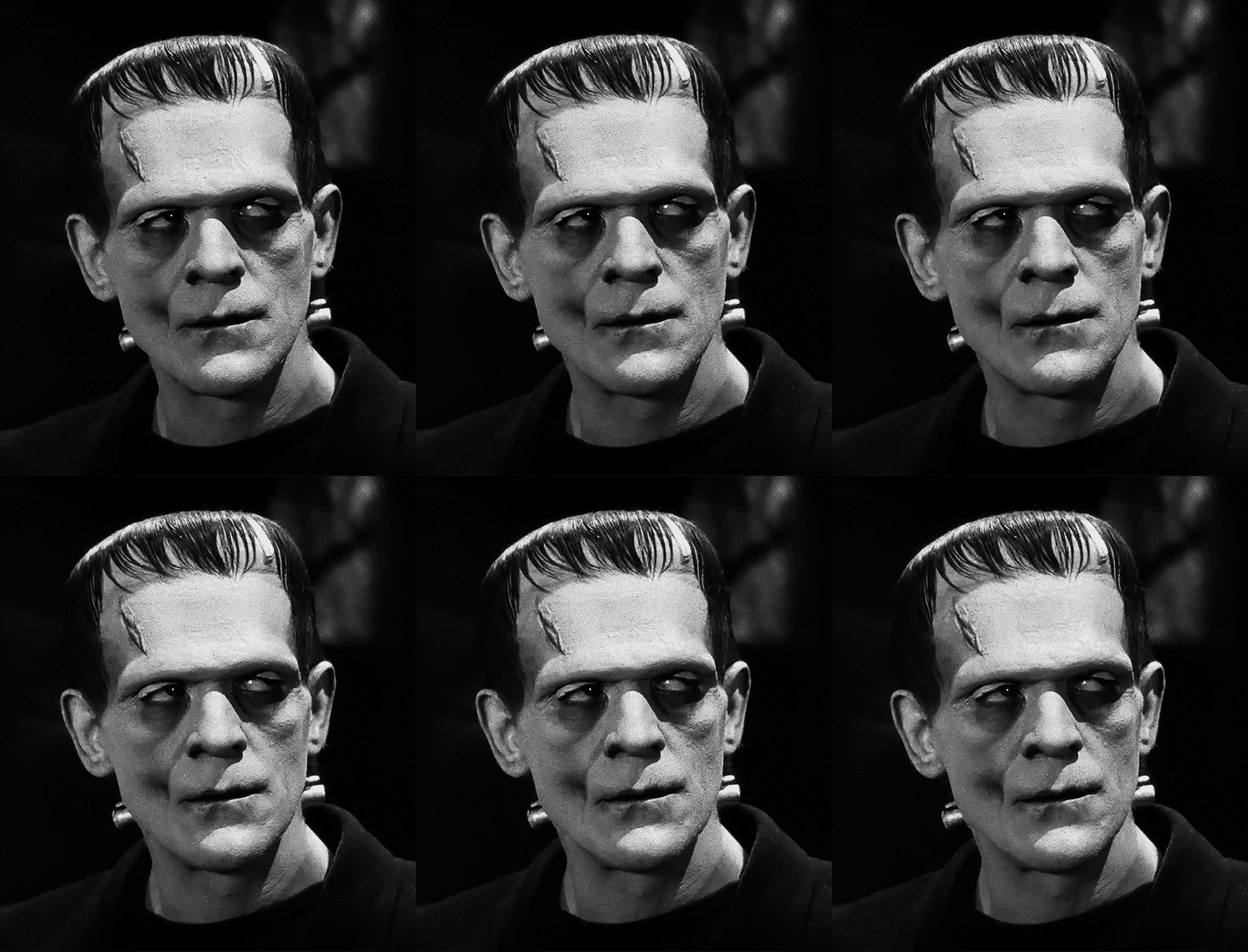
The history of monsters across cultures Frankenstein and the dread of the Other
The Brundlefly and the fear of the body
Count Orlok and the fear of desire, disease, and repression
But before anything… we must comprehend what a monster is.
Theorist Jeffrey Jerome Cohen tells us that monsters embody ‘a time, an emotion, a location’—they are shaped by our fears, worries, and aspirations.
Art critic Theodor Adorno tells us that art is where society meets itself. Monsters, then, are cultural reflectors. They represent all that a society is afraid to acknowledge.
PART II
Monsters in Art
1. Marina Abramović Rhythm 0
Let’s start with real life instead than fiction. In Rhythm 0, Marina Abramović lay out 72 objects: roses, chains, scissors… and a loaded pistol. She let the audience to do anything they pleased for six hours.
Idea: Painful and pleasurable objects were arranged to be used on Abramović.
What: The audience turns into the monster.
Why: As soon as the repercussions vanished, violence broke out. This act revealed that monsters are not supernatural. When no one is looking, it’s just regular people.
2. Hans Bellmer The Machine-Gunneress in a State of Grace
Concept: Fascist notions of bodily control and purity are confronted by disassembled doll-like female forms.
What: The monster’s body is designed to represent political aggression, fetishization, and cultural fixation.
Why: Bellmer shows how repressive governments, particularly fascism, try to control people’s bodies. In his works, monsters are manufactured by culture. The sculpture is unsettling because it depicts what society does to the bodies it fears, not because of its form.
PART III
The History of Monsters (Across Cultures)
To understand monsters in the media, we must trace their evolution.
Across time, every culture created monsters to navigate chaos.
THE ANCIENT WORLD Explaining Danger
Before science, earthquakes, storms, disease, and death were all explained by monsters.
Wendigo (Algonquin): Born from starvation, greed, and colonial trauma. a creature produced as humanity collapses.
Humbaba (Mesopotamia): Guardian of the Cedar Forest, signifying nature’s power against human arrogance.
Sirens: (Ancient Greece): served as warnings about the perils of desire, shipwrecks, and temptation. These creatures weren’t merely frightening, they explained.
THE MIDDLE AGES
Monsters as Moral Punishment
As Christianity grew, monsters became emblems of sin.
Adze (West Africa): A transformation myth used to explain disease or outsider behaviour.
Witches (Europe): Women who were accused of being monstrous for being independent, knowledgeable, or just existing in a different way.
Yōkai (Japan): Spirits that represent societal anxieties such as loneliness, resentment, and natural calamities. In this era, monsters policed behaviour. Anyone beyond the social norm could become ‘monstrous.’
THE 19TH CENTURY
Science, Otherness, and Technology
This was the age of industrialization and the genesis of contemporary monsters.
Cannibals: In travel literature, cannibals were used to degrade colonial people.
Vampires: reflected anxieties about disease, sexuality, and immigration.
Automata (mechanical dolls): expressed worries about technology replacing humans.
The beast shifted from the woods… to the laboratory.
THE 20TH CENTURY War, Trauma, and Upheaval
After two world wars, monsters embodied global trauma.
Godzilla: Radioactive fear of nuclear destruction.
Zombies: Represented pandemics, mass death, and societal collapse.
Aliens: Anxiety about invasion, espionage, and Cold War paranoia.
THE PRESENT
Fear of Everything
Today’s monsters reflect:
Climate anxiety
Digital surveillance
Pandemics
Political extremism
Loneliness and mental illness
In our age, where everything is watched, measured, and exposed…
We fear anything and everything.
PART IV
Frankenstein: Fear of the Other & Ambition
In Frankenstein, the Creature is feared for being different.
But the true monster is the creator.
Victor Frankenstein creates life but abandons it.
The villagers attack the Creature not for violence but for difference.
The story warns against:
Reckless ambition
Social prejudice
Science without ethics
Creating “others” instead of understanding them
Modern Parallel:
Writers compared Charlie Kirk to a “Frankenstein monster” created by extremist rhetoric that spiraled beyond control (The Wire; Roth).
Society fed ambition until it created something it could not contain.
PART V
Brundlefly: Fear of the Body
In Cronenberg’s The Fly, Seth Brundle merges with an insect — a metaphor for illness, aging, and loss of power over the body.
It reflects:
Degenerative disease
Addiction
Disability
Mental health struggles
Loss of identity
Shame and isolation
Modern Parallel:
Britney Spears (2007–08).
Her public breakdown became a spectacle — a transformation exploited and misunderstood.
Brundlefly=body deteriorates
Britney= body scrutinized, autonomy stripped
Both lose control, one biologically, one socially and legally
Both become “monsters” in the eyes of the public
Monstrosity becomes a label slapped onto suffering.
PART VI
Count Orlok: Scapegoating & Repression
In Nosferatu, Count Orlok is a creature of forbidden desire, a blend of fascination and repulsion.
He symbolizes:
Sexual repression
Xenophobia
Women’s autonomy
Disease panic
The weaponization of purity narratives
Some interpretations see Orlok as connected to anti-Semitic imagery which matters, because scapegoating occurred both in the film and in history.
During the AIDS crisis, gay men were blamed like medieval townsfolk blaming vampires for plagues.
Modern Parallel:
Figures like Lil Nas X are demonized for challenging dominant religious narratives.
His “Montero” visual was praised by some but treated as monstrous by others.
PART VII
Why Monsters Matter
So why do we keep telling monster stories?
Because monsters let society confess without admitting guilt.
They reveal:
Who we fear
Who we scapegoat
Who we exclude
And who we refuse to understand
Cohen writes:
‘The monster always escapes.’
Fear denied grows teeth.
Trauma unspoken becomes claws.
We don’t create monsters because we are afraid…
We create monsters because we refuse to face ourselves.
CLOSING
The Mirror With Teeth
When we talk about Frankenstein, Nosferatu, or the Brundlefly…
we’re not talking about creatures.
We are talking about:
ambition
shame
trauma
desire
bodies
politics
and the shadows of ourselves
Every era. Every culture. Every society…
creates monsters.
And the monsters always point back…
to their creators.
Look closely tonight.
See the teeth.
See the shadow.
See yourself.
Proposal:
“Art is the social antithesis of society, not directly deducible from it. It is the process in which society confronts itself,” says German philosopher and critical theorist Theodor W. Adorno, in his work Aesthetic Theory (Adorno 3).
Art holds a mirror to ourselves and makes us see the truths. This goes especially for monsters. Monsters are a reflection of social fears, anxieties, stigmas and all around the dark side of humanity. In my presentation I will be discussing the horrors of humanity portrayed by artistic creation.
My presentation will combine theory, performance and sculpture. I will be connecting monsters such as Frankenstein and the Brundlefly to a sculptural live performance act and a manifesto. I will use paper mache to make masks for my peers to wear in my presentation. I will find footage from movies, live interactions and play them in the background. I will look into Hans Bellmer’s The Machine Gunneress, in a State of Grace (1937) which depicts social norms of the Nazi regime, fetishization and obsession, expressed through surreal, disarticulated doll forms. I will look into Marina Abramovic’s Rhythm 0 (1974) to convey the monstrosity of humanity, where the audience became sadistic.
Then, I will speak of the modern monsters portrayed in films. I will explain Frankenstein and the horrors of ambition, neglect/abandonment and otherness. I will explain how in The Fly (1986), the fears root in degenerative illness and aging that leads to physical, psychological, and social disintegration. I will explain how Nosferatus sexuality both repulses and fascinates viewers due to hidden shameful desires. And if time permitting, I will discuss antisemitism
Using this synthesis, my performance will make the case that violence and social structures are the source of monstrous, which is never limited to fiction. Monsters make us face things we’d rather ignore, like our own harshness, the ways we stigmatize difference, and the impulses we’re afraid to express. In addition to seeing these creatures, my project invites viewers to put them on, face them, and reflect on what they might say about us in the present.
ᴸᴵⱽᴱ ᴬᴿᵀ ᴿᴵᵀᵁᴬᴸ: ᴿᵉˡᵃᵖˢᵉ ᴿⁱᵗᵘᵃˡ𓊔꩜
Score:
Artist Statment:
“My name is Breanna and I am an addict” is what I say every evening. I began my addiction issues when I was 17 and began to battle them when I was 21. I am now 24 and I am clean. Through my battles with addiction, there were slips and relaspes that almost felt ritualistic. A thing you hear in recovery is “One is too many and a thousand is never enough”. Like most addicts, I relate to that. It would begin with something legal or soft, then it would escalate to the harder stuff, until I said I’d stop. Then it would happen again and again like a ritual. Use, use something else, try a new drug, withdrawal and recovery. Until one day I woke up in my chaos and chose to change. Not for anyone, but for myself.
In this live art piece, I strive to convey the slippery slope and severity of addiction. This live art piece explores that dangerous rhythm ; the way addiction seduces, escalates, and eventually shatters. I employ shock as a tool, not for spectacle, but to make the hidden violence of dependency impossible to ignore. Through raw gestures, unsettling sounds, and symbolic substances, I reconstruct the relapse-to-recovery ritual while remaining physically safe. The audience is meant to feel unsettled, to sense the urgency of breaking free.
I will begin by turning off a lamp and sitting in the darkness. There will be an audio score, with notes descending and speeding up at each drug to depict the downfall. There will be terrifying imagery to convey the darkness in the mind while using. Then I will turn on the lamp symbolizing finding the light and I will do a reading about recovery.
The musical score starts off holding notes that descend. As the drug use becomes more intense, the faster the notes play and the more complicated the drums get; until silence. When it is silent, the noise stops and there is peace. Just like the peace I found when the chaos ended and I committed to recovery.
Documentation of Performance:
Moments of Magic:
☠︎︎ˢʸᵐᵖᵒˢⁱᵘᵐ: ᴮⁱᵇˡⁱᵒᵍʳᵃᵖʰʸ☠︎︎
Cohen, Jeffrey Jerome. Monster Theory: Reading Culture. University of Minnesota Press, 1997.
Murnau, F. W., director. Nosferatu a Symphony of Horror. Prana-Film GmbH, 1922.
ıı||ıı||ı|ıı|ˢᵒᵘⁿᵈ ᴼᵇʲᵉᶜᵗ ıı||ıı||ı|ıı
Intro:
Artist Statement:
From the ashes of a future without us, Shit Box 1000 is my sound object. I play the final survivor, creating music out of whatever crumbs I can find in this 2048 setting, long after AI has taken over and most of humanity has been wiped out. This composition, which was made out of a ripped-up metal junction box, two guitar strings, a rubber band, and a metal rod, is my attempt to bring sound into a silent world.
When I was first assigned the project, I wanted to assemble a band inspired by experimental noise groups such as Nihilist Spasm Band, who created homemade instruments — but no one wanted to join. So I became a one-man post-apocalyptic symphony. I used a loop pedal and a microphone connected to a voice modulator to layer distorted beats and vocals to weave a story about isolation, glitching hope, and resistance.
Every sound that comes from the Shit Box 1000 feels broken, metallic, and human. It’s imperfect — it buzzes, screeches, and clanks — and that’s what makes it alive. In the world of the piece, the act of making sound from garbage is rebellion. It’s proof that creativity survives even when civilization doesn’t.
The lyrics to my song, “404 — Humanity Not Found,” evoke the emptiness of a digital wasteland: a lone voice attempting to contact someone through static. The Shit Box 1000 is more than simply a found-object instrument; it’s a message in a bottle from the last human on Earth.
the Performance and Process:
ˢᵖᵉᶜᵘˡᵃᵗⁱᵛᵉ ⱽⁱᵈᵉᵒ▹
Video:
Artist Statement:
In our video, Jacks and I investigate a hypothetical future in which personal connection is replaced by digital connection and our identities are solely maintained through online contributions. I started with a straightforward query: What if WiFi was the only remaining true link in the world? From that “what if,” I created a metaverse that promises nirvana but is more like a dopamine minefield, where survival depends on visibility, cooperation, and constant engagement.
Before the main character gets pulled into the metaverse, the video opens with private, lonely moments like walking to the convenience store and eating noodles by themselves. To illustrate the character’s loneliness, it opens with silence and coldness. They display their melancholy and frantic search for happiness by donning a shirt that reads, “I heart Tequila.” Everything seems flawless in this digital world: flawless avatars with beautiful bodies, a never-ending supply of selfies and ads, and an economy based on engagement metrics, product promotion, and selfies. I tried to give a clue that this world is not as amazing as everyone believes by removing the eyes of the characters to convey a soullessness. I was motivated to study speculative design and fiction by the ways in which artists such as Ian Cheng, Hito Steyerl, and Wangechi Mutu employ world-building to reveal modern power structures. In my work, the metaverse functions as a mirror and a fantasy, showing how loneliness, poverty, and the need for approval influence our online activity.
Characters start to malfunction and become unstable as the digital world descends into an apocalyptic state due to a “data virus.” The protagonist’s discovery that they utilized the internet for greed, comfort, escape, and ultimately to fill a gap that technology cannot fill is analogous to this collapse. I was able to magnify these dynamics while staying rooted in the emotional reality of our contemporary interaction with digital life through the use of speculative imagining.
We created a fragmented visual language that represents the fragility of both the internet world and the individual using Blender, MakeHuman, green screen compositing, and discovered film. The metaverse characters are stylized and hyper-smooth, contrasted with the chilly, low-tech actual world. The music of the video, including glitches, alerts, and background hums, heightens the tension between fear and dopamine.
In the end, this piece is about the price of constructing identity on shaky ground. It is a meditation on digital labour, consumerism, loneliness, and the need to be noticed. I wish to shed light on the present by speculating about a future in which the internet becomes our only reality:
We are already living in a world where connection and collapse exist side by side.
Show of hands, Who here has heard of choice overwhelm?
Ya? A can any of you give me some examples of where thats most common for you?
Yes especially in this day and age you find this everywhere grocery stores, streaming services, online shopping, dinning places, even picking a career, dating apps, social interactions. Everywhere.
Now the study that popularize the term “choice overwhelm” was by Iyengar and Lepper in 2000.
In their iconic study, people presented with 24 types of jam were significantly less likely to choose one than those presented with only 6.
This may even lead to what is now commonly known as decision paralysis, decreased satisfaction in the decisions that you do make, fomo for the decisions that could have been made, regret.
And as they often do, the ultra wealthy have made an attempt to remove this kind of waisted time from their lives; starting what has been deemed the “blank box” phenomena.
Between 2021 and 2025, an trend has emerged among luxury homeowners: they have begun dedicating one room in their house to remain completely empty.
Not for design.
Not for storage.
But to combat decision fatigue.
This study about the jam is repeatedly cited as one of the main catalysts for this practice along with another study thats also associated with the wealthy tech billionaires type.
Have any of you heard of “ego deprecation”? Yes no?
Well the better question would be have you ever seen mark Zuckerberg do bill gates wear the same shirt… over and over and over again? Ya?
Well that is because of the theory of “ego depletion” the idea, first established by Baumeister and colleagues in 1998, is that self-control functions like a limited resource. The more small decisions you make throughout the day, the less mental energy you have for important ones.
So the “Blank Box” is reenforced by this the idea that by entering a space devoid of stimuli, individuals radically decrease the number of micro-decisions their brain needs to process. The room functions as a decision-neutral zone; a space that preserves cognitive energy for tasks that actually matter.
The “Blank Box” extends this insight to the domestic environment: when your home contains hundreds of visual and functional cues, the accumulated effect subtly taxes your decision-making ability.
A single room without objects interrupts this cycle.
It gives the brain a perceptual “quiet space,” reducing choice saturation and helping reset mental clarity.
An empty room represents the apex of order, not just cleanliness, but the elimination of all competing stimuli.
People using the Empty Room Method commonly report improved clarity, better organization, and a sharper ability to prioritize tasks after spending even brief periods of time in the space.
The connection between clutter and cognitive load is well-documented.
I mean how many of you have heard “our brains can’t actually multitask”
Research on hoarding disorder by Raines et al. (2014) found that excessive clutter directly correlates with attention and memory deficits.
More broadly, Newsome, Duarte, and Barense (2012) demonstrated that reducing perceptual interference improves visual discrimination, meaning the brain literally performs better when fewer visual inputs compete for processing.
So, how is this space actually being used, what do they do? Just go in? Walk around? Sit on the floor? Well as hustle culture and productivity of neoliberalism dictates, relaxation bad, efficiency good. So mainly this is done for the express purpose of making decisions for the day.
Early adopters were individuals already involved in high-performance, data-driven lifestyles. Many were influenced by trends in Silicon Valley optimization circuits, wellness culture, and architectural psychology. They recognized that unused square footage could be repurposed into a cognitive tool instead of merely a decorative one.
Now I know what you probably thought when I told you about this if you haven’t heard of it or even if you have already. “Wow, what a waste of space” and you are not the only one.
Leaving rooms empty as a cognitive wellness luxury is very obviously not only unavailable to the vast majority of citizens as a benefit but actively takes up space that could otherwise be used to better the lives of people who don’t even have a place to live.
I mean right off the bat, what are your economic, political, societal, critiques of using housing space like this?
Ya no totally
absurdly wasteful use of energy in a climate crisis
It encourages heating unused space, useless use of power.
. It doesn’t merely reflect underuse, it formalizes it, turning unused space into a cognitive amenity.
Some policy scholars have described this as a form of spatial wealth extraction.
There is also the view that characterizes these actions as personal freedoms, of right to do what you want on your own property.
Now who here thinks that giving they had the resources, they would do something like this? Show of hands, no judgment, if I was rich who knows?
Ya I thought so. But I’m gonna ask another question so to stick with me. Who here, even if it’s not where you live right now, or maybe it is, have you ever had a house with a lawn? Front or back yard ya.
Mhmm. And can anyone tell me why the “lawn” or “yard” was popularized enough to be a massive part of a lot of North American infrastructure?
Yes, because way back, monarchs and the upper class would have large lawns covered just in useless grass which takes tones of maintenance, like people with synths level of maintenance because it is a symbol of status to just have an expanse of land that is not only not used for crops but takes labor to maintain regardless, essentially a visual money pit to exemplify status.
Now everyone has a lawn, and that is quite literally the reason. If mean if you think about it there’s very little practical purpose for a lawn, yes the kids would play, and it gives you space for pets but even people who don’t have those things have lawns they need to maintain.
So is this just history repeating itself under the guides of being “healthy for your brain”
Now I have one more question for everyone. I want all of you to pull out your phones, and google this for me, (Have screen that says “unroom phenomena”) and tell me what comes up…
Now you may have realized by now, that there is nothing about what Iv’e told you about for the last 10 minutes because it dosnt exist. This doesn’t happen, and I’ve been lying about all of it. All of these studies are real, but I’ve entirely mischaracterized them to back up a totally fake trend that dosn’t exist. the history thing about lawn is also totally real Some of you may have already seen this coming because its been on my blog… all semester… but if you didn’t, or even if you did, were you going to google if after? Or just run with it, move on and believe me?
I encourage you to go on my blog when I have it fully posted by the due date. I have all of the misinformation tactics I used during this presentation laid out there, and if you hear any language the ever reminds you of this presentation, of anything I’ve said in the last few minutes, fact check, and fact check again.
“This study about the jam is repeatedly cited as one of the main catalysts for this practice…”
I presented the jam study as if experts commonly use it to justify this trend, even though no such expert consensus exists. By doing this, I artificially created the illusion of authoritative support.
Flawed Argumentation / False Generalization
“Between 2021 and 2025, a trend has emerged among luxury homeowners…”
I stated a broad trend as if it were factual without providing any evidence. This let me build an argument on an unsupported claim.
Astroturfing
“Early adopters were individuals already involved in high-performance, data-driven lifestyles…”
I implied that there was a growing community or movement behind the practice. By fabricating this “early adopter group,” I made it seem socially validated.
Exploiting Emotional Affect
“This may even lead to… decision paralysis… regret.”
I intentionally tapped into feelings like fear, anxiety, and FOMO to make my fake solution seem necessary and urgent.
Poe’s Law / Preservation of Ambiguity
“Starting what has been deemed the ‘blank box’ phenomena.”
I blended a serious tone with a claim that could be satire, making it difficult for the audience to immediately discern whether the information was real.
Impersonation of Expert/Authority Culture
“Have you ever seen Mark Zuckerberg or Bill Gates wear the same shirt…?”
I used tech billionaires as stand-ins for scientific authority, implying that their habits were evidence for my fabricated psychological claims.
Floating Conspiracy Implication
“The ultra wealthy have made an attempt to remove this kind of wasted time from their lives…”
I hinted at a hidden trend among elites, suggesting privileged knowledge or secret practices without actually providing proof.
Defining and Framing (Priming)
“They have begun dedicating one room in their house to remain completely empty.”
I framed the narrative upfront by defining the “trend” before offering any support, priming the audience to accept it as real.
Still Life After Dark is a video that imagines a world where the artwork and photographs in my bedroom come alive at night. The piece shifts between still shots of my room and sequences in which the objects and images animate, move, or interact with their surroundings, adopting an animistic lens.
A part from a couple animated found footage clips, every animated moment was created frame by frame a slow, repetitive process that mirrors the act of drawing itself and the quiet, enclosed space the work inhabits. The animation process became a key part of how I understood the work; referencing real videos of animals and people to study how bodies shift and gesture. The video oscillates between stillness and motion, the real and the impossible, the familiar and the uncanny.
Because I get sick easily, my experience of the world is often limited to the boundaries of my room. Even if something extraordinary were to unfold outside, I would only ever encounter its echoes in the small environment I live in. It felt natural, then, to let the imagined, speculative event occur not in a distant landscape or public space, but inside the only world I consistently occupy.
Ultimately, this piece reflects the way a confined environment can still hold an expansive inner world. By animating the objects around me, I’m animating the space I rely on most and letting it shift, stretch, and breathe in ways I can’t always allow myself to do physically. The work imagines a quiet, private kind of magic, one that exists entirely within the four walls I already know.
Background
Animism, the idea that objects, images, and environments have their own kind of life or agency, shaped the way I approached this project. Instead of seeing the artwork in my room as passive, animism suggests that objects can act, respond, or exist alongside us in meaningful ways. This connects directly to the concept of my drawings and photos waking up at night. The online materials from Anselm Franke’s Animism exhibition explore this concept in reference to the artistic environment as a whole. They explain how contemporary artists use animistic thinking to challenge the divide between the living and the nonliving. Engaging with the essays and information really helped me understand how giving motion and intention to the objects in my room fits into a larger artistic conversation.
Interviews with Pipilotti Rist helped clarify why the bedroom is such a fitting setting for this project. Rist often talks about domestic and private rooms as spaces where imagination naturally expands. Bedrooms hold dreams, memories, and emotional intensity, and they allow for a kind of inner world-building that public spaces do not. perspective supported my decision to center the entire speculative event within my room and helped me see it as an imaginative space rather than just a location.
I animated many of the drawings frame by frame based on the movment of real people and animals so here are some examples:
bibliography
Bellack, Dan. “Making Sense in a Fake News World | TEDxCharleston.” YouTube, uploaded by TEDx Talks, 29 May 2018, www.youtube.com/watch?v=XIa2SFcGoZM.
Bu, Y., Sheng, Q., Cao, J., Qi, P., Wang, D., & Li, J. (2023, October 29–November 3). Combating online misinformation videos: Characterization, detection, and future directions. Proceedings of the 31st ACM International Conference on Multimedia (MM ’23), Ottawa, ON, Canada. ACM. https://doi.org/10.1145/3581783.3612426
Ferreira, R. R. “Liquid Disinformation Tactics: Overcoming Social Media Countermeasures through Misleading Content.” Journalism Practice, vol. 16, no. 8, 2021, pp. 1537–1558, https://doi.org/10.1080/17512786.2021.1914707.
Lewandowsky, S., and S. van der Linden. “Countering Misinformation and Fake News through Inoculation and Prebunking.” Trends in Cognitive Sciences, vol. 25, no. 5, 2021, pp. 363–372, https://doi.org/10.1080/10463283.2021.1876983
This piece explores how sound and memory intertwine, and how an ordinary, unintentional sound can become something deeply personal and meaningful. Like the Proustian phenomenon, where scent evokes memory, the sound of nails on wood collapses time for me. The work activates that moment of recognition, an unintentional sound becoming a vessel of nostalgia, care, and identity.
The materials connect to both of my parents. The wire recalls my father, a farmer, whose tools and practicality shaped how I learned to make things quietly and carefully with whatever was available. The sound recalls my mother, a musician who taught me piano and guitar, using her hands as instruments of expression and inheritance. Constructing her hand with my own, through wire, motion, and sound, is a way of acknowledging the unintentional parts of my parents that live in me.
Background
When I was a kid, my mom would sit at the kitchen table thinking and tap her nails on the surface. I liked the sound so much that, even though she never meant to be doing it for me, when she stopped I would tell her to keep going. My mom has really strong nails, which I did not inherit. I used to think that when I grew up, I would get to have nice nails too, like it was something that just came with being an adult. I know now that is not true, my nails are weak and frankly unbecoming, especially after all the wire wrapping I did for this project. The structure and materials of my piece were chosen intentionally. The list of things my father and I can connect on is very short, but he did introduce me to making things with wire. When I read the Sound Object project description, I knew right away what I wanted to hear. If I could not make the sound myself, I would make something that could.
The conceptual basis of this piece draws on the Proustian phenomenon, the idea that sensory experiences can involuntarily trigger vivid memories. The sound of my mother’s nails on the kitchen table functions as a kind of bridge, connecting the present moment to childhood and the emotional landscape attached to it. This aligns with the wabi-sabi philosophy, which values imperfection and transience. The recreated sound is never exactly the same as the original, but its imperfections are what make it meaningful. It represents the impossibility of recreating the past and the beauty of what remains in memory and repetition.
I know I can’t talk about nail taping without mentioning ASMR although it’s not something I’m personally a big fan of. ASMR (Autonomous Sensory Meridian Response) also provides a framework for understanding why certain small, repetitive sounds can be comforting or emotionally charged. Research on ASMR describes it as a tingling or calming sensation triggered by specific auditory or visual stimuli, such as tapping, whispering, or gentle motion. These sounds are said to evoke feelings of relaxation, or nostalgia. Although the sound in my piece is not meant to deliberately induce ASMR, it operates within a similar emotional register.
If I were to remake this piece, there are a few things I would do differently. First, I would plan more thoroughly in advance, especially when it comes to measurements. I would also test the piece on different surfaces to better achieve my intention of making it capable of tapping on any surface it’s placed on. Finally, I would make the structure much sturdier and use nails that look more realistic.
Live Art Ritual
Wasting Time Together
This work is an exploration of ritual, waste, and intention. Each day, I find myself drawn into the endless cycle of scrolling on my phone; it’s a habitual ritual that consumes time yet leaves no memory or trace. In this performance, I choose to hold that ritual in the open, stripped of distraction, presented in silence and stillness.
In my performance, indulgence takes the form of regret, guilt takes the form of wasting audience time, and continuing is the choice to keep going or the choice to move on. By choosing not to distract myself with the phone, I remove the veil that usually softens the experience of wasted time.
My performance of my score was heavily inspired by John Cage’s 4’33” (1952), which draws attention to the beauty and presence of ambient sound and passing time, this work instead emphasizes absence, an intentional waste, a visible void in the growth progression.
The score itself is inspired by the form of George Brecht, Direction (1962) and its contextual ambiguity and broad application. Not all indulgence is harmful or wasteful, which is why this score specifies this indulgence to be dissociative in some form. It is a meditation on the pain of discipline versus the pain of regret. It asks: what does it mean to “continue”? To repeat? To move forward?
By staging this daily ritual as art, I invite viewers to confront the quiet addiction of distraction, and to recognize the tension between inhibition and indulgence. This is not an abstract performance, it is something we all rehearse, often without noticing. My performance simply slows it down, making visible in the wasting of time in a structure where stopping becomes the only true act of choice.
Live Ritual Introduction Script
Part of my daily routine, my rituals, is to mindlessly waste time.
I do it in many ways: scrolling on my phone, seeing things I won’t recall and, reading a book I won’t remember after reading so many, watching a show or a movie I’ve already seen.
Some of that time has to be wasted, like time in traffic. and some we have the power to make new when we bring new perspectives to the table, but some of that time simply doesn’t need to be wasted.
Everyone dissociates. But my focus here is on the time I waste when I do have a choice.
This guilt eats at me so I wanted to give it structure. This time wasting cycle of guilt.
I created a score to reflect this, one that captures the experience of time I regret wasting. Maybe it will feel familiar to you too.
I narrowed it down to five steps:
1. Get comfortable.
Because, as Jocko Willink says:
“There is no growth in the comfort zone.”
But this score begins there, where nothing grows.
2. Indulge.
In a feeling. In an action. In something that feels comforting and familiar, but does nothing for you.
3. Repeat until surroundings devolve.
Keep going until everything else starts to blur. You lose sense of where you are, or why. You stop noticing time passing.
4. Notice guilt.
That moment you snap back.
You become aware that time has passed, and you chose to let it.
It’s that sinking feeling of “What have I been doing?”
The pause between indulgence and reflection. The internal wince.
5. Continue.
But continue with what?
With what you were doing? With your day? With growth, learning, or something else entirely?
Or just… continue wasting time.
The choice is always there, even when it feels automatic.
I go through this cycle on my phone almost daily. But it’s not just about phones. We all do this, lose time to things that feel good in the moment but leave no trace.
Today I wont be going on my phone as it would void the first step: get comfortable, and I wouldn’t be comfortable.
Instead in this performance, indulgence takes the form of regret. Something I’m very familiar and comfortable with. Regret of the life I’ve wasted.
I will do my best to immerse myself, let you all desolve.
My guilt takes the form of wasting your time, or the self indulgence of this demonstration or any number of things.
And “continue” becomes an open question I’ll have to keep answering, until my time is up.
I don’t know how many times I’ll repeat this score during the performance.
But just like when you’re wasting time, you always have a choice.
So do I.
This is: “Wasting Time Together.”
Video:
Score
Background
Why these 5 steps?
An important aspect of wasting time that I considered was productivity culture and time as a commodity. “Doomscrolling” and dissociation through screens is as a coping mechanism that paradoxically creates guilt. But how much of that guilt is for waisting my time and how much of it is guilt born from the idea that time should MUST be optimized. Philosopher Byung-Chul Han argues that in neoliberal culture, time is consumed and optimized like a resource. I wanted this project to be focused on the time waisted that would otherwise be the memories and experiances of an individual that contribute to their growth. I didn’t want to perpetuate the idea that time spent living is wasted if not optimized which is why step 3 is specifically related to the concept of dissociation. This is to rule out the time spent doing things you enjoy that are very unproductive but foster relationships, memories and new perspectives.
While doing this project I kept running into the questions of how much agency a person has in addiction. This is a very sensitive and complicated subject that I didn’t feel I had the experience or expertise to broach which is part of the reason I was inspired by the broad application of Brecht’s Direction (1962). I didn’t want it to only be about phones because the concept I wanted to convey spreads to may aspects of my life. Just like his, I aimed to invite open interpretation. My score fits into this lineage, but I wanted to ground it in psychological reality. That being the deeply relatable yet shameful cycle of indulgence, guilt, and repetition.
On the more optimistic side of this general relatability I ironically was inspired by a TicTok I saw that really stuck with me. It was by Yoshi 2.0 and although I did find it humorous and pretty unserious, it made me reflect and played a part in what “continue” and “get comfortable” means to me in my score. “Do you want the pain of discipline or the pain or regret” was something have been asking myself a lot lately. Should the discomfort of continuing life outside of wasted time outweigh the discomfort of guilt that comes with staying comfortable in it? No.
For my presentation, I intend to explore the theme of misinformation and the role it plays in shaping public understanding. My approach will be to design a presentation that, on the surface, appears to be a legitimate research project on a specific topic, person, or event, but in fact, the entire subject matter will be fabricated. In this way, the presentation itself becomes both the medium and the message as a live experiment in misinformation.
My central goal is to demonstrate how easily trust can be manipulated when information is delivered with confidence, authority, and recognizable rhetorical strategies. To construct the presentation, I will research the formal techniques used by media outlets, public figures, and institutions to spread misinformation. This could include strategies such as, statistical manipulation, cherry-picking data, selective framing, and real-world examples of misinformation tactics, grounding the project in critical analysis while simultaneously enacting the strategies in practice.
The performative element of the project lies in how convincingly I can construct this fabricated subject. I want the audience to feel, even temporarily, that they are encountering a real, well-researched presentation. By doing so, my project does not simply “tell” about misinformation but makes the audience experience it, hopefully, impacting them in a way that informs their future approach to consuming information.
I am still considering how best to end the presentation. One option is to leave the fabrication undisclosed, so that the unease of being misled continues beyond the event. Another option is to reveal the deception at the conclusion, either verbally or through a handout that exposes each lie I used, laying out my purpose and connections to real-world strategies of misinformation. I believe both approaches have merit: concealment creates a more realistic effect, while revelation offers a more didactic, educational one. An approach that could satisfy both directions is to end with verbally offering a ‘learn more’ handout. The audience would have to make the effort to pick it up, which demonstrates how simple fact-checking can be, while also commenting on how easy it is to walk away and remain ignorant. I will experiment with these options as the semester develops.
The fabricated subject I ultimately choose will be carefully considered to align with my goals and highlight the techniques I want to showcase. I anticipate drawing on a wide range of research, including media studies, political communication, rhetorical analysis, and possibly even creative forms like manifestos or satirical essays, depending on what best supports the delivery.
Overall, this project will act as a commentary on how misinformation infiltrates our media environments and daily lives, while also using the presentation format itself as the site of experiment. It directly engages with the spirit of the “experimental studio” by transforming a conventional academic exercise into a critical performance that blurs truth and fabrication in order to inspire and hopefully have a positive impact on the media literacy of those in attendance.
My speculative video piece, Do Better, explores my speculation of the unfortunate reality of how the richest in the world and those in power don’t use their money for good and instead use it for destruction and their own greedy purposes. This is done through an abundance of layered found footage, a 3D scan of raining money, and the song Money by Pink Floyd which critiques corporate greed. In the background I layered found footage of the reality of corporate greed, military support, refugee camps, homeless people, deforestation, vast cityscapes, pollution, and unnecessary technological advancements. This reality demonstrates how wealth, power, and resources are greatly misused to get the rich and powerful more rich and powerful by funding suffering, displacement, and expansion. The faded foreground layer is my reimagined reality that I wish was more prevalent and that I wish was the priority among those who could make the greatest difference. This compilation consists of found footage that shows people supporting clean water efforts, feeding those experiencing poverty and homelessness, helping environmental conservation, equality in education, and enjoying life.
DOCUMENTATION LINK
Symposium Presentation Bibliography Draft and New Proposal
chaotic, messy, and unhinged history of Fleetwood Mac
the evolution of genres
their rise to being one of the most successful bands
the dynamic and messy relationships
the many affairs that occurred
important events, performances, drama
Potential Forms:
maybe power point or google slides
most likely a Prezi presentation
in the format of a timeline
in depth history of Fleetwood Mac’s evolution, relationships, music and successes
include many photos, video clips, songs (adding visuals and audios for better context)
Potential Research Methods:
biography books/music encyclopedia
documentaries
interviews
video essays (YouTube)
Sound Object Assignment
PROCESS PHOTOS:
ARTIST STATEMENT:
My sound object piece, Nostalgia Lamp, is a light sculpture that shines warm light through a cyanotype collaged lamp shade of personal family photos and emits a sound montage of home videos from my family’s past moments. Through the wooden base, warm lightbulb and history of photos, the lamp sculpture creates an inviting and homey atmosphere. The choice of a lamp is reminiscent of a peaceful living room and bedroom atmosphere where families often spend the most time together. The use of cyanotype photography compliments the family aspect due to the care and delicateness needed in its precise process. The layered audio of family memories and ambient music gives life to the photos and creates the sound of nostalgia that often leaves me longing for the childhood experience I had with my family. This feeling is one that I imagine I share with others and that can translate to others in many ways.
DOCUMENTATION LINK:
Live Art Ritual Assignment
ARTIST STATEMENT:
My Live Art Ritual piece, Caffeine & Acts of Service, depicts the morning ritual of making homemade personalized caffeinated beverages and the act of creating something that will be enjoyed by people you care about. Each morning my roommates and I make ourselves our go-to caffeinated beverage to start our day. This ritual consists of coffee or tea being made in our own unique ways and allows us to start our day more energetically. So, for my piece I took it upon myself to perform my roommate’s rituals of how they make their coffee or tea and then giving it to them to enjoy. They each wrote recipe scores for how they make their drink of choice and as I followed their rituals, they were also my audience which created a spontaneous and unplanned aspect to my piece since I was unaware of what they were going to say or do as I recorded. This led to their personalities being showcased through us having random conversations, musical outbursts, and them acknowledging the presence of the camera. Through this captured ritual, the usual ritual they perform for themselves is changed due to me making it for them. They get to rest while I make their individual drinks and feel cared for by my act of service for them.
HARVEST MOON AT A CONCERT…………………………. ……………..LOVE AT A CONCERT
Symposium Presentation Proposal
Topic:
the impact of music on humans
science of sound/music in psychology and physiology
music’s power over the brain
discovering why it has the power to make us feel and move in a variety of ways
short history of music development/when it began
Potential Forms:
power point or google slides or Prezi presentation
begin with short history
discuss my research on the psychology of music/sound
answer questions I have through my research (what part’s of brain does music engage? what notes, frequencies and sounds trigger certain emotions? why can music generally affect our emotions? why does different music elicit different reactions? etc.)
discuss certain songs and audio pieces that would cause certain mental and physical reactions
play the songs and audio pieces as I am discussing them
Potential Research Methods:
peer reviewed articles/books on music and psychology
What’s that? Woke up late and you need to catch the bus or your going to be late for class. Well that’s not very good, but remember, you can’t go on an empty stomach and with your breath smelling that way. Doooont worry though because I have a solution!.
List of Materials: First you need to collect some things before the bus comes!
Cereal
Milk
Bowl
Spoon
Toothbrush
Toothpaste
Waterbottle
School bag
Wallet with student card
Instructions: Just follow the steps!
Take all your things and quickly make your way to the bus
Get on the bus and find a place to sit
Take the cereal and milk out of the bag and open them if needed
First pour the cereal into the bowl and then the milk
Eat all the cereal
Bring the bowl up to your mouth and drink all the milk
Take out toothbrush and toothpaste from bag
Open toothpaste and put a bit on the brush
Brush your teeth
Gurgle water from your water bottle and spit it into the bowl once finished
Thank the bus driver and get off the bus
spill the spit water on the ground outside of the bus
Finally clean the bowl with your bottle of water
And just like that in 13 easy quick steps you are not late for your class, ready to go both well nourished and with good hygiene. Have a great rest of your day
Symposium Proposal:
I’m really interested in the idea of consciousness in both animals and humans. It’s fascinating to explore the intelligence that many animals have and the different levels at which they experience thought and awareness. Consciousness is the state of being aware of oneself, one’s thoughts, and the external environment. It involves the ability to experience, reflect, and respond to stimuli. The phrase “I think, therefore I am” is often used to capture this core idea of self-awareness. A lot of people still believe that only humans are capable of this kind of awareness, but that idea is completely wrong. Not only do many animals show signs of consciousness, but in some cases their level of awareness is much deeper than we ever imagined.
Take the Bluestreak Cleaner fish for example. Scientists discovered that it could recognize itself not only in a mirror but also in photographs. During the test, researchers placed the fish in a tank with a mirror. At first, the fish attacked its reflection, assuming it was another fish. But over time it started to realize it was looking at itself. Once it reached that point, the researchers placed a mark on its face. When the fish saw the mark in the mirror, it would try to rub it off using the sand at the bottom of the tank. Even more impressive, when shown photos of itself and other fish from the same species, the Bluestreak Cleaner was able to tell the difference. That kind of self-recognition shows a surprising level of intelligence, especially in something as small as a fish. It proves that the fish could not only recognize itself but also distinguish other individuals it had seen before.
This experiment, which was done in 2023, becomes even more interesting when you look at how the fish behave in the wild. Out in the ocean, the same fish does not recognize its reflection and immediately becomes aggressive. Some might see this as proof that wild fish lack consciousness. But that is not the case. What it really shows is that fish raised in a controlled environment have the time and space to reflect on themselves. Wild fish are too busy trying to survive to focus on something like self-awareness. In a way, this mirrors the path of human evolution. As humans moved away from relying only on physical strength to find food, water, and shelter, they started to spend more time learning, thinking, and creating. In the same way, when these fish are given a safe space with enough resources, their intelligence and consciousness are able to grow and fully develop.
Kohda, Masanori, Redouan Bshary, et al. “Cleaner Fish Recognize Self in a Mirror via Self-Face Recognition like Humans.” Proceedings of the National Academy of Sciences of the United States of America, U.S. National Library of Medicine, 14 Feb. 2023, www.ncbi.nlm.nih.gov/pmc/articles/PMC9963968/.
Kohda, Masanori, Shumpei Sogawa, et al. “Further Evidence for the Capacity of Mirror Self-Recognition in Cleaner Fish and the Significance of Ecologically Relevant Marks.” PLOS Biology, Public Library of Science, journals.plos.org/plosbiology/article?id=10.1371%2Fjournal.pbio.3001529. Accessed 5 Nov. 2025.
Kohda, Masanori, Takashi Hotta, et al. “If a Fish Can Pass the Mark Test, What Are the Implications for Consciousness and Self-Awareness Testing in Animals?” PLOS Biology, Public Library of Science, journals.plos.org/plosbiology/article?id=10.1371%2Fjournal.pbio.3000021. Accessed 5 Nov. 2025.
Birch, Jonathan, et al. “Dimensions of Animal Consciousness.” Trends in Cognitive Sciences, U.S. National Library of Medicine, Oct. 2020, pmc.ncbi.nlm.nih.gov/articles/PMC7116194/.
Blackmore. Consciousness: A Very Short Introduction. Oxford University Press, 2017.
BottleNeck Boogie:
My sound object consists of a bucket filled with water and weighted bottlenecks that sink to the bottom, producing a gentle bubbling sound. It was inspired by the shishi-odoshi, a traditional Japanese bamboo water feature that makes a rhythmic “donk” sound as it tips with the flow of water. Known for their continuous, meditative rhythm, shishi-odoshi evoke a sense of tranquility and the passage of time. My piece captures a similar feeling but in a condensed form, expressing calmness through short, consistent bursts of sound that maintain a steady tempo and soothing tone.
Notes:
Mission Statement
My work looks at how late stage capitalism and military power can come together in ways that harm both nature and people. I imagine a future that feels distant but may be closer than we think, where the push for growth and control leads to the loss of the natural world we depend on. We already see signs of this today, especially in the Amazon, Pantanal, and Cerrado, where recent 2025 reports indicate that the Brazilian meatpacking giants JBS, Minerva, and Marfrig continue to have links and exposure to deforestation. There is a sharp irony in the fact that companies built to provide food are driving the destruction of the very land that sustains life. By showing a future where the destruction of nature is treated as progress, I want to ask what happens when we place power and expansion above the wellbeing of the living world and the communities who rely on it. https://www.pnas.org/doi/10.1073/pnas.2003270117
Symposium Presentation:
What components make up consciousness:
Memory – The ability to remember people and visualize them
Sentience – the ability to feel things like pain, pleasure, heat, hunger
Self awareness – the ability to recognize ones self and their environment
What are the 3 levels of consciousness
Minimal consciousness – showing almost no signs of consciousness, just motion and life. Ex Jellyfish
Technically alive but with no brain and gets nutrients by letting the food source float into them or other methods
Have almost no capacity for emotion or self recognition
Primary Consciousness – shows signs of awareness to environment and possibly self but overall only able to process thoughts in front of them not being able to visualize or actualize goals. Ex Chicken
Solely focused on survival and functioning for needs
Has very little memory only chasing food when it is physically noticed by them
Even animals like these have many hints of higher consciousness for example chickens having great memory and also possible self recognition
Secondary Consciousness – full self awareness, high intense emotion, and visualization and thought. Ex pack of dogs
Fully aware of surroundings and current situation
Planned cooperation and communication
As well as intelligent understanding of other animals weaknesses as well as its own (showing self awareness)
This live art ritual is a reflection on the cyclical nature of our existence, the mundane and the way that we cope and try to make sense of the seemingly absurd, endless repetition of monotonous tasks.
The ritual also touches on the Sisyphean experience of being unhoused, where the day-to-day struggle to find food and shelter and basic needs met is coupled with the seemingly fruitless attempts to escape the situation.
For the symbolism represented in our video, there is a cycle of laundry that goes around in a circle; the fountain where we are located in the video is also in the shape of a circle. Sometimes it is difficult to identify when the cycle started and when the cycle ended.
This live art ritual was inspired by Albert Camus’ philosophical text “The Myth of Sisyphus.” Sisyphus was a “cunning king of Ephyra in Greek mythology”(Brittanica, 2020). Sisyphus was a mischievous figure who loved to antagonize the gods. Because of his antics, Sisyphus was banished to the underworld by Zeus and was condemned to push a boulder up a mountain for all eternity. This futile punishment is absurd to the point that it would drive a person to insanity.
Camus talks extensively about absurdity throughout his novel and suggests that readers picture Sisyphus as happy, pushing the boulder up the mountain (Camus 119-123). In our lives, certain tasks and commitments can feel absurd and futile, but the absurdity is a part of the condition of being human. There are two perspectives in the scenario of somebody caught at the crossroads of the absurd. The first person has accepted the absurd reality they have found themselves in and continues to live their life to the fullest. The second person rejects any notion of purpose and believes that their life experience is a series of insufferable events. The literal cycle of doing laundry goes as far as: washing, rinsing and drying.Underneath that surface remains the cycle-repeating task, one day after the other.
Are you caught in a cycle of suffering? Or, is there a glimmer of light that shines through the tinted glass?
Camus, Albert. The Myth of Sisyphus. Translated by Justin O’Brien, Penguin Classics, 2000.
Script:
Not the life I asked for, but the life I feel the most present in.
Not the life I asked for, I am a prisoner to this cycle.
I wring, fold, stack and repeat this process. I long, pretend and feel so deeply. I repeat this process.
I scrub, wring, my body grows weary. I have no choice but to continue.
The process, I do not find tedious or time-consuming, but rather I see it as a time to reflect on the clothing that formulates my existence.
Maybe if I had made do with fewer clothes, been more careful not to soil them, my load would not carry this much weight.
Some may label this as absurd, but what isn’t?
These people passing by are free to come and go, to do as they please. I hear joy, it taunts me.
I hear soft voices echoing in the background, behind the fountain of love that encompasses us every day.
She doesn’t want to participate in my joy, but I still keep trying regardless.
A cycle we are caught in, I cycle, I have become content with
I see he is content, but how could he be? We are stuck. I cannot stop.
For my sound object, I re-created a Truffula Tree from Dr. Seuss’ book The Lorax. As a child, I recall reading Dr. Seuss books in elementary school and my mother reading them to me at home. Reading the book as an adult, I now understand that the story of The Lorax is not just a children’s book; it is also a cautionary tale about the dangers of harming the environment and the creatures that inhabit it.[1] Trees are an integral part of nature and our survival in more ways than one. Trees also resonate with humans on a spiritual level due to the way they provide for us and the ways we provide for them. In the story, The Lorax states, “I speak for the trees, for the trees have no tongues.”[2] In essence, everyone on this planet has a responsibility to speak for the trees. Whenever we choose to protect the forests instead of chopping them down, we should also plant a seed so more trees can grow. People need to continue to spread awareness about climate change and appreciate the beauty of the plants that coexist alongside us. Speaking for the trees is a moral code established to protect our relationships with them. Every time we break this code, we hurt ourselves and our relationship with the trees. They sustain our breath, and we prolong their existence by speaking for them.
My process for this project was more technical than intuitive. I used a cardboard tube for the trunk of the tree, a reusable shopping bag, white fur strips, and hot glue to connect each piece. The tube was relatively easy to paint, but the hot glue required more thought to ensure the tree remained intact and accurately matched the illustrations from The Lorax. For the sound element of my object, I attached a microphone to the head of the tree that threaded through the trunk down to a transmitter taped to the bottom of the base. I plugged in an amplifier into my laptop to add reverb from GarageBand. The voices and background sound was then outputted through two speakers that rested near the tree. The reasoning for adding reverb was to make the presentation feel surreal. Almost as though you were transported to Dr. Seuss’ whimsical world.
1. Sundararajan, Louise. “Mind, Machine, and Creativity: An Artist’s Perspective,” The Journal of Creative Behavior 48, no. 2 (2014): 136–51, https://doi.org/10.1002/jocb.44.
2. Gerlich, Michael. “AI Tools in Society: Impacts on Cognitive Offloading and the Future of Critical Thinking,” Societies 15, no. 1 2025: 6, https://doi.org/10.3390/soc15010006.
My speculative video Form 32-B imagines a future where superhumans and humans co-exist in a world that is similar to the one we currently live in. In this video, I am playing a character named Martin. Martin is an insurance agent navigating a claim with a woman whose car was severely damaged by a kinetic energy beam due to a superhuman battle that occurred on the Brooklyn Bridge in New York City. I wanted to step away from sci-fi and post-apocalyptic visuals for my video and instead, show a perspective where the human is the primary focus rather than the superhuman. In the superhero genre, we rarely see stories where the human is the main character and must overcome supernatural challenges separate from the hero.
I went for a satirical approach for the dialogue in this video because superhero narratives typically adopt a serious tone, leaving little room for humour. Of course, there is the exception of movies like Deadpool and some of the cheesy Marvel and DC movie jokes. Humour, in my instance, creates a lighthearted and grounded atmosphere where the audience does not need to feel the existential dread of the world ending or being threatened by a deranged super villain. In essence, mundanity was the goal for my speculative video, while also leaving space for the dialogue to form something both familiar and peculiar.
Two artists who inspired this project were David Shrigley and Maurizio Cattelan. Shrigley employs humour in his drawings and animations, which could be described as absurd. I was drawn to the ridiculousness of his 2008 Video “Sleep,”[1] which features a cartoon man asleep, breathing heavily. Cattelan also uses satire in his artwork that critiques the institutional status quo. His 2011-2012 exhibition “All”[2] held in the Guggenheim in New York had many objects hanging on display, such as a horse and carriage, the pope, and a wax figurine duct-taped to a wall. In a CBS interview, Cattelan discusses the wax woman wearing a pant suit sitting in a refrigerator named Betsy. Neither Shrigley nor Cattelan integrates superhero themes into their artwork, but both artists exemplify how humour can be developed in one’s artistic practice. I couldn’t help but laugh out loud while watching this interview. I think there is a relatability in humour that everyone can get behind in some sense.
The 2025 video game Dispatch[3] heavily inspired the making of my speculative video as well. The game revolves around the main character, Robert. A former superhero who now works at a superhero dispatch center and manages a team of dysfunctional superheroes. Dispatch uses workplace comedy, which I found intriguing for the comedic aspects in my own work.
I wrote out some of the dialogue before I began filming, but most of it was improvised. Improvising made the conversation feel more authentic, which was the goal for my video. I chose to wear a suit and tie to try to match a corporate look and make the audience believe I am actually a guy working at an insurance company. The filming went smoothly overall. The difficult part of this assignment was editing the footage in post-production. I had trouble keeping the background from moving too much because the camera was shaking at certain points in the video. Getting the lighting in my footage to match the lighting in the found footage was also tricky.
A comprehensive approach towards digital marketing as a tool for artist’s growth. Demonstrated through a lecture-style presentation.
This lecture will be composed from my vast experience in the domain of digital marketing. This experience is from employment, organizations, and from my personal brands.
As I have reached millions of users, I will use the data from how users interacted with my content as a footprint for this lecture. As 10 million+ users is a solid market share. I will also relate Mr. Beasts methodologies in cracking the code for digital marketing and correlate the content with successful artists that have used this tool to make a name for themselves.
In today’s day and age, if you aren’t online, you are behind.
Digital marketing is a strong tool to grow your audience and career. You may be a painter (non digital artist) but posting your process online can help you grow your artistic brand. Potential co-collaborators, clients, or businesses won’t work with you unless you have X amount of followers. Having a large platform is sought after more than basic skills or even talent. Posting your content can showcase your skills like a portfolio. The difference is by doing it through digital marketing it reaches mainstream media where anyone can interact with it. This means that if what you post is attractive, you will gain attention and furthermore grow your identity.
My lecture on digital marketing will include statistics/algorithms, current trends, and ways you can start or continue to grow your image, brand, and artist identity. My goal is to hopefully embed a structured mentality on how to approach digital marketing correctly and create viral content.
Digital marketing is highly important. It allows you to communicate with people in real time from around the world. Instead of trying to breakthrough locally, you can gain attention and support internationally. Digital marketing allows you to reach more of your target audience then ever before. Digital marketing is something to care about because it makes growth and connection easier and it can help you become a self sustained artist.
The research methodologies will be done via my experimentations in the domain of digital marketing and from research through trusted sources. Digital marketing is a field that constantly changes but there is a story it can tell.
Moments of Magic
Live Art Ritual
Concept
Experimenting with probability and how we react to 4 options as tasks. A scientific and psychological approach to experimental art rituals. A task is given. Nothing is planned, everything occurs naturally.
Our project draws inspiration from Rirkrit Tiravanija. An artist which created experimental and live art ritual pieces which included cooking meals. His works, Untitled 1990 (pad thai) and Cafe Deutschland (1993) allow for unplanned environments based on specific tasks, repetitive in nature, surrounding specific locations/subjects (Food). We took on the subject of the classroom and offered repetitive and natural tasks to complete from that given subject.
Additionally, ‘Walking Each Other Home’ (2025-), Artist, Stacy Makishi provides breaks within her art, a moment to recoup, a moment that separates moments. The spinning of the wheel acts as a separator, similarly to Makishi’s breaks in her pieces. The wheel and its spinning aren’t separate from the piece but provides time to reflect.
We offered to include a wildcard option. As red is the rarest colour on the board. When given to perform it, it allowed us to recreate unique scenes that opened up memory portals. Separate from the other usual tasks which correlate with the colours being more common. Red is random and the task can be anything, the rest represent the basic activities done in each classroom.
Artist Statement
This live art ritual we’ve created is a reflection on past classroom experiences. What we’ve experienced consciously decides how we react when given tasks at random times.
Through experimentation, symbolism was created when we considered the colour wheel as a random numerator that offers a cycle in repetitive activities. The wheel itself is round and circular, offering an equal cycle.
Although tasks were done at random and through different ways when we each considered how to approach the task(s) given. It offered a lens into our lives as we considered past experiences to create the visible. Such scenes and tasks can be considered relatable and offers the viewer to partake and offer their version of how they would perform their own ritual.
We’ve performed these tasks daily since we were in pre-school without fully considering why we do what we do. We’re almost robotic in the sense that we constantly operate like this. We always use the laptop for writing notes/Google, we always ask questions to understand the material further. It is embedded into our way of life. By completing these tasks at random we take this daily and robotic ritual and create an experimental form out of it when we perform such tasks at unexpected times and without real reason.
Improv Ritual: Classroom Experiences is psychological. It makes us human. It is a test. Every time when a task is given, it is done different.
Score
Sound Object
CONCEPT
For my sound object, I was experimenting with potentially making a guitar out cardboard but it was too simple wasn’t experimental enough for me since it was a basic kitsch style object has been replicated many times from kindergarten to now. I still took cardboard into consideration. I had packaging from a monitor I bought and I thought that I could make something that is boxed within foam that offers an interesting sound which comes out of a designed area.
I remembered that I had a small electric guitar amp and a microphone. I plugged the mic into the amp. It offered a weird sound that was interesting because it was always different depending on the strength of the electricity coming out of a wall electrical outlet. The strength of the power coming from the outlet let the amp and microphone operate at various levels, almost like there wasn’t enough power. Additionally, since normal microphones do not work well with amps, this mix of using a microphone at lowest operational level on a loud amp offered the sound to be deduced to simplest level. Almost like putting sound waves that normally are smooth and operational in slow-mo and allowing the viewer to hear individual beats which are the various components in the devices communicating with each other to create sound. With the microphone not being as operational and old, when messing with the wire from it and the white wire it allowed for the sound to be altered into a different dimension or it allowed the sound to be playable, muting it-creating beats-creating breaks-creating experimental sound.
ARTIST STATEMENT
The sound object is a combination of craft and technology. A mixture that uses old sound equipment which is normally used in a band setting or a musical setting and allows it to resonate within a box and controlled by strings and held together by positional black sticks. A metal bowl covers the area in which sounds come from, allowing for sound to escape in a equal and circular manner as well as allowing altering the sound to make it more robotic, more metallic. A natural, a physical sound modifier which normally would be altered by a guitar pedal or choice on a digital software like within the GarageBand app. I enjoyed using guitar amp’s natural “plexi sound” and curving it and stretching it across to make it sound like an arcade arena with varying aspects within the sound. It isn’t just the same sound over and over, it is multi-layered. This sound object offers a lens into the basic resonances of devices which amplify sound and can be used like a boom box or a DJ board to alter and make varying noises whilst sticking to its basis.
Symposium Bibliography Draft
Digital Marketing for Artists
Appel, Gil, et al. “The Future of Social Media in Marketing.” Journal of the Academy of Marketing Science, vol. 48, no. 1, Oct. 2019, pp. 79–95. https://doi.org/10.1007/s11747-019-00695-1.
Gabler, Matt. “Leveraging Social Media for Art Marketing: Tips and Tricks for Artists.” Matt Gabler Studios, 30 June 2024, www.mattgablerart.com/post/leveraging-social-media-for-art-marketing-tips-and-tricks-for-artists. Accessed 26 Oct. 2025.
“Effective Social Media Strategies for Artists: Branding, Content, and Ads.” ArtRewards, 24 Oct. 2024, www.artrewards.net/editorial/promoting-yourself-as-an-artist-on-social-media. Accessed 27 Oct. 2025.
Speculative Video
What is Reality?
Concept and Artist Statement
My speculative video, What is Reality?, focuses on our life as a simulator. What if the life that we are living is actually a lie, what if we are robots. What if we are just programmed beings. Touch, smell, feeling – all reduced when we consider that we are in fact just a civilization on a spec in the large galaxy. What is the afterlife? What is life? What is the reality? We each go through 80 years of life, more or less. Good lives, bad ones, early ones or long ones. Lives with change or simple basic lives. Why are we here and why are we different. What is our purpose here. We discover new things but we don’t go farther than our earth to discover what is reality. Some individuals get rich, others live on the streets. Some are able to travel a lot but that is just called being a tourist. What is the purpose. This is a video on speculation with ideas on a topic that hasn’t been justified yet. On a topic that is being studied. Why are we here, were we put here or did we create this system ourselves. We can’t remember our early days as a baby, did we think then? Why is there no memories from then. Who created this cycle?
I created this video to show a perspective on what I think about. Some part of this is true to speculate. Some parts are influenced by movies, social factors and more. The lady turning ending up being a cyborg/ a hidden creature in disguise, influenced by the movie They Live. The ironic thought that we could be playing racing games on a simulator, simulating real racing while we ourselves are simulating this “life”. Is life really life or was it given to us, did we earn it or are we in a loop through time until we reach specific goals. I went for a serious but maybe funny approach. A surreal approach that immerses you in my POV. Potentially relatable or potentially mental. I used found footage from online and my own video. Some additional editing and text when working with green screen backgrounded items like the TV on a pedestal. Additional text and coding is imbedded near the end of the video and within the TV on the pedestal.
The following text/image is visually given for a few seconds within the video. Hidden within a green screened object and around a bustling city, it is a nod to the famous quote by Jim Carey, “Good afternoon, good evening, and good night” in the Truman Show. A movie about my ideas and my concept which could also be heavily influenced by this movie too! We don’t know what is reality both from few facts on what life is really about; before, during after. Additionally, the media we consume visually and by hearing about such influences our thoughts. We could also say that these influences may have been on purpose to remove our thoughts on this concept of reality since it could be a sensitive topic or top secret. To remove us from reality and the unknown. People demand answers but there aren’t any. So removing us from thinking about it is a good way to control but again this topic on who we are, if there are others, are we living in a loop or are we copying other civilizations light years away are still crazy questions and the answers are yet to be discovered.
A human being is part of the whole — called by us universe, a part limited in time and space. He experiences himself, his thoughts and feelings as something separate from the rest, a kind of optical delusion of his consciousness. This delusion is a kind of prison for us restricting us to our personal desires and to affection for a few persons nearest to us. Our task must be to free ourselves from this prison by widening our circle of compassion to embrace all living creatures and the whole of nature.
– Albert Einstein
The answer is not known. It is up to speculate. Some rely on the government, some on religion, some on their own thoughts as to who we are and what is our reality. Some go so low as to believe the Earth is flat and many don’t agree with each other on all of that.
Found Footage (Owned and Internet), Green Screen, Found Music/Audio (Internet), Premiere Pro Editing.
The final bibliography is on the last slide of the presentation above.
This symposium piece concludes a semester long research point on how artists should and could market themselves towards potential clients and viewers within the digital world. An understanding of what marketing and furthermore digital marketing means. How you can apply it towards developing your image or brand as an artist in 2025. The importance of marketing yourself or your work digitally. An outline of various mediums of platforms you can use to expand your reach and ways to best optimize these accounts/platforms to succeed (public creator accounts and marketing tools).
Not having some sort of representation online in 2025 as an artist is a huge step back compared to others in your field. If you do not like social media at least you can go down the path of creating a website through Canva or fully programmed by you for a small fee.
This presentation was a lecture, to be used as a tool of knowledge, on how to get started and how to grow. Examples included not focusing on hashtags as AI scanners from Meta already understand what your posting and will push it towards your followers, those similar to you or those involved in a familiar topic. A focus on adding music posts from Instagram’s music option increases viewership by engaging your work with trending sounds and by making your post more attractive as it has a further sound theme tied to its meaning. The sound itself can also act like an alarm when people scroll on their feed and are alerted to your post with the sound appearing as they forgot their volume was on high. When creating or using a current account for art, make sure it is a pro creator account (not business to avoid any copyright claims or limitations that business accounts have). If possible, turning on or signing up for beta versions of accounts or apps to get the latest updates to stay ahead of the competition. Facts and data like these shaped what this presentation could offer and hopefully created a better understanding of how to use the platforms professionally, accessibly, and fully.
Presentation Notes/ Overview of the Salem Witch Trials
White and Pure
They called me, I came and what I saw was absurd
Unexplainably contorted and ill
What is this, an ailment no doctor can cure
We were warned of things of this nature
The truth divulged
The devil is here
And it came in the form of the other
Our father, who art in heaven
Cleanse us with water
Deliver us
Keep these lands sacred
Once the weeds are tamed
And this savagery civilized
We shall be brought to greatness again
I am blind now I cannot see
What I know is obscured
Smoke rises white
But the charred remains
They are Black
This condition is worsening
Let us all do our part.
Eradicate it
By whatever means necessary
The body is sick
The affliction has spread
Diseases of the immune system cannot be cured
No cure from your hands
No prayer to deliver
You reflect the image you were made in
The wrong and injury of their bodies crave justice
Not land is holy
When the soil is soaked in blood
Why God will know. Nay God knows now.
To what end will this madness conjure
You’ve devoured yourself
I can see you won’t stop
Until everything you see is white and pure.
Poem Breakdown
“They called me, I came, and what I saw was absurd
Unexplainably contorted and ill
What is this, an ailment no doctor can cure
We were warned of things of this nature .”
(This opening section references the Salem witch trials, illustrating how fear and suspicion historically fueled violence, echoing today’s systemic injustices and societal scapegoating.)
“The truth divulged
The devil is here
And it came in the form of the other”
(the other here represents those afflicted or “bewitched”, across histories it represents migrants and displaced peoples, racialized individuals, queer folks, anyone who is demonized and existing outside heteroenormative or Eurocentric norms and the human cost of these labels.)
“Our father, who art in heaven
Cleanse us with water”
(Religion is included here to demonstrate how faith and religious beliefs have been the motivators for violence in many cases, justifying violent acts. Water represents the story in the Bible where God flooded the earth to destroy the corruption of humans.)
“Deliver us
Keep these lands sacred”
(Christian Nationalists, Zionist and other radicalized groups continue to use divine providence as justification for mass exile, deportation and imperialism as means to return order to a country or land they deem is divinely promised to them.)
“Once the weeds are tamed
And this savagery civilized”
(These lines reference residential schools where Indigenous children were forced into Catholicism, unable to speak their native languages and deemed uncivilized. The ‘weeds’ symbolize their culture and more specifically hair, often forcibly cut, representing cultural erasure and systemic violence.)
“I am blind now, I cannot see
What I know is obscured
Smoke rises white
But the charred remains
They are Black”
(The first line is a direct quote from Tituba, the first accused of witchcraft from the Essex County Court Archives. The following lines refer to the distorted reality of violence as a means to bring purity, whether it be religious or ethnic. The charred remains are those who have lost their lives to this violence. The image that came to mind here was the many images circulating on social media of small children killed in airtrikes and bombing attacks in Palestine.)
“This condition is worsening
Let us all do our part.
Eradicate it
By whatever means necessary”
(“This section can be taken two ways, either as a call for urgent action or a reflection on the cycle of violence. The phrase. “By whatever means necessary” is a Malcolm X quote from a speech where he advocates for Black liberation and freedom and the use of self-defence in response to the lack of government protection from violence.)
“The body is sick
The affliction has spread
Diseases of the immune system cannot be cured”
(The body is sick references the systemic nature of the issue, where it is not a singular or unique problem seen in one group but across populations and throughout history. The nature of autoimmune disorders is essentially the body not recognizing and attacking its own cells. Although there are various treatment options for autoimmune disorders, they are incurable. This section reflects the hopelessness felt.)
“No cure from your hands
No prayer to deliver
You reflect the image you were made in”
(This section turns to the God that is prayed to when we realize he has not stepped in. Regardless of what God is prayed to, it questions the role of divine justice in human suffering. If humans have the capacity to destroy one another like this and God made mankind in his image, then what kind of God are we praying to?
“The wrong and injury to their bodies crave justice
Not all land is holy
When the soil is soaked in blood”
(The first line is taken from a formal legal complaintsworn by two male community members during the Salem witch trials that used the pain felt by the girls as proof of guilt and a need for punishment, and the subsequent two references occupied Palestine, where the genocide continues over a land that is recognized and deemed holy by many religions.)
“Why God will know.
Nay God knows now.
To what end will this madness conjure”
(The first two lines are taken from the trials after a prominent Puritan woman is accused of witchcraft. She appeals to God as her true judge, and the magistrate shuts her down by insisting God already knows that she is guilty. It is an example of God. The woman sees God as the ultimate judge of truth, but then is twisted by the magistrate into a tool of state power. The last line aims to make sense again of the destructive cycle of violence. I chose the word ‘conjure’ here to dually reference summoning a spirit [though I am not entirely sure it grammatically makes sense here.])
“You’ve devoured yourself
I can see you won’t stop
Until everything you see is white and pure.”
(The final part of this poem concluded the ongoing cycle of violence and how it derails any attempt at peace and purity. The last line is the underlying desire for whiteness in America, for the eradication of people who threaten this desire and for the ongoing violence and imperialism seen across the world in our present day. This poem uses the Salem witch trials as an entry point, but collapses it with the present day, where the destruction of the other continues in every facet of humanity. It is a reminder of why we must never become complacent and accept these things as the norm.)
Symposium Final Bibliography
Baker, Joseph O., Samuel L. Perry, and Andrew L. Whitehead. “Keep America Christian (and White): Christian Nationalism, Fear of Ethnoracial Outsiders, and Intention to Vote for Donald Trump in the 2020 Presidential Election.” Sociology of Religion, vol. 81, no. 3, 2020, pp. 272–293. https://doi.org/10.1093/socrel/sraa015.
Clark, Josh, and Charles W. “Chuck” Bryant. “Salem Witchcraft Trials: More Bonkers Than You Know.” Stuff You Should Know, 26 Oct. 2021. Spotify app, 49 min.
Stroope, Samuel, Heather M. Rackin, and Paul Froese. “Christian Nationalism and Views of Immigrants in the United States: Is the Relationship Stronger for the Religiously Inactive?” Socius: Sociological Research for a Dynamic World, vol. 7, 2021, https://doi.org/10.1177/2378023120985116.
This video imagines our living spaces as a living entity, enmeshed with us, and an external part of our internal selves. This reality visually represents how we are reflected in our spaces and how our environment shapes us in return. The sound elements of this piece are borrowed from Mona Hatoum’s work titled “Corps Étranger.” In this work, the artist uses endoscopic footage of her body and gastrointestinal tract, alongside the sound of her heartbeat, to explore themes of identity, of having someone enter her body, and of being a body unable to return home. Drawing on these themes, I wanted to explore how our relationship to our living spaces shapes us, our comfort, and our identity. I chose to simulate the endoscopic camera exploring the internal organs of my home. The inside of someone’s home reflects aspects of their inner self and, by extension, is a part of the self. It responds to changes in our mood and, in turn, affects our mood. This work prompts us to question what our spaces mean in relation to ourselves and others, and what it means to enter another person’s home or to invite someone into ours. It raises questions about the parts of an individual’s identity affected by the absence of a living space, and what it means to be severed from our homes. What does it mean to take homes from others or deprive them of such? The “endoscopic” depiction of my home, which shifts with my mood and is central to my sense of balance and well-being, is visualized and conveyed through “Home Body”.
process
Creating this video involved a lot of trial and error. Starting with a vague idea of wanting to show the enmeshment of our lived environments and our living selves, I decided to bring the fabric greenscreen home as a starting point, as I knew I wanted the setting to be at home and was curious as to how I would incorporate found footage into this piece. I began by capturing footage with the blanket over me in place of the pink blanket that usually sits on the couch, and then I placed it over my blanket on my bed. I also put it over the hallway railing.
I experimented with some found footage and considered using anatomical footage to convey some of the ideas I was working towards. I could not find footage that I felt visually worked with what I had already shot, so I decided to return to the places I had already shot footage. I was initially inspired by the video example shown in class, “Sick Blue Sea” by Lilly Rose, which included colonoscopy footage but ultimately used the audio from a portion of Hatoum’s “Corps Étranger” that I found on YouTube and reimagined the endoscopic exploration through a new speculative reality. I also have had several colonoscopies and endoscopies myself, as I have ulcerative colitis, so with more time and in the event a gastroenterologist would allow it, it would have been interesting to use my own footage or sound from a procedure I have undergone.
Stills from “Sick Blue Sea” by Lilly Rose
Stills from “Corps Étranger” by from Mona Hatoum
artist inspiration
Mona Hatoum Lilly Rose
Symposium Bibliography Draft:
Salem Witch Trials
Baker, Joseph O., Samuel L. Perry, and Andrew L. Whitehead. “Keep America Christian (and White): Christian Nationalism, Fear of Ethnoracial Outsiders, and Intention to Vote for Donald Trump in the 2020 Presidential Election.” Sociology of Religion, vol. 81, no. 3, 2020, pp. 272–293. https://doi.org/10.1093/socrel/sraa015.
Ray, Benjamin C., et al. Salem Witch Trials Documentary Archive and Transcription Project. University of Virginia Library, Charlottesville, VA, 1999-. Web. Accessed 29 Oct. 2025. https://salem.lib.virginia.edu/home.html
Stroope, Samuel, Heather M. Rackin, and Paul Froese. “Christian Nationalism and Views of Immigrants in the United States: Is the Relationship Stronger for the Religiously Inactive?” Socius: Sociological Research for a Dynamic World, vol. 7, 2021, https://doi.org/10.1177/2378023120985116
The Crucible. Directed by Nicholas Hytner, performances by Daniel Day-Lewis, Winona Ryder, Paul Scofield, Twentieth Century Fox, 1996.
Sound Object: GarageBand
artist statement
The concept of this project was to reimagine the Mac and its ability to output sounds. Mac computers are mass-produced commodities with little visual variance across models. They have the capacity to play or otherwise manipulate sounds across various apps and platforms. This sound object is both a rejection of the visual uniformity of its mass-produced former self and a recontextualized platform for sound play.
One familiar app that is specific to Mac computers is GarageBand. This application allows users to play and compose music using recordings of instruments; however, the sounds in GarageBand are detached from their original contexts. Walter Benjamin discusses this concept in his 1936 paper titled “Mechanical Reproduction in the Digital Age,” where he argues that “aura” is lost when the object becomes detached from its origins and is reproduced (p.4). He writes, “Even the most perfect reproduction of a work of art is lacking in one element: its presence in time and space, its unique existence at the place where it happens to be.”(p.3) When we hear sounds played in the GarageBand app, we aren’t experiencing the instrument itself, but rather a reproduction of them being played. The aura of the sounds is diminished through this process of reproduction.
The notion of a unique existence underpins this piece, where the sound object version of GarageBand exists as a singular entity which invokes a sense of aura. The GarageBand sound object produces its own sound and is unique. The former iMac that hosted the app in the digital realm now hosts its reverted physical platform of sound play. Instead of experiencing sounds through code and reproduction, we reencounter them through direct human touch and interaction.
Benjamin, W. (1969). The work of art in the age of mechanical reproduction. In H. Arendt (Ed.) & H. Zohn (Trans.), Illuminations . New York, NY: Schocken Books. (Original work published 1935)
process
At no point did I know what the final object would look like until it was complete. The process involved several failed attempts to adhere metal to metal, unsuccessful soldering, a tube of caulking, sticky fingers glued together with Gorilla Glue, dumpster diving in the Zavitz electronic waste bin and a tube of silver paint.
The biggest challenge was creating movement without the piece breaking or a part loosening and falling off. I enjoyed the process of deconstructing wires and reconfiguring rigid metal pieces into biomorphic shapes that produced sounds. I challenged myself to use only found objects, which limited my materials and was not very practical at times.
In the end, the process of creating this sound object was integral to its final form. It required experimentation, trial and error and ultimately, responding to the materials and their interaction with each other to uncover their unique sounds.
artist inspiration: Len Solomon
“Len Solomon has been making instruments out of random objects for over 30 years. He’s performed as a one-man-band all over the world, and The Majestic Bellowphone is perhaps his DIY novelty masterpiece.”
This live art ritual is a reflection on the cyclical nature of our existence, the mundane and the way that we cope and try to make sense of the seemingly absurd, endless repetition of monotonous tasks.
The ritual also touches on the Sisyphean experience of being unhoused, where the day-to-day struggle to find food and shelter and basic needs met is coupled with the seemingly fruitless attempts to escape the situation.
For the symbolism represented in our video, there is a cycle of laundry that goes around in a circle; the fountain where we are located in the video is also in the shape of a circle. Sometimes it is difficult to identify when the cycle started and when the cycle ended.
This live art ritual was inspired by Albert Camus’ philosophical text “The Myth of Sisyphus.” Sisyphus was a “cunning king of Ephyra in Greek mythology”(Brittanica, 2020). Sisyphus was a mischievous figure who loved to antagonize the gods. Because of his antics, Sisyphus was banished to the underworld by Zeus and was condemned to push a boulder up a mountain for all eternity. This futile punishment is absurd to the point that it would drive a person to insanity.
Camus talks extensively about absurdity throughout his novel and suggests that readers picture Sisyphus as happy, pushing the boulder up the mountain (Camus 119-123). In our lives, certain tasks and commitments can feel absurd and futile, but the absurdity is a part of the condition of being human. There are two perspectives in the scenario of somebody caught at the crossroads of the absurd. The first person has accepted the absurd reality they have found themselves in and continues to live their life to the fullest. The second person rejects any notion of purpose and believes that their life experience is a series of insufferable events. The literal cycle of doing laundry goes as far as: washing, rinsing and drying.Underneath that surface remains the cycle-repeating task, one day after the other.
Are you caught in a cycle of suffering? Or, is there a glimmer of light that shines through the tinted glass?
Camus, Albert. The Myth of Sisyphus. Translated by Justin O’Brien, Penguin Classics, 2000.
script
Not the life I asked for, but the life I feel the most present in.
Not the life I asked for, I am a prisoner to this cycle.
I wring, fold, stack and repeat this process. I long, pretend and feel so deeply. I repeat this process.
I scrub, wring, my body grows weary. I have no choice but to continue.
The process, I do not find tedious or time-consuming, but rather I see it as a time to reflect on the clothing that formulates my existence.
Maybe if I had made do with fewer clothes, been more careful not to soil them, my load would not carry this much weight.
Some may label this as absurd, but what isn’t?
These people passing by are free to come and go, to do as they please. I hear joy, it taunts me.
I hear soft voices echoing in the background, behind the fountain of love that encompasses us every day.
She doesn’t want to participate in my joy, but I still keep trying regardless.
A cycle we are caught in, I cycle, I have become content with
I see he is content, but how could he be? We are stuck. I cannot stop.
Wash, rinse, repeat.
Wash, rinse, repeat.
score
Collect laundry in a basket.
Go to a body of water.
One at a time, submerge each item of clothing in the water.
Reading for me is an escape from reality and a distraction from my problems or struggles. As a kid I always loved to enter new exciting worlds through books but as I got older life got busy and I couldn’t make as much time for reading. But recently I have made it my goal to spend more time reading and to allow myself to escape into fictional stories. When I read, I am fully focused on the world created by the author and less aware of the world around me. I immerse myself by visualizing the scenes in my head while I read the words on the paper. Now reading has again become a sacred ritual for me and a part of my daily routine. I often take anytime I can get to read and am often in a variety of different environments while I am reading. While I am focused on the world in my book, I am unaware of the world around me. In a similar way the world or people around me are unaware of the world I am in. We are in the same place, yet I feel as if the people around me are far away. But in each environment, there can be different distractions that snap me back into reality. Reading is like a never-ending cycle of being pulled into one world and pushed back out to another. Through this live art ritual, I show this concept of an endless cycle of going in and out of reality. In different ways and environments, trying to keep myself present while there are other elements pulling me out of my world. This ritual follows my routine but from the perspective of a person who is unaware of what is happening in the book. Following my journey through my book but allowing viewers to make their own interpretation of what is happening in the book. Creating a mystery of what is happening in the book and what is happening around me while I am focused on the book.
Score/Script
Begin
Wake up
Have breakfast
Make coffee
Read until you finish your coffee
Take a break
Read until you get pissed
Rant
Then take a break from book
Finish the chapter you started
Evening
Read until you get tired
Go to bed
Start work
Alarm for first break
Go on break and read until break is over
Pause book a minute before break ends
Multitask
Pick another task you want to do
Begin reading while working on the task
Stop once you finish the chapter
Bus ride home
Find spot on bus
Begin reading
Stop reading when you are two stops from your apartment
Together yet not
Read while someone else is reading
Stop reading when they stop
Change locations
Find a comfortable spot outside of room
Begin to read
Read until you run out of time
Move around
Lay on the ground
Read half a chapter
Stand up and finish the chapter
Last chapter
Start final chapter
Read until you finish the book
Once done grab a new book
Read the next book
Moments of magic
Sound object: The chosen one
Process
For my sound object I chose to create a vessel for sound and a toy lightsaber as the vessel. In action films weapons are used for battle scenes and for visual aesthetic but the sounds aren’t seen as that important. I wanted to experiment with using an object seen as a weapon as a vessel for sound. To see how the sound could play through an object it would not normally be played through. And test how the sound might be altered if the object is in motion. I used a variety of materials to put together my lightsaber. I used pieces of pipes, tape, hot glue, a flashlight, paint ,a plastic sheet and a mini speaker to put it together. Music can be played through the speaker attached to the bottom of the lightsaber. It can be taken apart into two pieces to be able to insert and control the flashlight in the middle. I imagine this sound object being used as an interactive piece, being held and experimented with.
Speculative Video
Memory Parlour
I have always been a forgetful person and I worry about forgetting the important memories I want to hold onto. Ready player one is a movie set in the future which focuses on advanced technology and how the virtual world becomes peoples reality. Upload is a tv series set in the future, where there is a digital afterlife and before people die they can upload there consciousness to the afterlife. This show and movie inspired me to want to focus on the theme of preserving memories and technology that can enhance viewing memories. Being able to enter a virtual reality where you can flip through your memories like a journal. You can see memories you didn’t even remember and you get to see the people you have lost alive in your memories. Reliving whatever memory you chose and getting to be immersed in that memory. Memory parlour focuses on how future technology could allow us to live in a world where we can access every memory at anytime. And we can get to interact with people that have passed away through memories of them.
Process images
Symposium
Script
Is there a word for that dull, empty feeling you get after finishing a TV show or a book series? I recently finished Percy Jackson and the Olympians, and I can feel this subtle but physical sort of dull ache in my chest. I don’t know whether it’s longing for what’s already passed or nostalgia but it’s there. I was wondering if there’s a word for this feeling because I usually get it after following through on something that’s kind of a long-haul thing.
Hiraeth. It’s a Welsh word for being homesick for a home you can never return to or a place that doesn’t exist.
Whao….love that, thank you. Like when you dream of a place and it feels like the happiest place on Earth, or meet a person and they’re just right for you and when you wake up in your real life, you have a moment of pure ache, heartbreak, nostalgia, longing…..
Welsh has a word for that.
Hiraeth originates from Wales and is Welsh word that is hard to translate to word in the English language. Hiraeth is a longing or yearning for a place you can’t return to or that never was. A homesickness for a place that you have never been and you cannot go to. The need or want to return to a memory of a place or moment in time that you can no longer recreate or return to. The loss of a person or place you left in the past and the longing to relive your memories. The feeling of hiraeth is similar to nostalgia, but hiraeth has a deeper and more complex meaning.
To me hiraeth is the feeling I get when I want to return to being a kid at home on Christmas, writing letters to Santa, having my whole family with me, snow days and watching Christmas movies. But I can’t go back to that time and though I can go back to my childhood home, I can’t recreate the feeling of being a kid on Christmas in the early 2000s. Or that feeling after you finish a show you have been watching for months and the familiarity of that fictional world, the connection you make to the show. The feeling of ending the show and longing to return to a fictional place, yet you have never been.
I spent a year watching every Naruto episode and movie, it felt like home, my escape and safe place yet I have never been to their world, and it doesn’t exist but I long to return there that is hiraeth.
Adventure time was my brother and I’s favourite show growing up, we watched every episode together. My brother got the DVD’s of each season for Christmas so we could watch them on our portable dvd player on road trips. For me that show is a connection to my childhood and my brother, it brings me comfort, and it feels like home. It is my comfort show and even the songs from the show relax me still.
Tv shows and movies are my escape I feel a connection to the characters and their world, when I finish it, I feel lost and yearn to watch it for the first time again. But I can never feel the feelings I felt the first time I watched it and I cannot physically be a part of their world. I’m homesick from a place that isn’t real and long for people that are not real. The comfort I feel when I watch tv shows and movies leads me to the feeling of hiraeth.
My Hiraeth
My past, an old version of myself, my comfort shows/movies, my favourite activities and objects are all connected to different memories. The love I have for them is why I feel Hiraeth.
Proposal
For my symposium presentation I am going to talk about Hiraeth which is a word that describes an obscure feeling that not many people know about. Hiraeth, is the feeling of yearning or longing to return to a place you can never return to or a place that never was. The nostalgia of a memory of a place from your past you wish you could return to. Or the comfort and familiarity of a place that does not exist such as a fictional world and the yearning of returning to that place. A longing for a place at a specific time in your life such as longing to be a kid again, watching your favourite cartoon and pretending you were in the show. Recently I have been obsessed with learning about words that describe deep and complex feelings. I have felt this feeling of Hiraeth before but until I discovered this word, I always used different words to describe it that could not completely describe how I felt. There are many words similar to Hiraeth that describe these detailed and complicated emotions. In my presentation I plan to describe this word through a video art piece. This video art piece will include found footage from popular culture and other media to showcase the meaning of the word. Allowing viewers to visualize the meaning and emotions of the word. Along with the found footage I will do more research into other representations of this word in music, art, literature etc. To connect the word through multiple examples to help clarify the meaning of word. Although Hiraeth is rarely used directly in art and popular culture I believe it is often used indirectly. I think there are many pieces of media which refer to the emotions and feelings associated with this word unintentionally. Also included with my presentation I am considering adding a physical aspect such as a zine. A zine could be a fun way to explain the word in another form that is more interactive for the viewers. Giving a more detailed description of the word in tactile way. To allow people to get a more personal or up-close version of the presentation and video art piece. I want to mix text and visuals to try bringing the feelings of Hiraeth to life. I want to share this word with people because I think it is a beautiful word. I like being able to share something that not many people know or think about. Words are interesting and many other languages contain words that explain obscure emotions that many people don’t know. I find these words beautiful and find some of these complex emotions relatable. I find it cool that although I have spoken English my whole life there are still new words that I get to learn that I was never taught before. Emotions can sometimes be complicated to describe and knowing there are words that can describe some feelings I have felt is a beautiful thing. Being able to put feelings you never believed you could explain into words is powerful.
The theme I have picked for my symposium project is experimental fermentation. My inspiration for this project is an exhibition by Maria Simmons.
Marias exhibition Anoxic Memory highlight’s themes of fermentation, bogs and preservation.
Similarly, I will be fermenting different ingredients in a jug to preserve and create a concoction. These concoctions will consist of edible material so they can be tasted during the symposium.
The notion of drinking fermented liquids with my peers follows the symposium theme as it relates to the origins of a symposium. I will be experimenting with different techniques and recipes to create differnt samples to try. These recipes will include different fruits, spices and other consumable substances. I plan to make a grape, berries and apple concoction, as well as a mead. Mead is a honey fermentation. These concoctions will ferment for around 30+ days.
Within the presentation I will present a poem about fermentation and potentially other sources of written material that compliment the fermentation theme. I will also include artists that also focus on fermentation, preservation and similar themes in their practice to relate back to experimental artwork. I will also present a sound piece or video piece of moments during the fermentation process journey. This may include sounds the fermentation makes and process videos of the fermentation.
The history of fermentation and its origins will also be an aspect in my presentation. For example, fermentation practice was created in the Neolithic era and enjoyed by a plethora of cultures throughout the ages. Another aspect I will touch on is my findings. I will explore which fermentation process worked best, which recipe is most enjoyable, etc.
The reason that I am passionate about this topic for my symposium is due to my experimental 2 class. Maria Simmons was my professor and her passion for this topic inspired me. She did a demo on fermentation and gave a small artist talk about her fermentation practices and the art she creates. This broadened my thoughts on non-traditional art that can be created. Maria communicated her concept beautifully though her exhibition and fermented concoctions which was interesting to me. I also worked in a wine shop this summer and had the opportunity to learn about fermentation for some of the wine we sold. To add, I think having a tasting with my peers is an engaging and new experience to add to my symposium. The tasting relates directly to my current job as a bartender and my wine tasting job during the summer.
Live Art Ritual – Chai
My live art ritual incorporates a video and live performance of me making chai. Chai is a ritualistic drink as it’s a traditional beverage that is had daily in many Indian households. Chai is a nostalgic drink for me personally because it reminds me of sharing meals with my family as a child. I was inspired to make chai as my ritual due to my recent efforts to learn how to make traditional food and beverages from my culture. To write my script I took the original recipe and cut it up into pieces and picked them randomly to create a new order. This became my script to follow in the video and performance. The significance of “rewriting” the original recipe into a new script speaks on my learning process. As I have been practicing making traditional food and beverage, it has been trial and error for me to find the perfect recipe. By creating this new script I think it resembles this notion of trying something new and learning in the process, even though it might not turn out the way you expected.
The original recipe steps (shortened and rephrased)
The new recipe script steps
☆ Magic Moments ☆
Audio
Sound Object – Intimate
For my sound objects, I was inspired by the belief that when you put an empty conch shell to your ear, you hear the ocean through it. I wanted to replicate this idea on a larger scale and create a tactile and auditory piece. Additionally, I wanted to explore this idea further by applying it to other objects. The teapot worked well with this notion as it has handles similar to a shell, and a spout that is the perfect size to put your ear too. The shell played a quiet sound of ocean waves crashing that was only distinguishable when you held the shell to your ear. The teapot played sounds of a boiling kettle and liquid pouring. Likewise, these sounds were only heard when placing your ear to the spout. With these sound objects, I wanted to explore how I can contain sound and make it an intimate experience for the listener. These two objects paired well as they both have sounds in relation to water and liquid. This similarity causes the sounds to sound the same, almost like white noise.
Intimate – paper mache, wire, cardboard, tinfoil, paint
If I were to think about expanding the work I would start with how I would display it. Ideally, I would display the shell on sand and the teapot on a stove top. I like the idea of domesticating the objects and placing them in an environment where they look natural. I was also thinking about creating more of these sound objects to continue the series.
Tea Time
Ocean Shell
Speculative Video
With this video, I was trying to speculate how living in your dreams would feel. I wanted to recreate that sense of spontaneousness in dreams that makes sense when your dreaming. But becomes hard to explain when your wake up. I wanted to translate this idea in this video. I was inspired by segments from my own dreams and stories from my friends about their dreams. I tried capturing how location in dreams can be confusing and fast changing. I also wanted the dream segments to feel as the start and ending were ambiguous similarly in dreams. One dream segment also had to touch on dream cliches such as dying in a dream or your teeth falling out. So I incorporated the sandy landscape to drowning segment. I used found footage, found 3D scans, my own 3D scans, and AI generated voices as my source materials.
For my symposium presentation, I want to go beyond the clinical definitions of visual impairment and dive into the lived experience. As someone with low vision, I know that people often lack a real understanding of what it’s like to navigate the world with impaired sight. My goal is to bridge that gap by offering a tangible, firsthand perspective.
This topic is critical because misconceptions and a lack of awareness can lead to frustration and isolation for many people with visual conditions. My own personal experience drives the concept of my symposium. I myself have encountered countless situations where a simple lack of understanding has created a barrier. And I have heard of so many others experiencing the exact same because of their visual abilities. By sharing my story and the stories of others, I believe we can create a more inclusive community inside the classroom and out. Instead of just hearing about low vision, the class will get to experience a simulation of it. This will challenge assumptions and encourage everyone to think about how their own environment might feel to someone with a different visual capacity.
My presentation will be interactive and experiential, not a traditional lecture. The core of my plan is to intentionally blur or distort my visual aids, such as slides and text, to mimic my own visual experience. The class will be invited to read or view the presentation as if they have low vision, highlighting the common frustration of accessing information that others take for granted. I may even have the class try simple tasks while wearing special glasses or goggles that blur their vision. This direct, kinesthetic experience will be my main tool for teaching the class on the topic, especially in a more impactful and memorable way.
My research will focus on personal and informal accounts rather than clinical data. I will use my own lived experience as the core of the presentation, providing an authentic foundation for the discussion. I’ll also gather stories from other individuals with visual impairments through casual conversations and social media. My goal is to collect diverse firsthand accounts that illustrate the shared and unique challenges of living with low vision. The interactive component of the presentation will also serve as a form of research; by observing the class’s reactions, I can better understand how people without a visual impairment respond to these challenges, which will strengthen my argument for the need for greater awareness.
This interactive approach is inspired by a project I completed in Experimental Studio II. For that class, I created a pair of glasses called StarGlasses, which are the basis for how I can share the low vision experience. The lenses were blurred in the same spots as my vision at the time, accurately simulating my visual experience with macular degeneration. For this final presentation, I hope to expand on that idea by developing a more diverse range of visual impairments and simulation methods.
Symposium Bibliography
APH — American Printing House for the Blind. “Living with Low Vision: Insider Perspectives.” YouTube video. February 26, 2021. https://youtu.be/f9884pHH8Hw.
“Can you describe the experience of being visually impaired or legally blind (not totally blind)?” Quora. Accessed October 29, 2025. https://www.quora.com/Can-you-describe-the-experience-of-being-visually-impaired-or-legally-blind-not-totally-blind.
Evelyn Hoekstra, “My Experience with Visual Impairment,” self interview, October 2025.
“What Is Having Low Vision Like?” Chadwick Optical, Inc. Accessed October 29, 2025. https://chadwickoptical.com/what-is-having-low-vision-like/.
As artists and creators in this Experimental Studio, we are the ones who build the future. We design the posters, the spaces, the videos, and the experiences. So, the next time you are choosing a font size… The next time you are picking a color palette… The next time you are deciding how an audience will interact with your work… I want you to remember the frustration you felt wearing those glasses. Don’t design for the “standard” user. The standard user is a myth. Design for the person who needs to squint. Design for the person in the “limbo” of 20/70 vision. If you create with that person in mind, you create a better world for everyone.
How to Be Blind is an exercise in kinesthetic empathy designed to disrupt the passive consumption of information. As an artist living with low vision, I am acutely aware of the dissonance between the clinical definition of blindness and the lived reality of navigating a world built for 20/20 vision. My goal with this piece was to move the audience beyond the statistics of disability and into the friction of the experience itself.
The core of my presentation lies in the tension between the standard environment and the non-standard user. Ultimately, I chose to leave my visual aids entirely unaltered with sharp, high-contrast, and standard-sized slides. However, the audience was required to view these materials through modified safety goggles, each fabricated to simulate a specific visual impairment, from the “Swiss cheese” effect of Diabetic Retinopathy to the tunnel vision of Glaucoma. By refusing to adapt the slides to the audience’s simulated impairment, I replicated the daily hostility of the built environment. The frustration my classmates felt trying to read the screen was not a bug; it was the primary medium of the artwork.
This approach was critical because misconceptions about low vision create tangible barriers. Most people understand total blindness and perfect sight, but few understand the bureaucratic limbo between 20/50 vision (where one loses their driver’s license) and 20/200 vision (where one qualifies for government support). This is the space where I, and 1.2 million other Canadians, exist. We are often too sighted to be seen as blind, but too impaired to access the world freely.
I am passionate about this project because design exclusion is often invisible to those it benefits. During the presentation, the relief the audience felt upon removing the goggles was palpable. That moment of relief was the final, crucial conceptual beat of the piece, highlighting that for the able-bodied, disability is a costume that can be removed. For the rest of us, it is a permanent filter through which we must perceive the world. How to Be Blind argues that until we design for the “edge cases”—the squinters, the blurriness, the limbo—we are not designing for reality at all.
Live Art Ritual:
Script:
Traffic has stopped in both directions to let a girl cross the street. People in Miami never stop for pedestrians, except maybe in school zones. One car, driven by a man talking on his cell phone, pulls forward to plug the gap left by the car in front of him and moves into the path of the girl. I see him jump, like maybe she whacked the side of his car. His window goes down. I can’t hear what they say, but she nods, turns to her left, and walks around the front of his car. That’s when I see the white cane.
The blind girl stops, lifts her chin, and takes a deep breath. If occurs to me that, till now, she has been walking through thick, humid silence. I wonder, when there are no sounds, if it’s like moving through nothingness. Hearing the palm fronds rattle and leaves rustle must furnish the landscape for her. I’m reminded of sitting in the library last week when I cut classes, watching tree branches moving in the wind and deciding I’d rather be deaf than blind.
To get to the bay, she has to either continue on the path, which circles the entire park, or cross the grass and dodge the trees. If it was me, I’d stick to the path, but she uses her cane to find where the lawn starts and, with her nose held high, heads straight for the water. Maybe she’s planning to drown herself. I might if I was blind. This gives me a good excuse to stick close. If she wades in and goes under, I’ll be there to sound the alarm, and jump in to save her.
Instead of swinging her cane widely from side to side, she’s sweeping it in a narrow arc just ahead of where she’s stepping. I move around to get in front of her and realize she’s making a soft clicking sound with her tongue—like water dripping. I’m tempted to warn her she’s headed for a tree, but something about the sureness of her pace makes me think she knows it’s there. When she’s a yard or two away, she tucks the cane into the crook of her arm and keeps walking. The clicking turns to humming, and she begins turning her head from side to side. Two feet short of the tree, she reaches out, touches the trunk with her fingers, and runs her hand over the bark. “Gumbo limbo,” she says, and turns back toward the bay.
I fall in behind her and watch her check out every tree on her way to the water. Most are Australian pines; tree on her way to the water. Most are Australian pines; the last is a sea grape growing at the water’s edge. She stands near it and breathes deeply, then, using her cane, she heads for the park bench where the homeless man is now sitting up.
She stops short of the bench, as if she’s seen the homeless man. He’s been watching her, too.
“I’d like to sit there if you don’t mind sharing.”
The guy glances over his shoulder and sees me. “I was leaving.” He stands unsteadily, leans to gather up the newspaper, and almost falls over. “You want I should leave the paper?”
I gasp at his rudeness, and the girl turns in my direction. She smiles and faces him again. He isn’t exactly where she’s looking anymore. He’s stepped to one side. “Is it the Braille edition?”
“Ha. That’s a good one. I was blind myself last night.” When he says that, she adjusts where she’s looking to where he’s standing. “Do you have insight this morning, or just sight?”
It takes him a moment to interpret this, and he laughs. “Same as every morning: I can see, but ain’t too interested in keeping my eyes open for long.”
I’m thinking, How can you say that to a blind person? when the girl steps forward and puts her hand out. It’s about six inches to the right of where he’s standing, but he reaches for it, pulls his hand back, wipes it on his dirty pants, and shakes her hand.
“My name is Zoe.”
“I’m Dwayne.”
“Nice to meet you, Dwayne.”
“Wouldn’t be if you could see me.”
“I don’t agree. I see differently, but quite clearly.”
“Ain’t you blind?”
“I am, but that means I only see what’s important about a person, not their physical self.”
“Can I help you to the bench?” Dwayne says.
“No need. I do okay, considering.”
“I’d like to anyway.” He steps forward and takes her arm. “I’m here most mornings, if I don’t get run off by a cop the night before. Maybe I’ll see you again.”
“I hope so.”
He leaves Zoe on the bench facing the water, but not before he stacks the newspapers, brushes off the seat, and picks at a dried spot of bird poop with his index finger.
Dwayne glances at me. “Is that girl there a friend of yours?”
“Not yet.” Zoe looks in my general direction.
“Why would I want to make friends with another person with needs? I walk away. Not far. Just away.”
Artist Statement:
How to Read Blind serves as both a public confrontation and a private reckoning with my own visual impairment. In this piece, I read a specific excerpt from the children’s book, How to Speak Dolphin, which I first encountered a decade ago, around the age of ten. The chosen passage introduces the character of Zoe, a girl who is blind, and explores the main character Lily’s initial resistance to friendship, driven by a youthful misunderstanding and fear of “special needs.”
When I first read this book as a child, I remember tacitly agreeing with Lily’s perspective, this was a reflection of my own limited understanding of disability and difference. Now, ten years later, I stand on the precipice of that very world. My current low vision is uncorrectable and degenerative; I am one line on the Snellen chart away from being legally blind, and my future will inevitably involve total blindness.
This performance is designed to disrupt a personal ritual of avoidance as I have not read more than a page of text in nearly five years due to the difficulty my eyesight presents. By choosing to perform a live reading, I force an intentional act of struggle. The visible effort and moments where I stumble or pause on the words are not mistakes; they are the heart of the artwork. This live struggle with the text, paired with the narrative’s content about early encounters with blindness, creates a powerful feedback loop.The performance seeks to give a real, unvarnished presentation of what low vision looks like and how it impacts an everyday act like reading. It transforms a moment of youthful ignorance—my own and the character’s—into a decade-later moment of profound, visceral self-awareness. How to Read Blind is an act of disrupting fear with action, of reclaiming a once-beloved activity, and of publicly acknowledging a personal truth: the language of sight is changing, and I am learning, line by line, to read in the dark.
Moments Of Magic
Sound Object: Sound of a Sound
A sound is defined as “the vibrations that travel through the air or another medium and can be heard when they reach a person’s or animal’s ear”. Another meaning of the word sound refers to “a narrow stretch of water forming an inlet or connecting two wider areas of water such as two seas or a sea and a lake.”
Artist Statement:
My sound object, Sound of a Sound, plays with the dual meaning of the word “sound”, both as an auditory phenomenon and as a geographical feature. I merge these two definitions into a single, quiet experience.
The core of this project involved an exploration of sound creation and amplification. My initial concept was to build a speaker from scratch, using a magnet and copper wire coil. I intended to utilize the map’s cone-like shape to replace a typical cup or cone structure, hoping it would help amplify the sound. Through experimentation however, I discovered that in simple speaker constructions, the cone is essential for translating the electromagnet’s vibrations into audible air movement, rather than pure amplification. After unsuccessful attempts to achieve a satisfactory sound quality with the handmade components, I switched direction. I chose to dismantle an old pair of headphones, repurposing the small functional speaker from inside.
My Sound Object is a topographical map of a geographical sound, specifically based on an actual body of water in Saskatchewan. The map is constructed from successive layers of cardboard, with each contour cut and joined together using hot glue. This sculptural process gives the map its cone-like structure. I then painted the finished topography to achieve a more aesthetically appealing and calming appearance, further emphasizing the peaceful nature of the subject.
The map is built onto a wooden frame, which allows for easy display and suspension on a wall. It is also equally compelling when displayed horizontally, inviting the viewer to look down upon the sound from a bird’s-eye perspective.
The repurposed speaker is discreetly mounted behind the bottom layer of the map, which is replaced by a mesh cloth to allow sound to travel through.
The sound emitted is the actual sound of a sound, gentle, ambient noise of waves and water. The speaker’s volume is deliberately quiet, demanding intimacy. This quiet nature draws the viewer in, closer to the work to understand its subtle depth, echoing the experience of being near a body of water where the natural sounds recede into a peaceful, calming background noise. The piece invites a moment of quiet contemplation, blending the visual representation of water with its ethereal auditory presence.
Speculative Video: Sonar Safari
Sonar Safari explores the speculative theme of sensory navigation and disability by imagining a world where I, a visually impaired individual, learn to navigate the world through echolocation, learning from nature’s masters themselves. Whales, Orcas, Dolphins, Shrews, Dormice, Tenrecs, Aye-Ayes, Oilbirds, and most notably Bats, all use this super-power like ability, so why not learn from the experts? Not only is this a fantastical idea, but it’s also almost humorous to imagine me spending time with each of these animals, mimicking their movements and sounds and trying to act like them.
Sonar Safari was deeply inspired by Lizzy Rose’s Sick Blue Sea, a piece that examines disability and its effects. Much like her work addresses chronic illness, my video addresses disability, through a more positive and playful lens. I was particularly inspired by Lizzy’s use of the whale as a representation of herself, which made me think of how a whale could represent me? As someone a part of the Low Vision community, I resonate with one part most in a whale, their reliance on sound, particularly Sonar, to “see” and move.
This idea of non-visual sight was further inspired by the work of Daniel Kish, President of World Access for the Blind. Kish, who lost his sight as a child, is a master of human echolocation. His ability demonstrates that the “absurd” skill I explore in the video is actually possible, anchoring the speculation in reality.
My body of work often addresses the topic of vision, but I aim to present it not as a negative or limiting factor, but as an opportunity for positive reframing. This video serves to challenge the notion that sight is everything, arguing instead that a rich and full life can be navigated using other senses.
To bring this concept to life, I employed a deliberately playful and scrappy technical approach. The process involved filming myself against a green screen as I attempted to mimic and interact with various echolocating animals, from tiny bats and shrews to massive humpback whales. I studied the movements and mannerisms of each creature and mimicked them by flopping around on the floor or balancing on a stool. The resulting messy footage adds to the video’s lighthearted tone. By depicting myself at the same scale as all the creatures, big and small, the video reinforces the idea that the “seriousness” often attached to visual perception is ultimately arbitrary. The resulting video is an exploration of the world through sound, inviting the viewer to join me on this acoustic adventure.
Sonar Safari is a vibrant, speculative journey that uses humor and unconventional visuals to champion the idea that we can learn new ways to see the world. It’s a positive statement on adaptation, demonstrating that limitations can inspire unique and powerful abilities, proving that non-visual perception is not a deficit, but a fascinating and attainable path to discovery.
The Cincinnati Zoo & Botanical Garden. “Aye-aye Rare Madagascar Lemur – Cincinnati Zoo.” YouTube video, 2:22. June 23, 2011. https://www.youtube.com/watch?v=Ivh6DIznclk.
BatsMichael Durham. “Bats in Flight.” YouTube video, 1:41. July 20, 2017. https://www.youtube.com/watch?v=tYzOwACodwY.
National Geographic. “Meet the World’s Biggest Bat.” YouTube video, 2:21. December 29, 2011. https://www.youtube.com/watch?v=5FK9tWT5pA4.
NewportWhales. “Underwater Footage of a Common Dolphin Pod Echolocating.” YouTube video, 0:55. May 18, 2020. https://www.youtube.com/watch?v=K4DcwaA4rOo.
DolphinsJohn Downer Productions. “Biggest ever dolphin superpod shot off coast Costa Rica.” YouTube video, 1:53. December 30, 2013. https://www.youtube.com/watch?v=zpANEtKcfQY.
NewportWhales. “Underwater Footage of a Common Dolphin Pod Echolocating.” YouTube video, 0:55. May 18, 2020. https://www.youtube.com/watch?v=K4DcwaA4rOo.
DormiceBBC Earth. “Finding the Notoriously Shy Dormouse.” YouTube video, 8:44. August 20, 2023. https://www.youtube.com/watch?v=vivJKwGyAEM.
Smithsonian Channel. “This Dormouse is Too Busy Eating to Watch for Predators.” YouTube video, 1:30. May 22, 2019. https://www.youtube.com/watch?v=ejV3b4FfQYs.
OilbirdsJames Wolfe. “Oilbirds come to Costa Rica.” YouTube video, 5:29. October 23, 2021. https://www.youtube.com/watch?v=4HAOEH65JNc.
Tim Forrester. “Sounds of Oilbirds (Steatornis caripensis) – Rio Claro, Colombia.” YouTube video, 2:38. April 18, 2016. https://www.youtube.com/watch?v=Wn7CKDzKzFo.
OrcaRed Bull. “Jacques de Vos Dives With Orcas.” YouTube video, 7:47. May 4, 2017. https://www.youtube.com/watch?v=sK2aqcvSJto.
ShrewsNature on PBS. “Tiny Water Shrews Are the ‘Cheetahs of the Wetlands’.” YouTube video, 3:13. April 3, 2023. https://www.youtube.com/watch?v=jRr-hqNBox8.
Wild Ambience. “Shrew Sounds – The high-pitched squeaky twittering calls of a shrew in a meadow in the UK.” YouTube video, 0:49. May 28, 2021. https://www.youtube.com/watch?v=nT6wR8e1ays.
TenrecsBBC. “Madagascan Tenrecs Use Quills To Communicate – Madagascar, Lost Worlds, Preview – BBC.” YouTube video, 1:54. February 11, 2011. https://www.youtube.com/watch?v=W9kJKu4cpXM.
Whales side + topDinoSasha. “Sound Effects-Humpback Whale.” YouTube video, 3:44. January 15, 2023. https://www.youtube.com/watch?v=t6ixT6XosBg.
National Geographic. “Witness a humpback whale birth caught on camera in Hawaii.” YouTube video, 4:19. November 17, 2023. https://www.youtube.com/watch?v=BQPAgFH96mQ.
Here is a copy of the instructions on how to make your envelope into a journal:
More inspo for your new journals:
Speculative Video
*
*
✴︎The video “Shadows” is a collage of original and found footage combined with 3D captures and found foley style sound. “Shadows” aims to invoke the feeling you get in the dark particularly in the forest; when you can’t quite make out the exact forms in the distance and your mind tries to fill in the gaps.
When this project was first introduced I immediately thought of the pipe telephones I would play with at the park as a kid. I thought a lot about what audio it should play and landed on a never ending loop of slightly irritating hold music.
In my artistic practice I explore themes around the passing of time, memory, and the grief surrounding growing up, saying goodbye to your younger self, and forgetting memories that you once used to cherish. With this assignment I wanted to expand on these ideas and make a piece that invokes both a sense of nostalgia and grief over lost childhood innocence and whimsy.
My sound object was constructed using plumbing pipes and attachments, yellow spray paint, and a portable radio that plays a seven and a half minute looped audio clip.
The audio used is a mix of free hold music and phone-sound clips that have been sampled and spliced together.
(Audio sources below).
Symposium Proposal
The Art of Documentation Proposal
My proposed topic for the symposium presentation is documentation. Within this topic I would discuss the importance of documentation within an art practice, the importance of documenting the mundane/ pointless documentation, collecting vs hoarding and where they intersect and become art.
My presentation would take the form of a slideshow, an activity, and discussion.
My research methods will include looking into artists such as Thomas Dieninger, Judith Selby-Lang and Richard Lang, Tara Donovan, Mark Dion, and Felix Gonzalez-Torres. I will be looking at various online sources and academic sources. Additionally, I will be using my own previous/ continued research.
My research will include old and new collections and ‘Junk Journals’ (including the one in the images)
Live Art Ritual
Avion Symphony – Victoria Woods
For my live art ritual I thought of the joy I and many others receive from listening to birds singing in the morning. Similar to the piece Requiem for a Glacier I preformed with/ for an unknowing participant/ audience.
When preparing for this ritual I researched the types of birds living in the arboretum, in which areas they live, and when they are most active. This led me to choose Victoria woods as my location and the early morning as the time I would go and film.
For this piece I wanted to insert myself into the morning ritual of the song birds that live within Victoria Woods which is a part of the University of Guelph Arboretum. I wanted to be a part of their cheerful song. To do this I acted as the conductor of their choir, leading the mornings song, attempting to formalize and unify all of their individual voices into a cohesive ensemble. Meanwhile having no real effect on the happenings of the forest around me.
Documentation and Magical Moments
Inserting Myself Into Another’s Ritual:
( Click arrow for more information) When thinking about how to interact with the bird’s morning ritual of singing while they forage in the I had the idea of acting as an orchestra conductor. This idea led me down a path of research on various figures who lead rituals such as priests and shamans, as well as how do conductors actually conduct?
The difference between a priest and shaman:
“A shaman gains spiritual authority from direct, personal experience with the spirit world, often through psychological crisis, and serves the community through healing and spiritual insight, typically on an individual basis”. “A priest is a socially ordained and trained functionary of an established religious institution, serving the community by performing formalized rituals and bridging the sacred and profane realms”.
What does a conductor do?
“A musical conductor leads orchestras, choirs, or other ensambles by interpreting musical scores, setting the tempo, and conveying the composer’s intentions through gestures and cues” “Their primary responsibilities include providing the rhythmic beat, shaping the emotional expression of the music, unifying the musicians, and ensuring a cohesive performance. Conductors also oversee rehearsals, making adjustments to the music and guiding the musicians to achieve a unified and inspiring artistic vision”
Some great videos on how to conduct:
When it came to writing the score I used conducting hand motion diagrams as inspiration:
That’s the end of this blog. For more follow me on Instagram